Notification
Go to Home All Tools Compare Glossary Blog Contact

Car Loan vs Personal Loan Comparison

Compare secured Car Loans against unsecured Personal Loans. Analyze interest rates, EMIs, processing fees, and total repayment costs.

A Car Loan

%
Yrs

B Personal Loan

%
Yrs
Car Loan Monthly EMI
₹0/mo Total Interest: ₹0
Personal Loan Monthly EMI
₹0/mo Total Interest: ₹0
Verdict

Car Loan saves ₹0

Car Loan has a lower total interest payout.

Cumulative Payout over Time
Car Loan Personal Loan

Side-by-Side Loan Matrix

Metric Car Loan Personal Loan Difference
Loan Amount
Interest Rate (p.a.)
Loan Tenure
Monthly EMI
Total Interest Cost
Total Repayment Amount

Secured vs Unsecured: Why Rates Differ

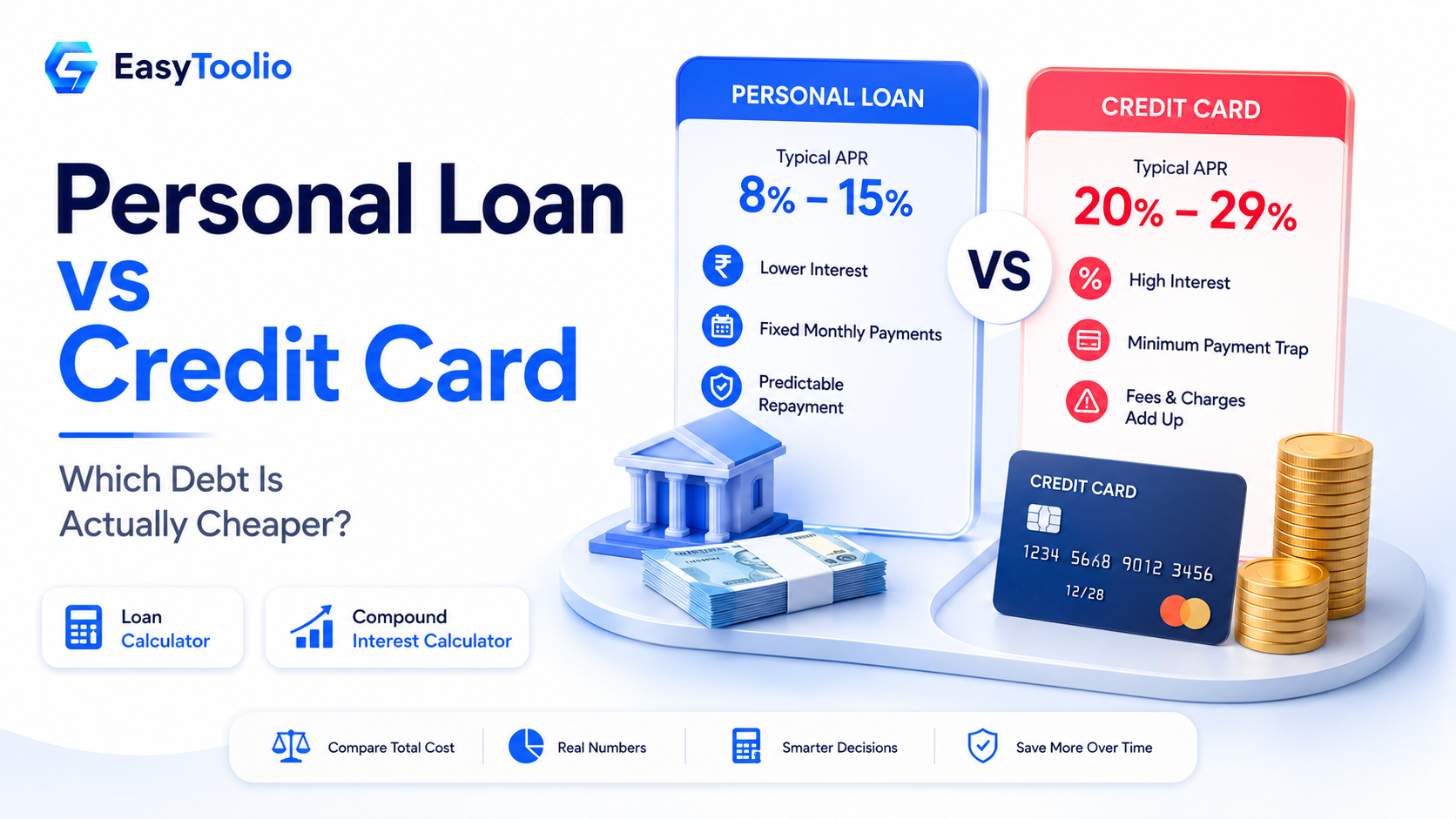
A car loan is secured against the vehicle itself — the lender registers a hypothecation on the RC and can repossess the car if you default. That collateral sharply reduces the lender's risk, which is why car loan rates are usually several percentage points lower than unsecured credit.

A personal loan has no collateral backing it at all. The lender is relying purely on your income, credit score, and repayment history, so it prices in a much higher risk premium — which is exactly why personal loan interest rates run so much higher than car loan rates for the same borrower.

Down Payment & Loan-to-Value

Car loans typically finance only 80-90% of the on-road price, so you need to arrange the remaining 10-20% as a down payment from your own savings. This loan-to-value cap also gives the lender a cushion, since the car depreciates from the moment it leaves the showroom.

A personal loan, in principle, can cover 100% of the purchase price with no down payment required. That convenience comes at a real cost though — borrowing the full amount at a much higher interest rate means you pay significantly more in interest over the loan's life than you would financing 80-90% at a car loan rate.

What Happens on Default: Repossession vs Unsecured Recovery

If you default on a car loan, the lender's recourse is straightforward: repossess the vehicle under the hypothecation agreement, sell it, and adjust the proceeds against your outstanding dues. It's a defined, asset-backed process, and the lender's downside is capped by the resale value of the car.

Default on a personal loan and there's no asset to seize. The lender pursues recovery agents, reports the default to credit bureaus (tanking your CIBIL score), and can eventually pursue legal action for the outstanding balance. Because the lender has no collateral cushion, unsecured defaults tend to hit your credit profile harder and faster.

Tenure Limits and Why They Differ

Car loans commonly stretch out to 7-8 years because the vehicle itself secures the loan for its entire life — the lender is comfortable extending the term since it always has the asset as backup, and a longer tenure also keeps EMIs affordable relative to the loan size.

Personal loans are typically capped at 3-5 years. With no collateral, lenders want their money back quickly to limit exposure to your changing income or creditworthiness over time, so tenures are deliberately kept short — which pushes the monthly EMI higher for the same loan amount.

When a Personal Loan Actually Makes Sense for a Car Purchase

A car loan isn't always available. If you're buying an older used car that a bank won't finance as a car loan (many lenders cap vehicle age or refuse loans on cars beyond a certain number of years), a personal loan can be the only financing route left, despite the higher rate.

A personal loan can also make sense if you want full ownership with no lien on the RC from day one, or if you need funds disbursed quickly with minimal paperwork — car loans require vehicle valuation, insurance tie-ups, and hypothecation formalities that take extra time a personal loan skips entirely.

Frequently Asked Questions

A car loan is a secured loan where the vehicle itself is the collateral, which is why lenders offer lower interest rates. A personal loan is unsecured, meaning no collateral is required, but it usually carries a higher interest rate to compensate the lender for the extra risk.

Because the car serves as collateral, the lender can repossess and sell it if you default, which lowers their risk. This lower risk is passed on to you as a lower interest rate compared to an unsecured personal loan of a similar amount and tenure.

Yes, a personal loan can be used for any purpose, including buying a car, and it gives you full ownership of the vehicle from day one with no lien registered against it. The trade-off is a higher interest rate and typically a shorter maximum tenure than a dedicated car loan.

On a car loan, the lender can repossess and sell the vehicle to recover the outstanding amount since it is held as collateral. On a personal loan, the lender has no direct asset to seize and must pursue recovery through other legal means, which is part of why personal loans carry a higher interest rate.

Car loans generally offer longer tenures, often up to 7-8 years, since the vehicle backs the loan. Personal loans are usually capped at shorter tenures, typically around 5 years, reflecting their unsecured, higher-risk nature.

Most car loans finance only a portion of the car's on-road price (commonly 80-90%), requiring you to pay the remaining amount upfront as a down payment. A personal loan used to buy a car can, in principle, cover the entire purchase price, though borrowing 100% of any purchase increases your total interest cost.

A larger down payment reduces the loan principal, which lowers both your EMI and total interest paid over the tenure. If you have the funds available and no higher-return use for that cash, a bigger down payment on either loan type generally reduces your overall borrowing cost.

Policies vary by lender. Many banks allow prepayment on floating-rate car loans with little or no penalty after a lock-in period, while some personal loans charge a prepayment or foreclosure fee (commonly 2-5% of the outstanding amount). Always check your specific loan agreement before assuming either is penalty-free.

What do you need to work out next?

Search 190+ free tools by name, or pick a category below. Every one runs instantly in your browser — no signup, nothing to install.

More Finance tools