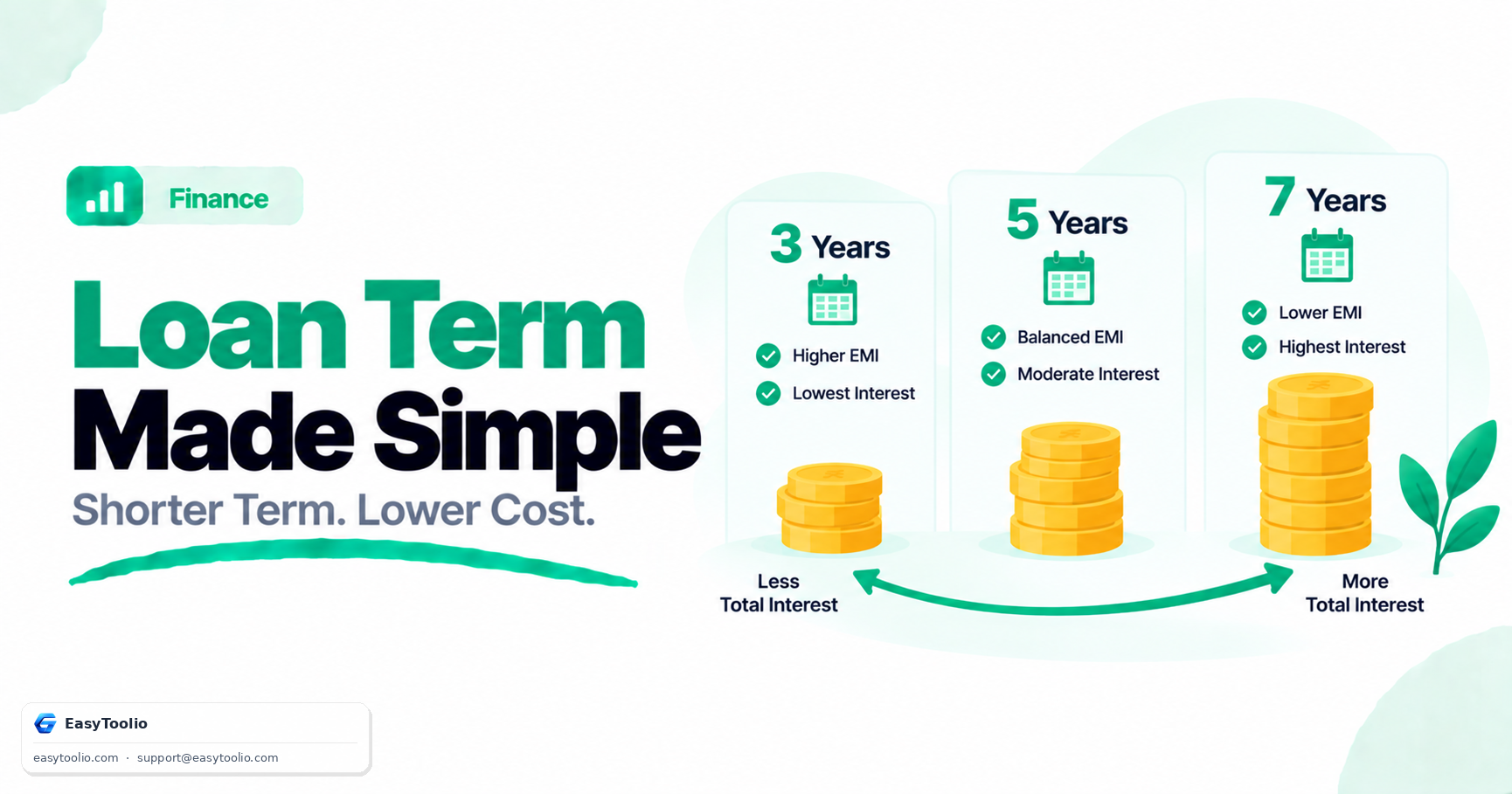
When you take out a loan, the loan term — how long you have to repay it — is one of the most financially significant decisions you will make. A longer term lowers your monthly payment but dramatically increases the total interest you pay. A shorter term costs more each month but gets you out of debt faster and cheaper.
The Core Trade-Off
The loan term trade-off is always the same, regardless of loan type:
- Longer term → Lower monthly payment, Higher total cost
- Shorter term → Higher monthly payment, Lower total cost
The size of the difference depends heavily on the interest rate and loan amount.
Side-by-Side Comparison: $20,000 Loan at 7% APR
| Loan Term | Monthly Payment | Total Paid | Total Interest | Interest as % of Loan |
|---|---|---|---|---|
| 12 months (1 year) | $1,736 | $20,835 | $835 | 4.2% |
| 36 months (3 years) | $618 | $22,244 | $2,244 | 11.2% |
| 60 months (5 years) | $396 | $23,763 | $3,763 | 18.8% |
| 84 months (7 years) | $302 | $25,347 | $5,347 | 26.7% |
The key insight: Going from a 1-year to a 7-year term reduces the monthly payment by $1,434 — but costs an extra $4,512 in interest. That is the price of the lower monthly payment.
How to Decide Which Term Is Right for You
The Budget Rule
If the shorter-term payment genuinely strains your budget — meaning it would prevent you from covering essentials or maintaining an emergency fund — choose a longer term. It is always better to make a payment than to default.
The Interest Rate Rule
The higher the interest rate, the more costly a long term becomes. At 5% APR, the difference between 36 and 84 months is manageable. At 15% APR (common in personal loans), the difference is brutal:
| Loan Term | Monthly Payment (15% APR, $10,000) | Total Interest |
|---|---|---|
| 24 months | $485 | $1,647 |
| 60 months | $238 | $4,273 |
| 84 months | $193 | $6,178 |
At 15% APR, an 84-month term costs $6,178 in interest on a $10,000 loan — 62% of the original amount borrowed.
The Prepayment Strategy
If you choose a longer term for cash-flow flexibility, plan to make extra payments when possible. Most personal loans allow early repayment without penalty. Even one extra payment per year on a 60-month loan at 7% reduces the effective term by 5–6 months and saves roughly 8% of total interest.
Auto Loans: When Loan Term Meets Depreciation
Auto loans have an additional dimension: the vehicle depreciates. A 7-year auto loan at a typical 6–8% APR means:
- For the first 3 years, your loan balance often exceeds the car's market value (being "underwater")
- You will likely pay more in interest over 7 years than the car will be worth at the end
Financial advisors generally recommend no longer than 60 months for auto loans to avoid negative equity.
Mortgages: The 15 vs 30 Year Decision
For home loans, the term decision has even larger stakes. On a $300,000 mortgage:
| Term | Rate | Monthly P&I | Total Interest |
|---|---|---|---|
| 30 years | 6.5% | $1,896 | $382,633 |
| 15 years | 5.75% | $2,495 | $149,026 |
The 15-year mortgage requires $599 more per month but saves $233,607 in lifetime interest. That is the trade-off in its starkest form.
Calculate Any Loan Scenario
Use our Loan Calculator to compare any combination of loan amount, interest rate, and term length side by side. See exactly how much your monthly payment changes and how much total interest each term costs before you sign.
Our EMI Calculator provides a full amortisation schedule showing the exact interest-to-principal split in every payment.
Frequently Asked Questions
Q: How much more does a 7-year loan term cost compared to a 1-year term? A: On a $20,000 loan at 7% APR, a 7-year term lowers the monthly payment by $1,434 (to $302) but adds $4,512 in extra interest compared to a 1-year term.
Q: What's the maximum loan term recommended for a car? A: Financial advisors generally recommend no longer than 60 months for auto loans, since longer terms often leave you "underwater" — owing more than the car is worth — for the first few years.
Q: Is a 15-year or 30-year mortgage the better choice? A: It depends on cash flow: on a $300,000 mortgage, a 15-year term costs $599 more per month but saves $233,607 in total interest compared to a 30-year term.