Buying a home is one of the most significant financial milestones in a person's life. Yet, the mathematical engine behind home loans remains a mystery to many. When you receive a pre-approval letter or view a listing online, the number that usually commands the most attention is the monthly payment. But how is that payment calculated? Why does it change over time? And how can understanding the mechanics of a mortgage save you tens of thousands of dollars?
This comprehensive guide will demystify the mathematics of mortgage calculations. We will break down the formulas, analyze the impact of down payments, explore auxiliary costs like taxes and PMI, examine real-world comparison tables, and outline key strategies to pay off your home years ahead of schedule.
1. The Anatomy of a Monthly Mortgage Payment
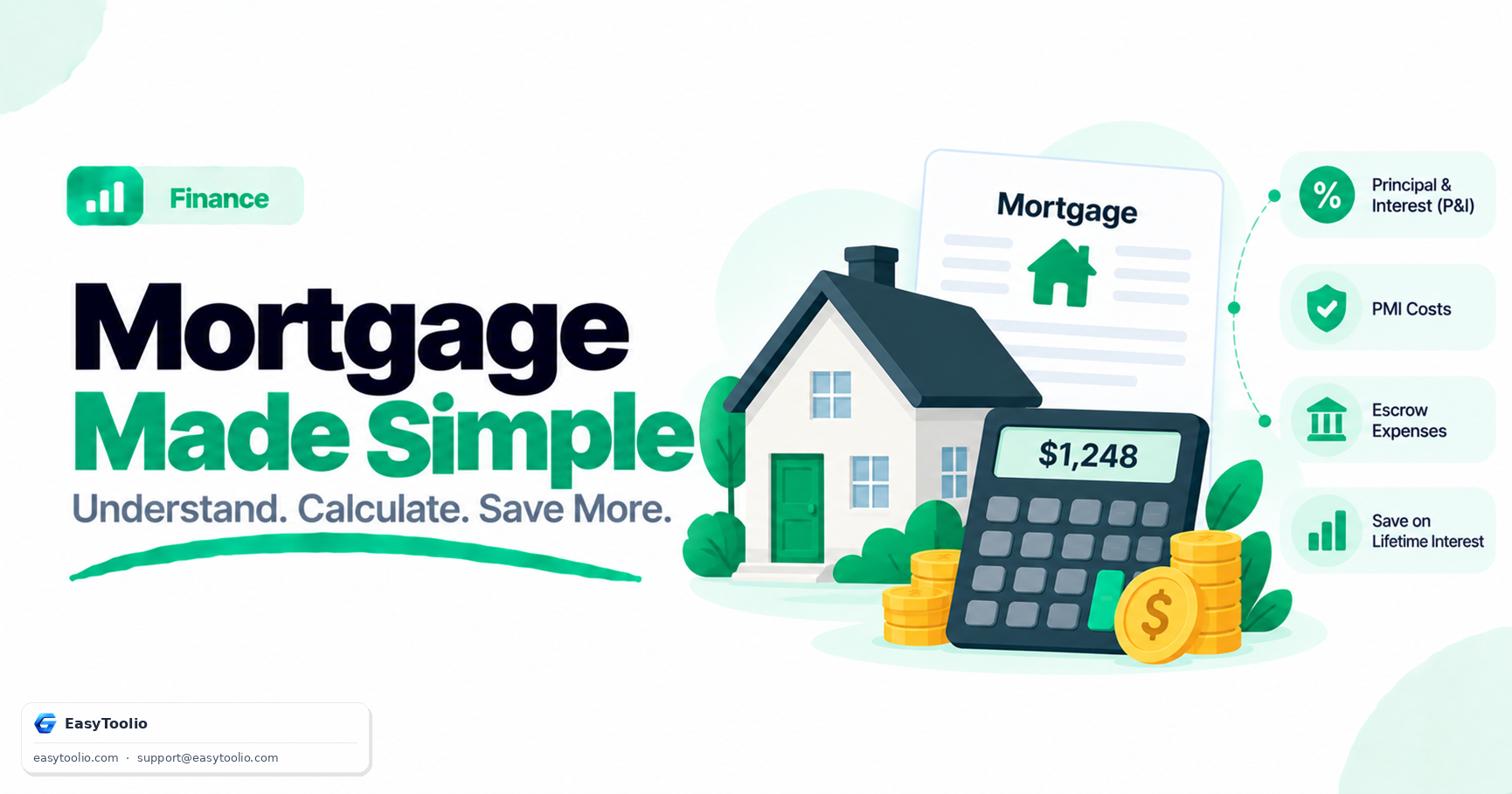
To understand how a mortgage is calculated, you must first understand that a monthly mortgage check rarely goes entirely toward paying off your home. Instead, it is typically divided into four main components, commonly referred to by the acronym PITI:
- Principal: The actual balance of money you borrowed from the lender. Each month, a portion of your payment goes toward reducing this principal balance.
- Interest: The fee the lender charges you for borrowing their money. In the early years of a mortgage, interest makes up the majority of your monthly payment.
- Taxes (Property Taxes): Local governments levy taxes on real estate to fund public services like schools and roads. Lenders typically collect 1/12th of your annual tax bill each month and hold it in an escrow account to pay on your behalf.
- Insurance (Homeowners Insurance): Lenders require you to carry insurance to protect the property against fire, storms, and other hazards. Like property taxes, this is usually collected monthly and held in escrow.
Auxiliary Components
Depending on your loan type and financial structure, your payment may also include:
- Private Mortgage Insurance (PMI): Required if your down payment is less than 20% on a conventional loan.
- Homeowners Association (HOA) Fees: Paid to a community association for maintenance of shared amenities, though often billed separately from the mortgage itself.
2. The Core Formula: Calculating Principal & Interest
The most complex mathematical component of a mortgage is the Principal & Interest (P&I) payment. Because mortgages are amortized loans, the monthly payment remains fixed, but the ratio of interest-to-principal shifts over time.
To calculate the monthly P&I payment ($M$) manually, you use the standard amortization formula:
$$M = P \frac{r(1+r)^n}{(1+r)^n - 1}$$
Where:
- $M$ = Total monthly P&I payment
- $P$ = Principal loan amount
- $r$ = Monthly interest rate (annual interest rate divided by 12 months)
- $n$ = Total number of payments (loan term in years multiplied by 12 months)
Step-by-Step Example Calculation
Let's calculate the payment for a typical home purchase scenario:
- Home Purchase Price: $400,000
- Down Payment (20%): $800,000 (meaning loan amount $P = $320,000)
- Annual Interest Rate: 6.5% (meaning monthly rate $r = 0.065 / 12 = 0.0054167$)
- Loan Term: 30 years (meaning total payments $n = 30 \times 12 = 360$)
Now, plug these numbers into the formula:
- Calculate $(1+r)^n$: $$(1 + 0.0054167)^{360} \approx 6.9918$$
- Calculate the numerator: $$0.0054167 \times 6.9918 \approx 0.03787$$
- Calculate the denominator: $$6.9918 - 1 = 5.9918$$
- Divide the numerator by the denominator: $$0.03787 / 5.9918 \approx 0.0063206$$
- Multiply by the principal ($P$): $$320,000 \times 0.0063206 = $2,022.60$$
Thus, the fixed monthly Principal & Interest payment for this loan is $2,022.60.
💡 Pro Tip: Even though the monthly P&I payment is fixed at $2,022.60, the exact split between interest and principal changes every month. In month 1, you pay $1,733.34 in interest and only $289.26 in principal. By month 300, the split reverses, and most of your payment goes to principal.
3. The Impact of Down Payments and Private Mortgage Insurance (PMI)
Your down payment is the initial cash payment you make toward the purchase price of the home. The size of your down payment directly influences three factors:
- The principal loan amount ($P$).
- The interest rate offered by the lender (larger down payments reduce risk, often yielding lower rates).
- The requirement for Private Mortgage Insurance (PMI).
Understanding PMI
PMI is an insurance policy that protects the lender in case you default on the loan. It does not protect you, the buyer. For conventional loans, if your down payment is less than 20% (meaning your Loan-to-Value ratio is above 80%), PMI is mandatory.
PMI typically costs between 0.2% and 1.5% of the original loan amount annually, depending on your credit score and down payment percentage. This annual premium is divided by 12 and added to your monthly bill.
Down Payment Comparison Table
To see how down payments alter your financial profile, review this comparison for a $400,000 home purchase at a 6.5% interest rate:
| Down Payment % | Down Payment $ | Loan Amount | Monthly P&I | Est. Monthly PMI | Total Monthly P&I + PMI |
|---|---|---|---|---|---|
| 3% (Minimum) | $12,000 | $388,000 | $2,452.42 | $291.00 | $2,743.42 |
| 5% | $20,000 | $380,000 | $2,401.86 | $253.33 | $2,655.19 |
| 10% | $40,000 | $360,000 | $2,275.44 | $150.00 | $2,425.44 |
| 20% (Tipping Point) | $80,000 | $320,000 | $2,022.60 | $0.00 | $2,022.60 |
By putting 20% down instead of 3%, you save $720.82 per month and avoid paying thousands of dollars in non-recoverable mortgage insurance premiums.
4. Property Taxes, Home Insurance, and Escrow Accounts
Lenders want to ensure that the asset securing their loan (your house) is protected. If you default on property taxes, the local municipality can place a lien on your home. If the home burns down and is uninsured, the lender's collateral is destroyed.
To mitigate these risks, lenders set up escrow accounts.
How Escrow Works
- Calculation: Lenders estimate your annual property taxes and homeowners insurance bills.
- Collection: They divide the total by 12 and add that amount to your monthly mortgage payment.
- Disbursement: The lender holds these funds in a specialized account. When your tax and insurance bills are due, the lender pays them directly to the county assessor and insurance company.
Estimating Escrow Costs
- Property Taxes: Tax rates vary dramatically by state and county. For example, Hawaii has an average property tax rate of 0.28%, while New Jersey averages 2.47%. On a $400,000 home, this equates to a range of $1,120 to $9,880 annually ($93 to $823 per month).
- Homeowners Insurance: The national average cost of homeowners insurance is roughly $1,800 per year ($150 per month), but this can escalate in zones prone to hurricanes, earthquakes, or wildfires.
5. HOA Fees and Auxiliary Housing Costs
When calculating your monthly budget, do not limit your numbers to the bank's mortgage statement. Owning a home introduces several adjacent expenses:
Homeowners Association (HOA) Fees
If your home is in a planned subdivision, townhouse community, or condominium building, you will likely pay monthly or quarterly HOA fees. These fees cover collective expenses like landscaping, trash collection, snow removal, and structural maintenance.
- Cost Range: $100 to $1,000+ per month.
- Impact on Loans: Even though HOA fees are usually paid directly to the association rather than the lender, lenders factor HOA fees into your Debt-to-Income (DTI) ratio when qualifying you for a loan.
Maintenance Reserves
As a homeowner, you are your own landlord. Major structural items wear out over time. It is highly recommended to budget 1% to 2% of your home's purchase price annually for ongoing maintenance and emergency repairs. For a $400,000 home, this means setting aside $4,000 to $8,000 per year ($333 to $666 per month) in a dedicated savings account.
6. How Amortization Works: A Simulated Schedule
The magic—and the danger—of a fixed-rate mortgage lies in how it amortizes. "Amortization" comes from the Latin mort, meaning "to kill." An amortization schedule is literally a chart showing how the loan is killed over time.
In the beginning, your loan balance is at its highest, meaning the interest accruing each month is also at its peak. As you make payments and reduce the principal, the interest due next month drops slightly, allowing more of your fixed payment to pay down the principal.
Let's look at the first 6 payments of our $320,000 loan at 6.5% interest with a $2,022.60 monthly payment:
| Month | Starting Balance | Monthly Payment | Interest Paid (6.5%/12) | Principal Paid | Ending Balance |
|---|---|---|---|---|---|
| Month 1 | $320,000.00 | $2,022.60 | $1,733.33 | $289.27 | $319,710.73 |
| Month 2 | $319,710.73 | $2,022.60 | $1,731.77 | $290.83 | $319,419.90 |
| Month 3 | $319,419.90 | $2,022.60 | $1,730.19 | $292.41 | $319,127.49 |
| Month 4 | $319,127.49 | $2,022.60 | $1,728.61 | $293.99 | $318,833.50 |
| Month 5 | $318,833.50 | $2,022.60 | $1,727.01 | $295.59 | $318,537.91 |
| Month 6 | $318,537.91 | $2,022.60 | $1,725.41 | $297.19 | $318,240.72 |
Notice that in Month 1, 85.7% of your payment went directly to the bank as profit, and only 14.3% went toward building equity in your home. By Month 180 (Year 15), the split will reach roughly 50/50. Only in the final 5 years of the loan does the payment go almost entirely to principal.
7. Strategies to Save Tens of Thousands in Mortgage Interest
Because interest compiles monthly over 30 years, conventional home loans are incredibly expensive. Under a standard 30-year schedule, borrowing $320,000 at 6.5% interest will result in you paying $408,136.21 in total interest—more than the original value of the loan itself!
Fortunately, you are not locked into this timeline. By applying smart repayment strategies, you can bypass the amortization curve.
Strategy A: The Extra Principal Payment
Any money you pay above your required monthly payment is applied directly to your principal balance. By reducing your principal faster, you reduce the interest that can accrue in all future months.
- The Impact: Adding just $150 extra per month to our $320,000 loan reduces your loan term by 4 years and 3 months, saving you $61,840.40 in interest.
Strategy B: The Bi-Weekly Payment Method
Instead of making one monthly payment, you make a half-payment every two weeks. Because there are 52 weeks in a year, you will make 26 half-payments, which equals 13 full payments instead of the standard 12.
- The Impact: This simple schedule adjustment pays off your 30-year mortgage roughly 4 to 5 years early and saves you close to $60,000 in interest, without you ever having to budget "extra" money out of pocket.
⚠️ Warning: Ensure your lender supports bi-weekly payments and does not charge processing fees. Many third-party "equity services" charge setup fees to manage bi-weekly schedules that you could easily execute yourself for free.
8. Case Study: 15-Year vs. 30-Year Mortgages
One of the most crucial choices you will make when structuring a mortgage is selecting the loan term. While the 30-year term is the most popular due to its lower monthly payments, the 15-year term is a massive interest-saving mechanism.
Let’s run a direct comparison using our $320,000 loan amount. Typically, lenders offer lower interest rates on 15-year terms because they are carrying the risk for a shorter period. Let's assume the 15-year rate is 5.75% (0.75% lower than the 30-year rate).
Financial Comparison Table
| Metric | 30-Year Fixed | 15-Year Fixed | The Difference |
|---|---|---|---|
| Assumed Interest Rate | 6.50% | 5.75% | -0.75% |
| Monthly P&I Payment | $2,022.60 | $2,659.83 | +$637.23 |
| Total Payments (Months) | 360 | 180 | -180 months |
| Total Principal Repaid | $320,000.00 | $320,000.00 | $0.00 |
| Total Interest Paid | $408,136.21 | $158,769.45 | -$249,366.76 |
| Total Lifetime Cost | $728,136.21 | $478,769.45 | -$249,366.76 |
The Trade-off
- The Cost: The 15-year loan requires an extra $637.23 per month, which reduces your monthly cash flow.
- The Benefit: By committing to this higher monthly payment, you save a staggering $249,366.76 in lifetime interest and own your home free and clear 15 years sooner.
9. Frequently Asked Questions (FAQ)
Q: What is the difference between interest rate and APR? A: The interest rate is the base cost to borrow the principal balance. The APR (Annual Percentage Rate) represents the total cost of the loan, including the interest rate plus any lender fees, discount points, broker fees, and closing costs. APR is always higher than the interest rate and represents the true annual cost of borrowing.
Q: Can I cancel my PMI once my home equity grows? A: Yes. For conventional loans, once your principal balance drops to 80% of the home's original purchase price, you can request that your lender cancel the PMI. By law, the lender must automatically terminate PMI when your balance reaches 78% of the original purchase price. Alternatively, if home prices in your area rise, you can pay for an appraisal to prove your current loan-to-value ratio is below 80% and request cancellation early.
Q: How does a bi-weekly mortgage payment compare to monthly? A: A bi-weekly payment schedule divides your monthly payment in half and schedules payments every two weeks. Over a year, this results in 26 half-payments (13 full payments). This extra payment applied directly to your principal reduces your loan balance much faster, shortening a standard 30-year term to roughly 25-26 years and saving thousands of dollars in interest.
Q: Are there penalties for paying off my mortgage early? A: Most modern residential mortgages do not have prepayment penalties. However, some loans (especially subprime or non-conforming loans) may impose a penalty if you pay off the mortgage entirely within the first 3 to 5 years. Always review your loan documents or check with your lender before initiating an aggressive paydown strategy.