Notification
Go to Home All Tools Compare Glossary Blog Contact

Property Cost Calculator

Calculate the true cost of buying a property, including GST, stamp duty, registration, and brokerage fees.

Financial Inputs

6%
1%
5%
1%

Visual Cost Distribution

Base Price (80%)
Govt Taxes (15%)
Fees & Others (5%)
Total Actual Cost

5,475,000

Acquisition Costs Breakdown
Agreement Value ₹50,00,000
Stamp Duty ₹3,00,000
Registration Fees ₹50,000
GST Charges ₹2,50,000
Brokerage Fee ₹50,000
Other Charges ₹50,000
Typical Property Budgets

Quick load reference budgets to see tax allocations:

Formula Reference

Property Cost Formula

The advertised price of a property is rarely the full cost of buying it. Government taxes (GST, stamp duty, registration) and transaction costs (brokerage) are each calculated as a...

$$\text{Total Cost} = P + P\left(\frac{\text{GST}+\text{Stamp Duty}+\text{Registration}+\text{Brokerage}}{100}\right) + \text{Other Charges}$$
View Full Formula, Step-by-Step Guide & Worked Examples
Real Estate Expert

AI Advisor Property Advisor

Ask AI

Why the Same Property Cost Can Look Like a Different Price-Per-Sq.Ft

Two projects quoting an identical total property cost can display very different "price per sq.ft" figures depending on which area the builder measures against. Knowing the difference helps you compare quotes on a like-for-like basis.

Carpet Area

The actual usable floor space inside your walls, excluding wall thickness. This is the smallest of the three figures and the one RERA requires builders to disclose.

Built-Up Area

Carpet area plus the wall thickness and balcony space. It's typically 10-15% larger than carpet area, which lowers the effective rate per sq.ft.

Super Built-Up Area

Built-up area plus a share of common spaces like lobbies, stairwells, and clubhouses. Most under-construction flats are priced on this larger figure.

Since the property cost calculator above works from the total agreement value you enter, it's worth checking which area definition that value is based on before comparing two properties side by side. This site also has dedicated carpet area and super built-up area calculators if you want to convert between the two.

Education

Understanding Property Purchase Costs

01

A Property Cost Calculator Reveals the Real Total, Not Just the Sticker Price

The base price a builder or seller quotes is only the starting point. A property cost calculator adds stamp duty, registration fees, applicable GST, brokerage, and other charges on top so you see the actual amount you need to arrange before the deal closes.
02

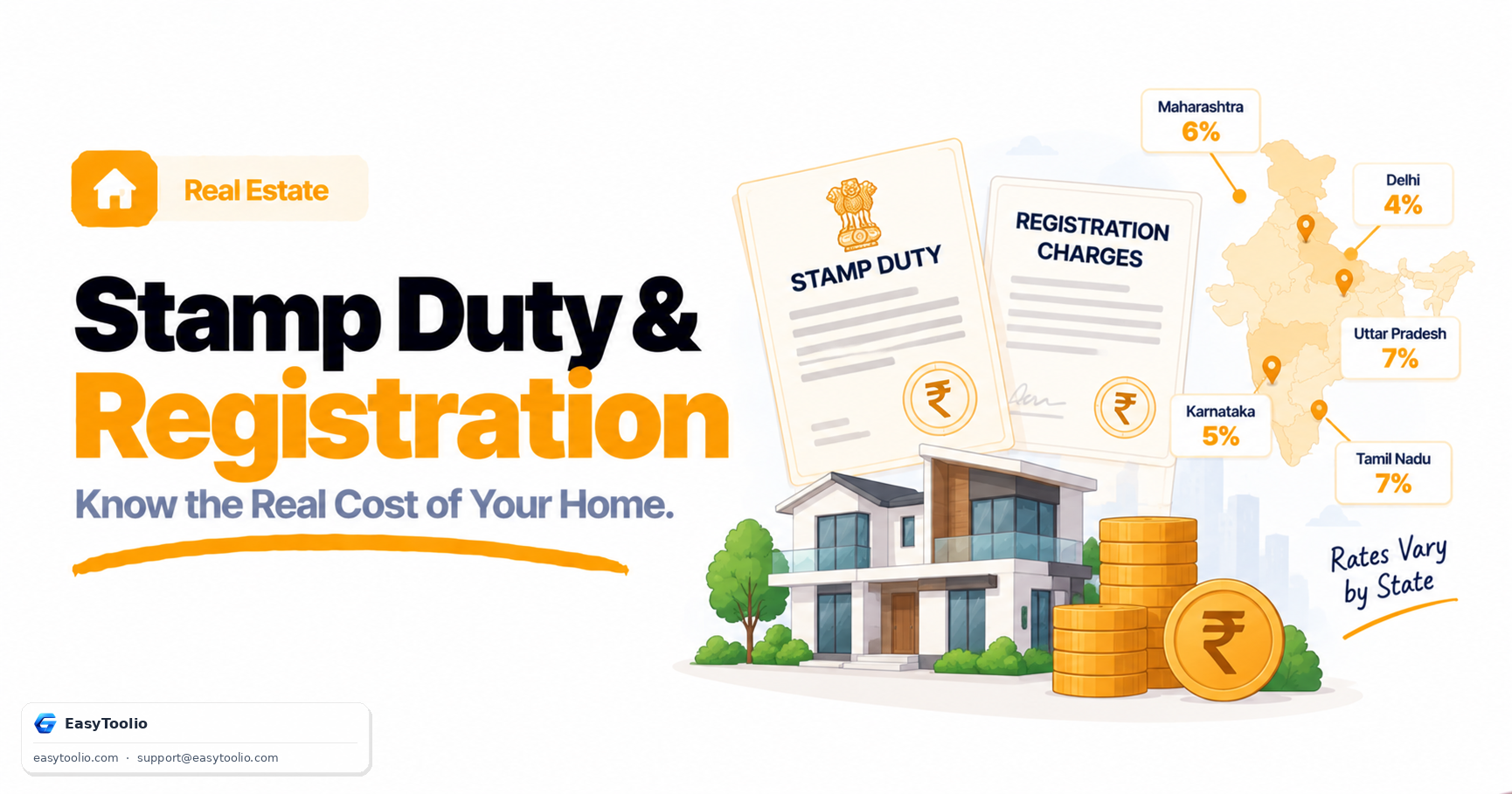
Stamp Duty and Registration Charges Vary by State

Stamp duty and registration rates are set by state governments and vary by location, typically in the single-digit percentage range, with some states offering a small rebate for women buyers. Always confirm the current local rate with your sub-registrar or a local lawyer before finalizing your budget.

03

GST Usually Applies Only to Under-Construction Property

GST is generally charged when you buy a flat directly from a developer before it receives its completion certificate, but it typically does not apply to ready-to-move-in units or resale properties. Check with your builder which category your purchase falls under before assuming GST applies.

04

The Common Mistake: Budgeting Only the Base Property Cost

Many first-time buyers plan their savings and loan around the advertised property cost alone, then get caught off guard when stamp duty, registration, GST, and other charges add another 8-12% on top at the time of registration. Running your numbers through a property cost calculator early helps you avoid a last-minute funding gap.

05

Brokerage and Society Deposits Add Up Too

If you used an agent, brokerage fees commonly range from 1-2% of the property value. Separately, most housing societies collect a one-time deposit for maintenance, parking allotment, and utility connections, which is worth budgeting for even though it is not a government charge.

06

Always Ask for an Itemized Cost Sheet Before Signing

Before signing the agreement to sell, request a written, itemized cost sheet covering the base price, stamp duty, registration, GST, brokerage, and any preferential-location or club-membership charges. Cross-check every line against your property cost calculator estimate so nothing gets added quietly later.

07

Home Loans Affect Your Total Ownership Cost

When you finance the purchase, the total amount you eventually pay is higher than the property cost because of loan interest over the tenure. Comparing lenders and loan tenures alongside your property cost estimate can meaningfully reduce your long-term outgo.

Good to know

Questions, answered

Quick answers about how this tool works.

The actual cost of buying a property is the sum of the base property price plus additional mandatory expenses such as Stamp Duty, Registration Fees, GST (for under-construction properties), Brokerage, and other society development charges.

Stamp Duty usually ranges from 4% to 8% of the property value, depending on the state and gender of the buyer. Registration fees are typically 1% of the property value or a fixed cap set by the local government.

GST is only applicable on under-construction residential properties (typically 1% for affordable housing and 5% for non-affordable housing). Ready-to-move-in properties with a Completion Certificate (CC) are exempt from GST.

Beyond the base cost, you must pay stamp duty, registration charges, जीएसटी (GST), brokerage, legal fees, parking fees, and maintenance deposits.

Stamp duty is a state government tax calculated as a percentage (typically 4% to 8%) of either the agreement value or circle rate, whichever is higher.

Popular Tools on EasyToolio

Swipe

What do you need to work out next?

Search 190+ free tools by name, or pick a category below. Every one runs instantly in your browser — no signup, nothing to install.

More Real Estate tools