
Why Developers Use Super Built-Up Area
Super built-up area is commonly used by developers for property pricing because it reflects both private living space and access to shared amenities such as lobbies, elevators, clubhouses, and corridors.
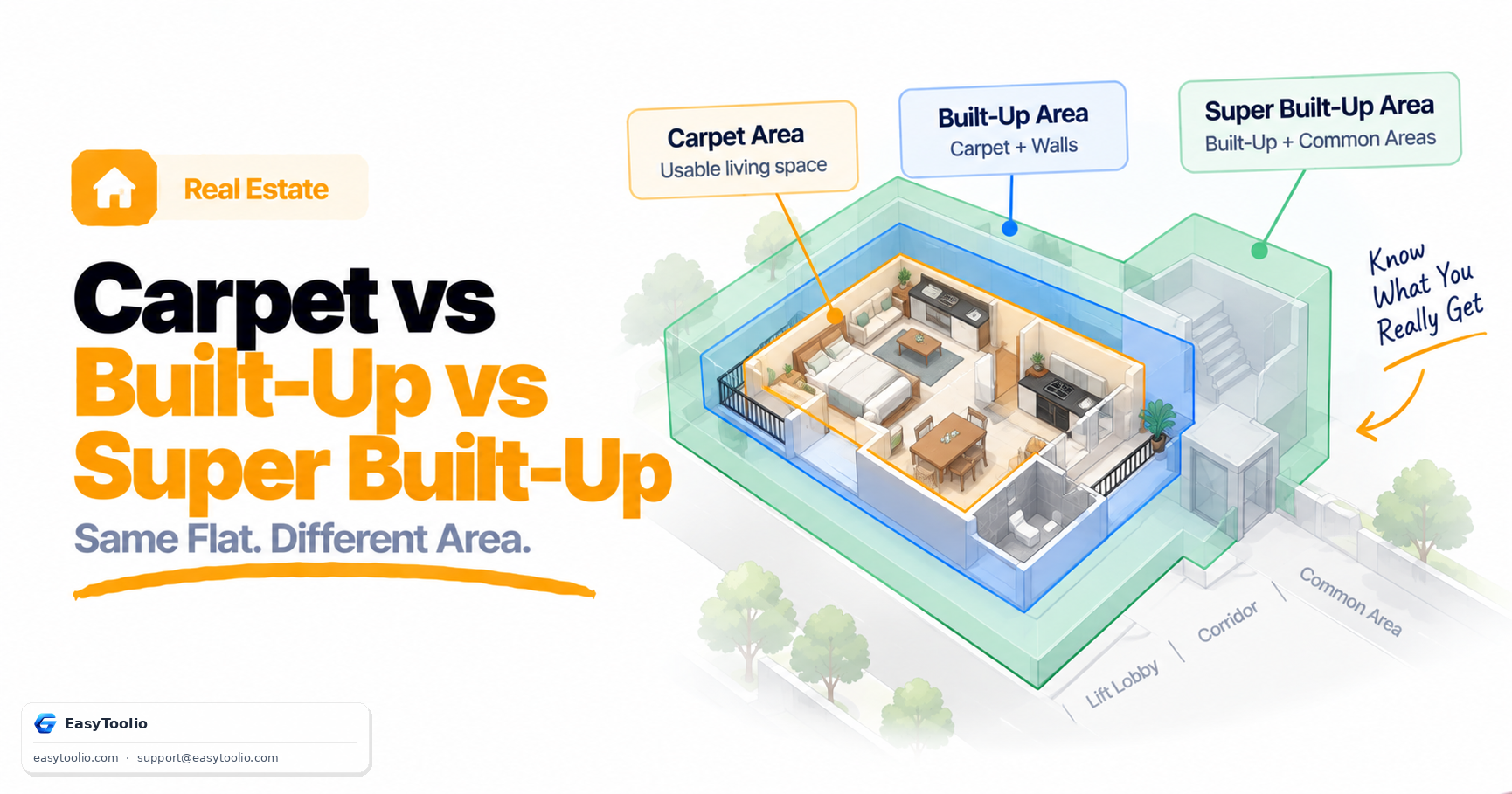
Calculate the super built-up area of your flat from its built-up area, including common spaces like lobbies, lifts, and staircases.
The share of common spaces (lobby, parking, gym, elevators) added to the built flat space (typically 20%-40%).
The **Built-Up Area** is the physical boundaries of your apartment, which includes the usable carpet area plus inner/outer wall thickness and balconies.
The **Super Built-Up Area** is the total saleable space builders charge you for. It includes your personal Built-Up Area plus a proportionate share of all common residential spaces.
Super Built-Up Area = Built-Up
Area * (1 + Loading Factor %)
Usually, common amenities and lobbies add a
loading factor of 15% to 40% on top of the built-up space.
Load common flat sizes to check expected super saleable spaces:
Super Built-Up Area — often called "saleable area" — is the figure developers actually price and sell against. It adds a "loading" percentage on top of the Built-Up Area to account...
Super built-up area is commonly used by developers for property pricing because it reflects both private living space and access to shared amenities such as lobbies, elevators, clubhouses, and corridors.

When comparing multiple properties, relying only on the saleable area can be misleading. Reviewing carpet area alongside super built-up area provides a clearer picture of the actual usable space you receive.
Many residential societies calculate maintenance fees based on super built-up area. A larger super built-up area may result in higher recurring maintenance costs even if the usable living space remains similar.
Understanding super built-up area helps buyers evaluate property pricing, compare projects fairly, estimate long-term ownership costs, and avoid confusion between advertised area and actual usable space.
Quick answers about how this tool works.
Loading factor is the percentage of common area added to the built-up area to calculate the super built-up area. It represents the space you pay for that is shared with other residents, such as elevators, corridors, and clubhouses.
Super built-up area is the saleable area, representing the private built-up area plus a proportionate share of common amenities (lifts, lobby, stairs, clubhouse).
Loading factor is the percentage difference between carpet area and super built-up area, typically ranging from 20% to 40%.
Common areas include corridors, lobbies, staircases, lifts, generator rooms, and security booths shared proportionately among owners.
Plain-language explainers that sit next to this tool.
Confused why the flat you booked at 1,200 sq ft feels smaller than expected? Learn the exact difference between carpet, built-up, and super built-up area, with formulas and a worked example.
Most Indians accept an EMI figure from their bank without questioning it. This guide explains exactly how Indian banks calculate EMI — the reducing balance method, how RBI repo rate changes flow through to your loan, and what you can do to pay off your home loan years early.
Rental yield tells you whether a property is a good income investment, not just a good home. Learn the gross vs net yield formulas, a worked example, and healthy benchmark ranges.
Wondering why the bank approved less than you expected? Learn exactly how lenders calculate home loan eligibility using income, FOIR, credit score, and tenure, with a worked example.
Search 190+ free tools by name, or pick a category below. Every one runs instantly in your browser — no signup, nothing to install.
Tap a star to rate us instantly.