Notification
Go to Home All Tools Compare Glossary Blog Contact

Home Loan vs Renting Comparison

Compare buying a home with a loan against renting and investing the difference. Analyze net worth, EMI outgo, and property appreciation over time.

Buy vs Rent Variables

₹
Min: ₹5 Lakh Max: ₹5 Cr
₹
Min: ₹50,000 Max: ₹2 Cr

Ideally should not exceed the Home Price above — the loan amount is automatically floored at ₹0.

%
Min: 6% Max: 15%
Yrs
Min: 5 Yrs Max: 30 Yrs
%
Min: 0% Max: 15%
%
Min: 0% Max: 5%
₹
Min: ₹1,000 Max: ₹5 Lakh
%
Min: 0% Max: 15%
%
Min: 1% Max: 20%
Scenarios:
Buy (Net Worth) ₹0
Property Value: ₹0
Less: Maintenance & Tax: -₹0
Monthly EMI: ₹0
Rent + Invest (Net Worth) ₹0
Down Payment Invested: ₹0
Growth from Surplus Invested: ₹0
Starting Monthly Rent: ₹0
Net Worth Difference

Buying builds ₹0 more net worth

Comparing property value against an invested rent-savings corpus.

Net Worth Growth Projections
Buy Rent + Invest
Step-by-Step Guide

How to Use the Home Loan vs Renting Calculator

Model the real 15 to 30 year financial impact of purchasing real estate with an EMI mortgage versus renting and investing the monthly surplus into market assets.

1

Input Property & Loan

Enter the target property purchase cost, upfront down payment (typically 20%), home loan interest rate (8.5%–9.5%), and tenure in years.

Real estate purchase model
2

Define Rent & Escalation

Input current monthly rent for an equivalent home, expected annual rent increase (typically 5%–7%), and your expected investment CAGR on savings.

Rent inflation tracking
3

Compare Terminal Net Worth

Analyze the growth chart: see property value (minus total loan interest and maintenance) compared directly against the compounding value of the invested surplus.

Net wealth divergence
4

Weigh Lifestyle & Share

Factor in liquidity, job mobility, and property maintenance overheads in the matrix below. Click Share to save your customized housing report.

1-Click link sharing

Real Estate Rule: The Rental Yield Benchmark

In Indian metropolitan centers (Mumbai, NCR, Bengaluru, Hyderabad), residential rental yields hover between 2.5% and 3.5%. When home loan interest is 8.5%–9.0%, renting and consistently investing the down payment and EMI difference in index funds often produces greater liquid wealth over a 15–20 year span.

Decision Guide

Home Loan vs Renting: Which is Better?

Neither option is universally superior. The optimal financial decision hinges on your career mobility, holding horizon, and investment discipline.

When Buying Wins

Best for long-term stability & equity creation

  • Long-Term Horizon (10+ Yrs): You plan to stay in the same city long enough to absorb transaction costs.
  • Hedge Against Rent Inflation: A fixed loan EMI locks your major housing outgo, while rents rise 5-8% every year.
  • Emotional Security: Complete freedom to renovate, zero landlord eviction risk, and building a tangible family asset.
  • Forced Savings Discipline: EMIs compel wealth accumulation for buyers who struggle to self-invest surplus cash.
Builds generational physical equity

When Renting + Investing Wins

Best for career mobility & liquid wealth compounding

  • Career Mobility (<7 Yrs): You want the agility to relocate across cities or countries without selling property.
  • Low Rental Yields (2.5-3.5%): In Indian metros, rent is vastly cheaper than loan interest, leaving a large investable surplus.
  • 100% Capital Liquidity: Mutual fund investments can be partially redeemed at any moment without brokerage or registration hurdles.
  • No Maintenance Burdens: Society sinking funds, property tax, and major structural repairs remain the landlord's headache.
Unlocks maximum portfolio compounding

Buying a Home: Pros & Cons

Advantages (Pros)
  • Every EMI builds permanent, unencumbered home equity.
  • Shields your family against arbitrary landlord rent hikes.
  • Sec 24(b) and Sec 80C tax deductions under the Old Tax Regime.
Trade-offs (Cons)
  • Large upfront down payment locks up liquid emergency reserves.
  • Highly illiquid; property takes months or years to monetize.
  • Ongoing maintenance, property tax, and society corpus calls.

Renting + Investing: Pros & Cons

Advantages (Pros)
  • Immediate freedom to relocate for lucrative job promotions.
  • Equity mutual funds historically beat residential real estate CAGR.
  • Zero liability for property depreciation or costly structural repairs.
Trade-offs (Cons)
  • Zero ownership equity created from years of monthly rent outgo.
  • Requires strict discipline to invest monthly surplus instead of spending.
  • Lack of tenure permanence; subject to landlord lease non-renewals.
Crucial Factors

4 Reality Checks Before You Decide

The 7-Year Breakeven

Buying requires 5–8 years simply to recover sunk costs (stamp duty, registration, loan interest). Selling sooner almost always yields a net loss.

Unmodeled Sunk Costs

Stamp duty (5–8%), brokerage (1–2%), interiors (10%), and property taxes silently dilute actual real estate compounding returns.

Appreciation Dispersion

A property is a single illiquid bet on one neighborhood. Index funds distribute risk across hundreds of global growth companies.

Emotional Peace of Mind

No spreadsheet can capture the pride of owning a permanent home. Balance the cold math against your family's emotional comfort.

Side-by-Side Parameter Matrix

Direct feature-by-feature comparison between owning and renting

Feature Buying with Home Loan Renting + Investing
Monthly Cash Outgo Fixed EMI for full tenure Lower starting rent, climbs 5-8%/yr
Upfront Capital Lock-in Substantial down payment (10-25%) ₹0 locked; full capital invested
Maintenance & Upkeep 1-2% of property value/year ₹0 (Landlord responsibility)
Capital Liquidity Low (Months to sell or refinance) High (Redeemable in T+2 days)
Terminal Wealth Composition Appreciated Physical Property Liquid Compounded Financial Portfolio
Final Net Worth Property Value minus Maintenance Costs Full Compounded Surplus Corpus
Case Studies

Real-World Comparison Scenarios

Illustrative models based on realistic Indian urban profiles

Scenario 1 20-Year Horizon
Metro Family

₹80L Flat in Metro (Bangalore/Pune)

Rahul puts down ₹16L (20%) and borrows ₹64L at 8.5% over 20 years (EMI ~₹55,500). An equivalent flat rents for ₹30,000 with 5% escalation.

• Buying: At 5% appreciation, flat grows to ~₹2.12 Cr. Maintenance ~₹16L.
• Renting + Investing: ₹16L down payment + investable monthly surplus at 11% generates ~₹2.24 Cr.
Key Takeaway: Neck-and-neck outcome. Buying provides unshakeable stability for settled families.
Scenario 2 10-Year Horizon
Mobile Young Professional

₹50L Starter Home vs Renting

Priya is 27 and considers buying a ₹50L suburban flat or renting for ₹16,000 while investing her ₹10L down payment in mutual funds.

• Buying: 10-year holding period leaves high interest unpaid; stamp duty and brokerage bite hard.
• Renting + Investing: At 12% equity CAGR, her ₹10L plus surplus generates ~₹48L in 100% liquid assets.
Key Takeaway: Renting and investing yields far superior flexibility and liquid net worth under 10 years.
Good to know

Questions, answered

Quick answers about how this tool works.

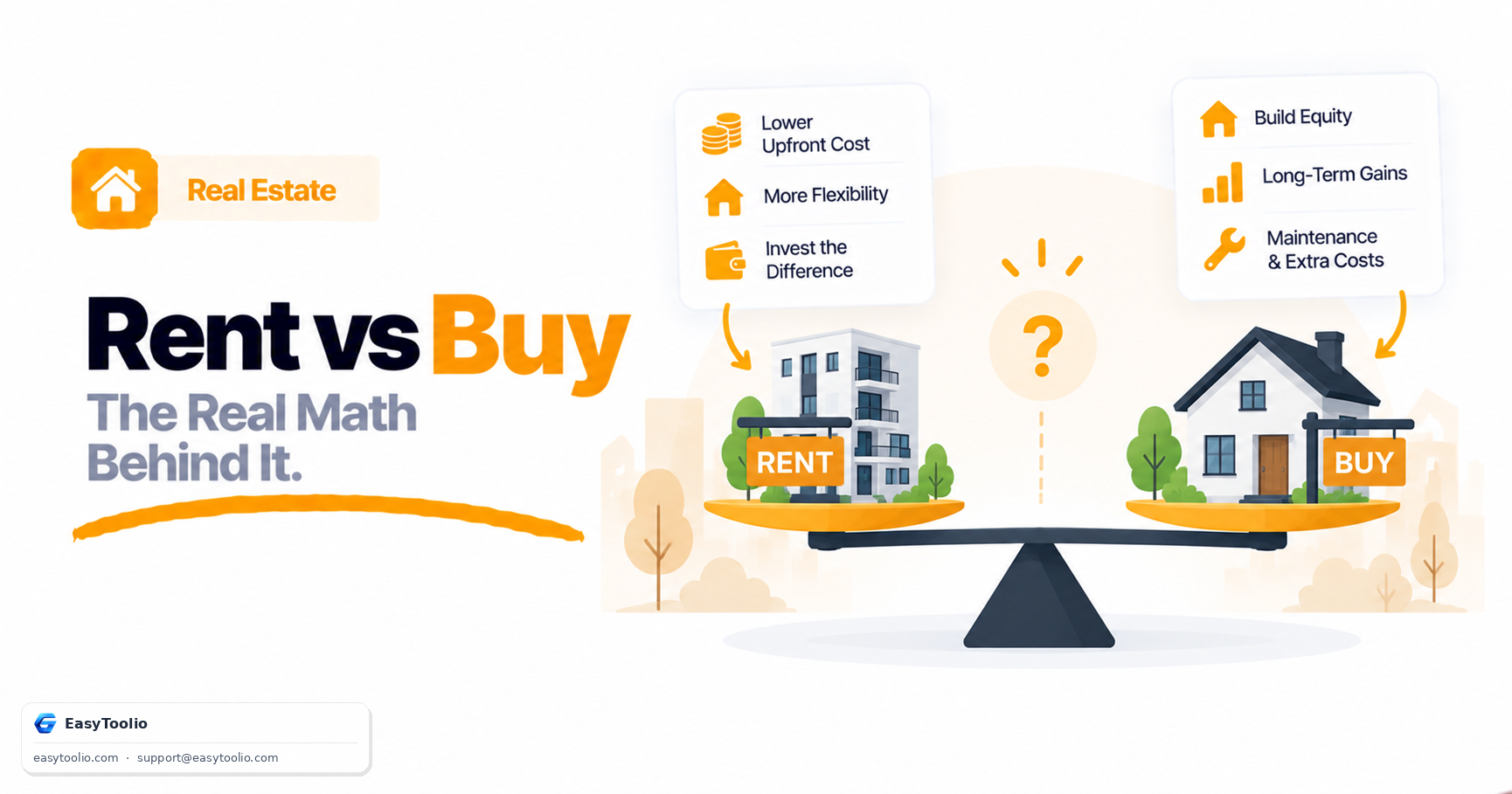
No. Buying builds equity in an appreciating asset but ties up your down payment and locks you into EMIs, maintenance, and property tax. Renting keeps you flexible and lets you invest the money you would have spent on a down payment. Which is better depends on how long you plan to stay, local property appreciation, and the return you could earn by investing instead.

The breakeven point is roughly how many years it takes for a home's built-up equity and appreciation to outweigh what a renter could have accumulated by investing the down payment and any EMI-rent difference. Shorter stays usually favor renting since upfront costs like registration and brokerage take years to recover.

Higher expected appreciation makes buying more attractive since your home's value compounds over the holding period, similar to an investment. However, property appreciation varies a lot by city and locality and is far less predictable than a diversified investment portfolio's long-term average return.

Stamp duty and registration charges (typically several percent of property value), brokerage, home loan processing fees, society maintenance, property tax, and repair costs are frequently left out of a simple "EMI vs rent" comparison, but they meaningfully affect the true cost of owning.

What do you need to work out next?

Search 278+ free tools by name, or pick a category below. Every one runs instantly in your browser — no signup, nothing to install.

More Finance tools
AI ADVISOR & COACH

Ask AI Advisor

Ask AI