
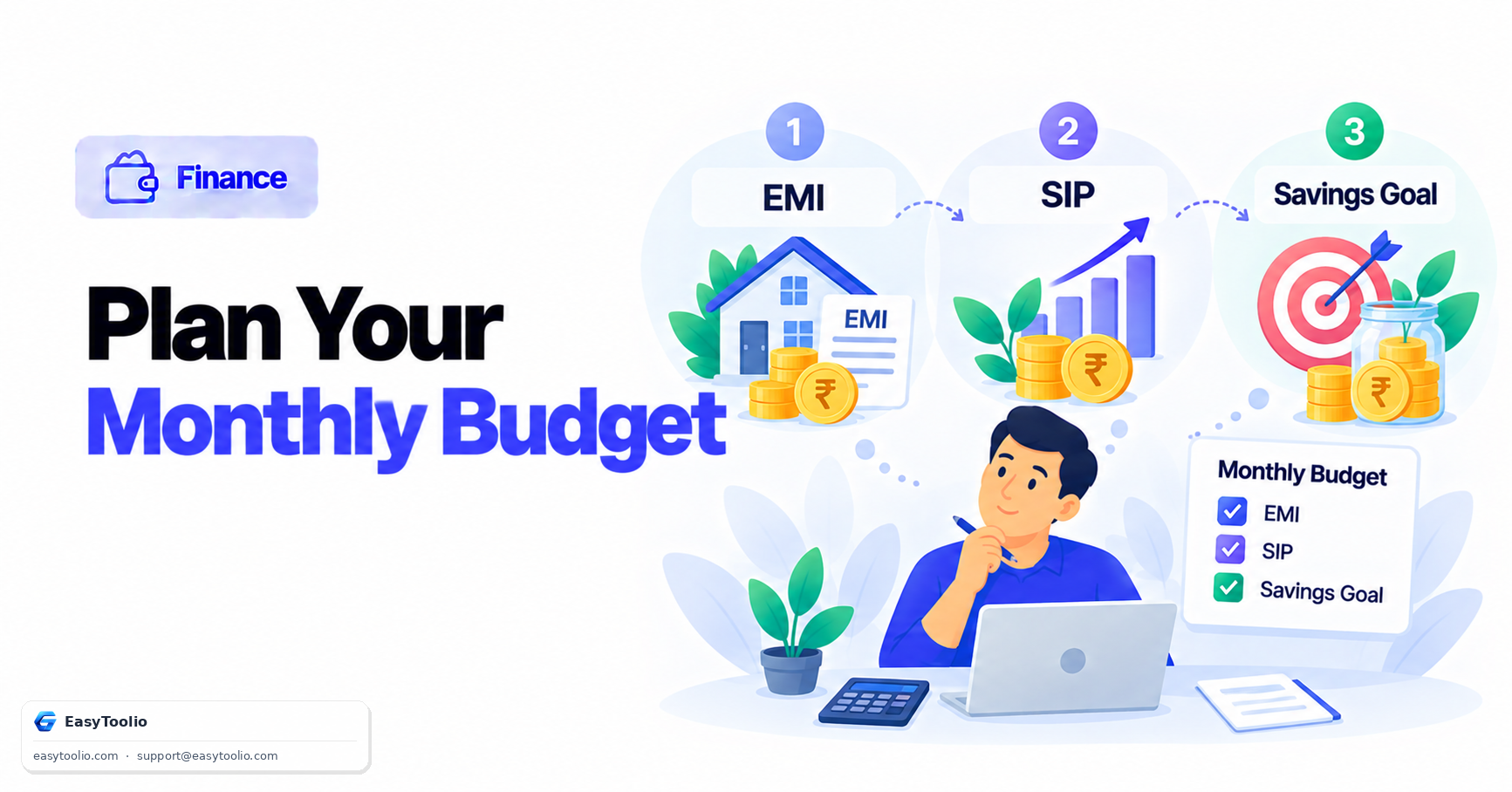
Most people build a monthly budget backward — they spend first, save whatever's left, and treat loan EMIs and investments as separate, unrelated line items handled by different mental accounts. That order is exactly why so many people end up over-committed on loans and under-invested for the long term. A more reliable approach treats EMI, SIP, and savings goals as three sequential steps in one deliberate order, not three unrelated numbers.
Direct Answer: Build a monthly budget in this order: first, lock in your fixed EMI obligations (existing loans plus any new loan you're evaluating) using an EMI calculator, since these are contractual and non-negotiable once taken. Second, commit a SIP (Systematic Investment Plan) amount for long-term wealth building using a SIP calculator, treating this as a near-fixed commitment rather than a leftover. Third, allocate whatever surplus remains toward specific near-term goals — an emergency fund, a vacation, a gadget — using a savings goal calculator to see exactly how long each goal will take at your chosen monthly contribution. Following this order specifically prevents the common mistake of over-committing to EMIs before any money has been set aside for investing.
Why the Order Matters More Than the Amounts
Budgeting frameworks often present EMI, investing, and saving as three parallel choices, but they're not equally flexible:
| Category | Flexibility | Consequence of Getting the Order Wrong |
|---|---|---|
| EMI obligations | Fixed once a loan is taken; missing a payment has serious credit consequences | Taking on too much EMI before budgeting for investing permanently crowds out SIP capacity |
| SIP investment | Semi-flexible; can be paused, but pausing forfeits compounding time that never comes back | Treating SIP as "whatever's left over" typically means it gets skipped in tight months, which is precisely when consistency matters most |
| Savings goals | Most flexible; a goal can be delayed or resized without lasting damage | Low cost to getting this one "wrong" compared to the other two |
This is why EMI comes first (it's the least forgiving), SIP comes second (it's time-sensitive but adjustable), and discretionary savings goals come last (they're the most forgiving of the three).
Step 1: Lock In EMI Obligations First
Before deciding anything else, get an exact number for every existing and prospective loan payment. Use our EMI calculator for each loan:
EMI = P × r × (1+r)^n / [(1+r)^n − 1]

P = loan principal, r = monthly interest rate, n = total number of monthly installments
A common mistake here is evaluating a new loan (say, a car or a larger home loan) in isolation, without checking the combined EMI-to-income ratio across all loans together. Most lenders and financial advisors suggest keeping total EMI obligations under roughly 40% of monthly take-home income — going meaningfully above that threshold tends to squeeze out both investing and savings capacity for the life of the loan.
Step 2: Commit to a SIP Amount Second
Once fixed obligations are known, decide your SIP amount before looking at discretionary spending — treating this step as "leftover money" is the single most common reason long-term investing plans fail. Use our SIP calculator to see what a given monthly contribution grows into over time:
Future Value = P × [ ((1+i)^n − 1) / i ] × (1+i)

P = monthly SIP amount, i = expected monthly rate of return, n = number of months
The reason this step comes before discretionary savings goals, not after, is compounding: a SIP contribution delayed by even a year or two loses meaningfully more long-term growth than the same delay costs a short-term savings goal, because the missed contribution never gets the extra years to compound. Treating SIP as a near-fixed monthly commitment — similar in priority to a bill, not similar in priority to optional spending — is what actually makes long-term wealth building happen consistently.
Step 3: Allocate the Remaining Surplus to Specific Goals
Only after EMI and SIP are accounted for should the remaining surplus be split across near-term goals — an emergency fund, a planned trip, a large purchase. Use our savings goal calculator to see exactly how long each goal takes at a given monthly contribution:
Months to Goal = Goal Amount / Monthly Contribution
        (adjusted for any interest earned on the savings, if applicable)
Unlike EMI or SIP, these goals can be resized, reprioritized, or delayed without the compounding penalty that a delayed SIP carries or the credit consequences that a missed EMI carries — which is exactly why they belong last in the sequence, not first.
Worked Example: Allocating a Sample ₹80,000 Monthly Income
| Step | Category | Amount | Running Balance |
|---|---|---|---|
| Start | Monthly take-home income | — | ₹80,000 |
| 1 | Existing home loan EMI | ₹22,000 | ₹58,000 remaining |
| 1 | Car loan EMI | ₹8,000 | ₹50,000 remaining |
| 2 | SIP investment commitment | ₹12,000 | ₹38,000 remaining |
| 3 | Emergency fund goal contribution | ₹6,000 | ₹32,000 remaining |
| 3 | Vacation goal contribution | ₹4,000 | ₹28,000 remaining |
| — | Remaining for discretionary/living expenses | — | ₹28,000 |
In this example, total EMI (₹30,000) sits at roughly 37.5% of income — within the commonly recommended 40% threshold — leaving room for a meaningful SIP commitment before any discretionary goal allocation. If the EMI total had instead consumed 55-60% of income, there would be little realistic room left for the SIP step at all, which is exactly the over-commitment problem this ordered approach is designed to prevent.
Frequently Asked Questions
What if my EMI obligations already exceed 40% of my income?
This is a signal to prioritize paying down or restructuring existing debt before taking on new loans, and to start a SIP at even a small, symbolic amount rather than skipping it entirely — consistency matters more than size in the early years of investing.
Should I ever pause my SIP to hit a savings goal faster?
Occasionally, for a genuinely time-sensitive and important goal, but it should be the exception rather than the default approach, given how much long-term growth a paused SIP forfeits. A better default is trimming the savings goal contribution amount before touching the SIP.
Is it better to prepay a loan or increase my SIP contribution?
It depends heavily on the loan's interest rate versus your SIP's expected return — prepaying a loan with a rate meaningfully higher than your expected investment return (common with personal loans or credit card debt) is usually the better move, while a low-rate home loan often makes sense to let run alongside continued investing.
How many savings goals should I track at once?
Two or three concurrent goals is a practical limit for most people — tracking too many simultaneously often means each one gets a token contribution that takes far longer to reach than expected, which can be discouraging even when the underlying plan is sound.
Does this three-step order apply the same way to variable or irregular income?
The same order still applies, but with irregular income it helps to base the SIP and goal contributions on a conservative, lower-end monthly income estimate rather than an average, so obligations stay met even in a lower-earning month.
References: Reserve Bank of India (RBI) guidance on household debt-to-income considerations; Securities and Exchange Board of India (SEBI) investor education materials on SIP and mutual fund investing.