Before launching a new product line, leasing storefront space, or scaling production, small business owners must answer one fundamental question: How many units must we sell before we cover all expenses and begin making a net profit? The financial framework used to answer this is Break-Even Analysis.
Direct Answer: The Break-Even Point is the exact sales volume (in units or total dollar revenue) where total revenue equals total costs, resulting in $0 net profit and $0 net loss. Calculating your break-even point requires identifying Fixed Costs (rent, salaries, insurance) and Variable Costs (raw materials, packaging, payment processing fees) to determine your Contribution Margin per unit.
Disclaimer: Cost structures and break-even scenarios presented in this article serve as educational examples and do not constitute formal accounting or tax advice.
1. Core Mathematical Formulas
The break-even calculation relies on isolating contribution margins:
1. Contribution Margin per Unit:
Contribution Margin = Selling Price per Unit (P) - Variable Cost per Unit (VC)
2. Break-Even Volume (Units):
Break-Even Units = Total Fixed Costs ÷ (Price per Unit - Variable Cost per Unit) = Fixed Costs ÷ Contribution Margin
3. Break-Even Revenue ($):
Break-Even Revenue = Break-Even Units × Selling Price per Unit OR Break-Even Revenue = Total Fixed Costs ÷ Contribution Margin Ratio Where Contribution Margin Ratio = Contribution Margin ÷ Price per Unit.
To calculate your company's break-even thresholds dynamically, use the Break-Even Calculator and evaluate unit-level profit margins with the Profit Margin Calculator.
2. Step-by-Step Small Business Example: Coffee Roastery
A specialty coffee roaster leases a small commercial facility. The financial parameters are:
- Fixed Costs (Monthly): Rent ($3,000), Utilities ($500), Equipment Lease ($1,000), Admin Salaries ($3,500) = $8,000 Total Fixed Costs.
- Selling Price per Bag ($P$): $20.00
- Variable Costs per Bag ($VC$): Green Coffee Beans ($5.00), Packaging & Labeling ($1.50), Shipping ($1.50) = $8.00 Total Variable Cost.
Unit Price: $20.00  ──►  Minus Variable Cost ($8.00)  ──►  Contribution Margin: $12.00 per Bag
Fixed Costs: $8,000 ──►  Divided by $12.00 Margin      ──►  Break-Even Point: 666.67 Bags / Month
Calculation:
- Contribution Margin: $20.00 - $8.00 = $12.00 per bag
- Contribution Margin Ratio: $12.00 ÷ $20.00 = 0.60 (60%)
- Break-Even Volume: $8,000 ÷ $12.00 = 666.67 Bags/month (667 bags required)
- Break-Even Revenue: 667 × $20.00 = $13,340 per month
Every bag sold beyond 667 bags generates $12.00 in net profit directly to the business.
3. Fixed vs Variable Cost Categories
| Cost Type | Definition | Examples |
|---|---|---|
| Fixed Costs ($FC$) | Overhead expenses that remain constant regardless of production volume. | Storefront rent, business insurance, fixed salaries, software subscriptions. |
| Variable Costs ($VC$) | Direct expenses that scale linearly with each unit produced or sold. | Raw materials, product packaging, direct merchant gateway fees, piece-rate labor. |
For setting wholesale vs retail discounts and adding local sales tax to a break-even price, explore the Discount Calculator and GST Calculator.
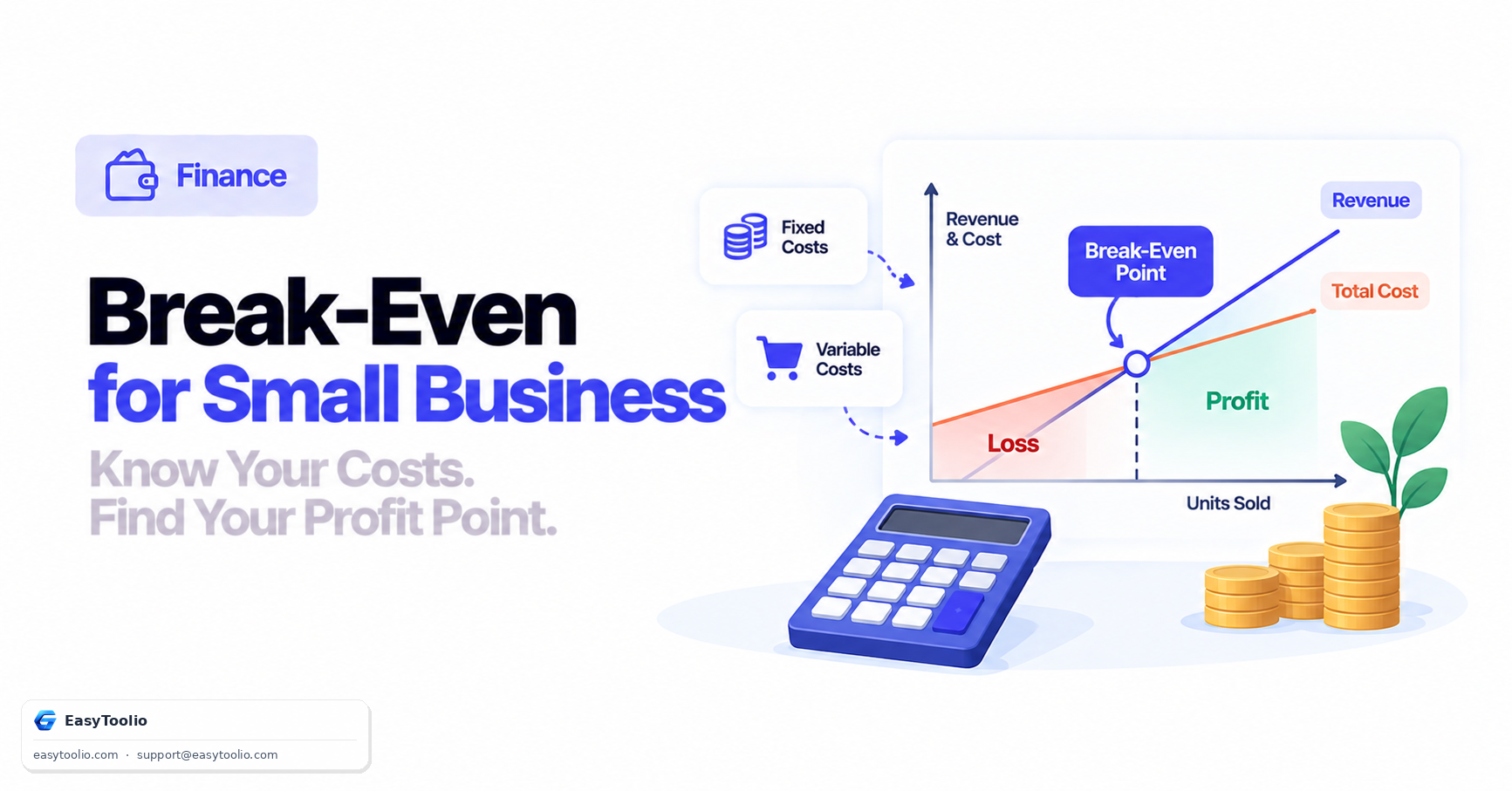
4. Visualizing the Break-Even Chart
Even without plotting software, it helps to picture the three lines a break-even chart plots against unit volume on the x-axis and dollars on the y-axis:
- Fixed Cost Line: A flat horizontal line at $8,000 — it never moves regardless of how many bags are sold.
- Total Cost Line: Starts at $8,000 (at zero units) and rises by $8.00 for every additional bag sold (fixed cost + variable cost).
- Total Revenue Line: Starts at $0 and rises by $20.00 for every bag sold.
The Total Revenue line and Total Cost line intersect exactly at 667 bags / $13,340 — the break-even point. Below that volume, the Total Cost line sits above Total Revenue (the shaded "loss zone"); above it, Total Revenue pulls ahead (the "profit zone"). The vertical gap between the two lines at any given volume is the business's net profit or loss at that sales level.
5. Margin of Safety: How Much Cushion Do You Have?
Once you know your break-even point, the Margin of Safety tells you how far actual (or budgeted) sales can fall before the business slips back into a loss:
Margin of Safety (Units) = Actual Sales Units - Break-Even Units Margin of Safety (%) = (Actual Sales - Break-Even Sales) ÷ Actual Sales × 100
Example: If the coffee roastery actually sells 900 bags a month against a break-even point of 667 bags:
Margin of Safety = 900 - 667 = 233 bags Margin of Safety (%) = 233 ÷ 900 × 100 = 25.9%
This means monthly sales could drop by roughly 26% before the business stops being profitable — a useful early-warning metric for budgeting and risk planning, especially in seasonal businesses.
6. Break-Even for Multiple Products (Weighted Contribution Margin)
Most real businesses sell more than one product at different price points and margins, which means a single break-even formula won't work directly. Instead, calculate a weighted-average contribution margin based on each product's share of total sales:
Example: The coffee roastery also sells brewing equipment alongside coffee bags:
| Product | % of Sales Mix | Contribution Margin per Unit | Weighted Contribution |
|---|---|---|---|
| Coffee Bags | 80% | $12.00 | $9.60 |
| Brewing Equipment | 20% | $40.00 | $8.00 |
| Weighted Average | 100% | — | $17.60 |
If fixed costs remain $8,000/month, the blended break-even point in total units sold (across both products, in their existing 80/20 mix) becomes:
Break-Even Units = $8,000 ÷ $17.60 = 454.5 total units (weighted across both products)
7. Frequently Asked Questions (FAQs)
Does break-even analysis account for taxes?
No. The standard break-even formula works at the operating level (revenue minus fixed and variable costs) and does not factor in income tax. A business can reach $0 pre-tax profit at the calculated break-even volume; taxes only apply once the business moves into taxable profit above that point.
What happens to the break-even point if I raise my prices?
Raising the selling price increases the contribution margin per unit (since variable cost per unit stays the same), which lowers the number of units needed to break even — but it may also reduce sales volume if customers are price-sensitive, so break-even analysis should be paired with demand/pricing research, not used in isolation.
Is break-even analysis useful for service businesses that don't sell physical units?
Yes. Service businesses can substitute "units" with billable hours, client engagements, or subscription seats, and use the same Fixed Costs ÷ Contribution Margin formula. A consulting firm, for example, can calculate the number of billable hours needed per month to cover office rent, salaries, and software costs.
How often should a small business recalculate its break-even point?
Recalculate whenever fixed costs change materially (a rent increase, a new hire, a new software subscription), whenever supplier or material costs shift the variable cost per unit, or whenever prices change. Many businesses review break-even assumptions quarterly, or immediately before any major pricing or cost decision.