Notification
Go to Home All Tools Compare Glossary Blog Contact

Fixed Deposit Calculator

Calculate estimated FD maturity, interest earned and total value from your deposit amount, interest rate and tenure.

✓ Embeddable
Deposit Parameters
Currency
₹
Min: ₹5,000 Standard: ₹1,00,000 Max: ₹1 Cr
%
Min: 1% Standard: 7.50% Max: 15%
Yrs
Mths
1 Year 3 Years 10 Years

Most Indian banks compound FD interest quarterly. Select Simple Interest for short-term/flat tenures.

Also works for these schemes:

Also works for SCSS, NSC, KVP, and other fixed-rate savings schemes — enter the scheme's current rate and tenure. Rate shown is indicative as of Q2 FY2026-27 (Jul–Sep 2026) — verify the current official rate before relying on it.

Estimated Maturity Value
₹0
Principal Deposit ₹0
Estimated Interest ₹0
Principal: 80% Interest Growth: 20%
Estimated Maturity Date: Calculating...
Wealth Growth Trajectory
Principal Total Maturity

Estimate only: This calculator uses the assumptions you enter. Actual FD maturity, interest payout, taxation, TDS and premature-withdrawal terms depend on the financial institution, product and applicable rules. Scheme presets (SCSS, NSC, KVP) use illustrative, date-sensitive rates only — this tool does not verify scheme eligibility, investment limits or maturity rules. Confirm current official rates and rules with the relevant post office or government source before relying on these figures.

Year-by-Year Compounding Projection

Fixed Deposit Knowledge Hub

How Fixed Deposits (FD) Compound Returns & Protect Capital

A Fixed Deposit (FD) is one of India's most established savings instruments, allowing individuals to lock in a lump sum capital with a registered bank or financial institution at a predetermined rate for a fixed tenure.

Compounding Frequency Impact

Most Indian bank deposits compound interest quarterly (4 times/year). As interest is credited to the principal every 3 months, subsequent quarters earn interest on past interest, producing an effective annual yield that exceeds the nominal advertised rate.

DICGC Deposit Insurance

Eligible bank deposits are covered by DICGC deposit insurance subject to applicable rules and limits. The current statutory insurance limit is ₹5 Lakh per depositor per bank, encompassing both principal and interest combined.

Inflation & Post-Tax Returns

FD interest is treated as taxable income under income tax slabs. After adjusting for tax deductions and prevailing annual inflation, evaluate your real net yield to ensure your capital preserves long-term purchasing power.

Mathematical FD Formulas & Methodology

EasyToolio computes Fixed Deposit maturity values using standard RBI and banking compound interest methodologies:

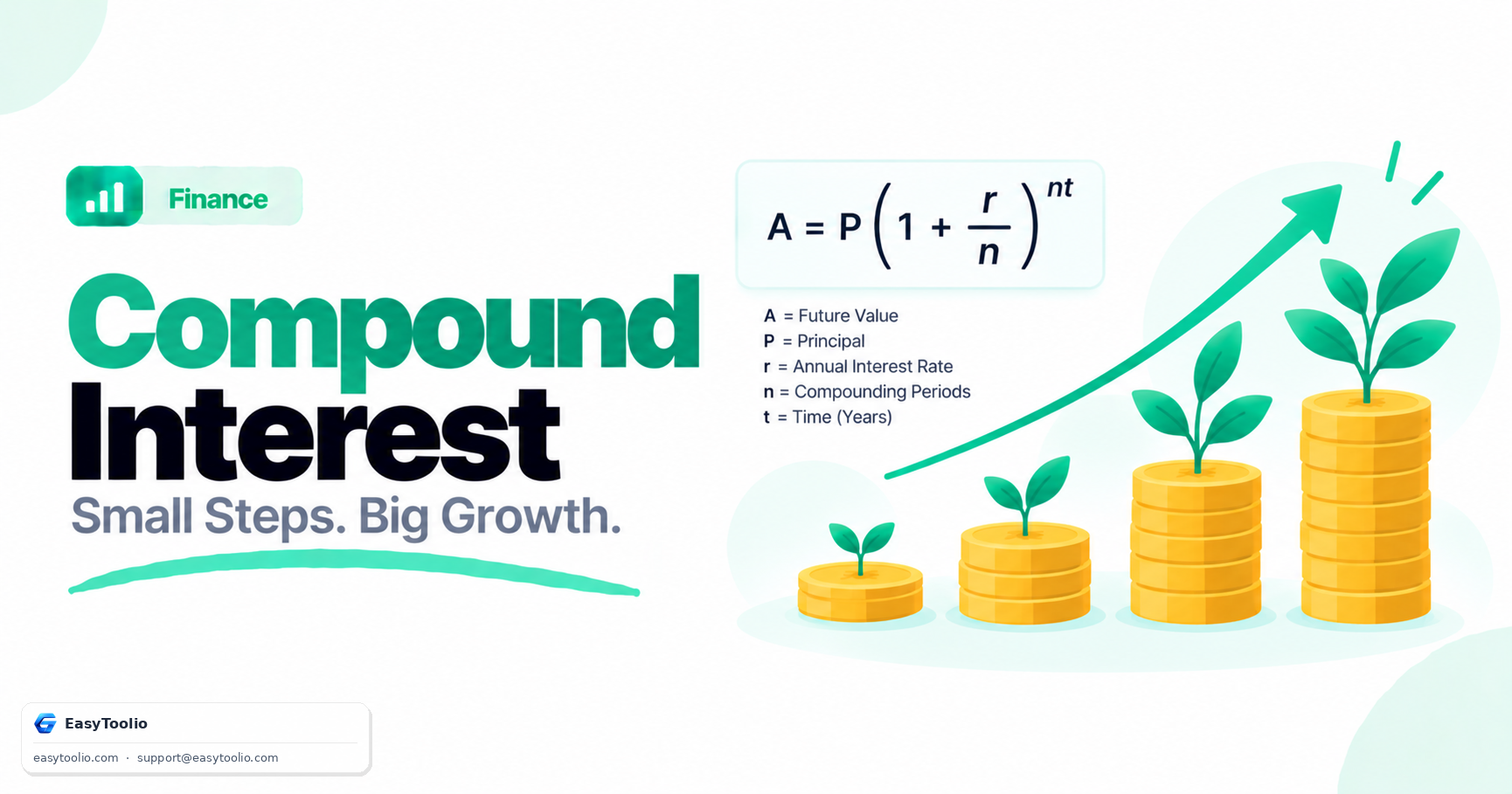
1. Compound Interest (Quarterly / Periodic Compounding): A = P × [1 + (r / n)]^(n × t)
2. Target Goal (Required Deposit Principal): P = A / [1 + (r / n)]^(n × t)
• P (Principal): Initial deposit amount (e.g. ₹1,00,000)
• r (Annual Rate): Nominal annual rate in decimal form (e.g. 7.5% = 0.075)
• n (Compounding Periods): Cycles per year (Quarterly: 4, Monthly: 12, Half-Yearly: 2, Yearly: 1)
• t (Tenure in Years): Total investment duration in years
Live Standard Worked Example:

For a deposit of ₹1,00,000 at 7.50% p.a. for 3 years with quarterly compounding (n=4):
Quarterly rate = 0.075 / 4 = 0.01875. Total quarters = 4 × 3 = 12.
Maturity = 1,00,000 × (1.01875)^12 = ₹1,24,972. Interest Earned = ₹24,972.

Cumulative Fixed Deposit

In a cumulative fixed deposit, interest is retained in the account, compounded quarterly, and paid out along with the principal at maturity.

  • • Best suited for wealth accumulation and goal planning.
  • • Yields maximum maturity value due to uninterrupted compound growth.

Non-Cumulative Fixed Deposit

In a non-cumulative FD, interest is disbursed periodically (monthly, quarterly, half-yearly, or yearly) directly into the depositor's savings account.

  • • Best suited for retirees and individuals needing regular cash flow.
  • • Principal remains untouched and is refunded at the end of the term.
Financial Advisor

AI Fixed Deposit & Wealth Advisor

Ask AI
Education

Complete Fixed Deposit (FD) Guide & Interest Rules

01

Safe and Predictable Returns with DICGC Protection

A Fixed Deposit (FD) locks a lump sum with a bank at a predetermined interest rate for a chosen tenure, ensuring your maturity value is guaranteed regardless of market volatility. Deposits are insured by DICGC (a subsidiary of RBI) up to ₹5 Lakh per depositor per bank (principal plus interest combined), making FDs one of India's safest investment options.

02

Compounding Frequency Changes Your Effective Yield

Most Indian banks compound FD interest quarterly, but monthly, half-yearly, yearly, and simple-interest options are also common. Higher compounding frequencies generate slightly higher effective annual yields even at identical nominal interest rates.

03

Cumulative vs. Non-Cumulative Fixed Deposits

Cumulative FDs reinvest interest until final maturity, maximizing compound growth. Non-cumulative FDs pay out interest periodically (monthly, quarterly, or annually), providing steady cash flow for retirees but yielding lower total maturity returns.

04

Tax-Saving FDs (5-Year Lock-in under Section 80C)

Tax-saving fixed deposits have a mandatory 5-year lock-in period and qualify for deductions up to ₹1.5 Lakh under Section 80C (under Old Tax Regime). However, prematurely breaking a tax-saving FD is prohibited, and interest earned remains taxable based on your income slab.

05

TDS Rules on FD Interest (Section 194A)

Banks deduct 10% Tax Deducted at Source (TDS) on FD interest when total annual interest earned across all accounts in a bank exceeds ₹40,000 (₹50,000 for senior citizens). Submitting Form 15G (or Form 15H for senior citizens) prevents TDS if your net taxable income falls below the taxable slab threshold.

06

Premature Withdrawal Penalties

Withdrawing funds prior to maturity usually incurs a penal rate reduction of 0.5% to 1.0% off the effective interest rate for the actual duration held, which reduces your expected maturity yield.

07

FD Laddering Strategy for Optimal Liquidity

Instead of locking your entire savings into a single long-term FD, laddering splits capital across multiple FDs with staggered maturity dates (e.g., 1-year, 2-year, 3-year). As each deposit matures, you can either reinvest at prevailing rates or utilize funds without breaking other deposits.

08

How This FD Calculator Computes Maturity Values

The calculator applies the standard compound interest formula A = P(1 + r/n)^(nt), where P is principal, r is nominal annual interest rate, n is compounding frequency per year, and t is tenure in years. Enter custom deposit terms in days, months, or years to project accurate total interest and final maturity value.

09

Using This Calculator for SCSS, NSC and KVP

Government fixed-rate savings schemes like the Senior Citizen Savings Scheme (SCSS), National Savings Certificate (NSC) and Kisan Vikas Patra (KVP) use the same underlying principal-rate-tenure-compounding mathematics as a bank FD, so this calculator can estimate their maturity value as well. Use the "Also works for these schemes" presets to quickly fill in illustrative current rates and standard tenures for each scheme, then adjust the rate and tenure to match the exact terms confirmed with your post office or bank.

10

SCSS: Quarterly Payout for Senior Citizens

SCSS is a government savings scheme for senior citizens that pays interest quarterly rather than compounding it, so it is modeled here using Periodic (non-cumulative) payout mode. This calculator does not verify age eligibility, account limits or scheme rules — confirm these with an authorized post office or bank branch.

11

NSC: Annual Compounding, Paid at Maturity

NSC compounds interest annually, with each year's interest added back to the principal, but the entire accumulated amount — principal plus compounded interest — is paid out only at maturity. This calculator models NSC using Cumulative payout mode with Yearly compounding to match that convention.

12

KVP: A Fixed Doubling Period at a Fixed Rate

Kisan Vikas Patra is typically marketed by its doubling period (currently around 115 months) rather than its annual rate, but that doubling period is itself derived from a fixed annual interest rate compounded yearly. This calculator lets you model KVP by entering that maturity period directly in the tenure fields alongside Yearly compounding.

13

Why Rates for These Schemes Change Every Quarter

Unlike a bank FD rate that you lock in with your bank, small savings scheme rates for SCSS, NSC and KVP are set by the Government of India and reviewed every quarter. A rate that applies to a deposit opened today may not apply to one opened next quarter, so always re-check the rate in effect on your actual investment date rather than relying on any preset figure indefinitely.

Good to know

Questions, answered

Quick answers about how this tool works.

A Fixed Deposit is a secure financial instrument provided by banks and NBFCs where you invest a lump sum of money for a fixed tenure at a predetermined interest rate.

An FD calculator takes your principal deposit amount, annual interest rate, tenure, and compounding frequency to compute total interest earned and final estimated maturity value.

For cumulative fixed deposits, maturity is calculated using the compound interest formula: A = P × (1 + r/n)^(n×t), where P is principal, r is annual interest rate as a decimal, n is compounding periods per year, and t is tenure in years.

Quarterly compounding (4 times a year) is selected by default because it is the standard practice across most Indian commercial banks. You can also select Monthly, Half-Yearly, Yearly, or Simple Interest.

Embed Fixed Deposit Calculator

Free

What do you need to work out next?

Search 244+ free tools by name, or pick a category below. Every one runs instantly in your browser — no signup, nothing to install.

More Finance tools