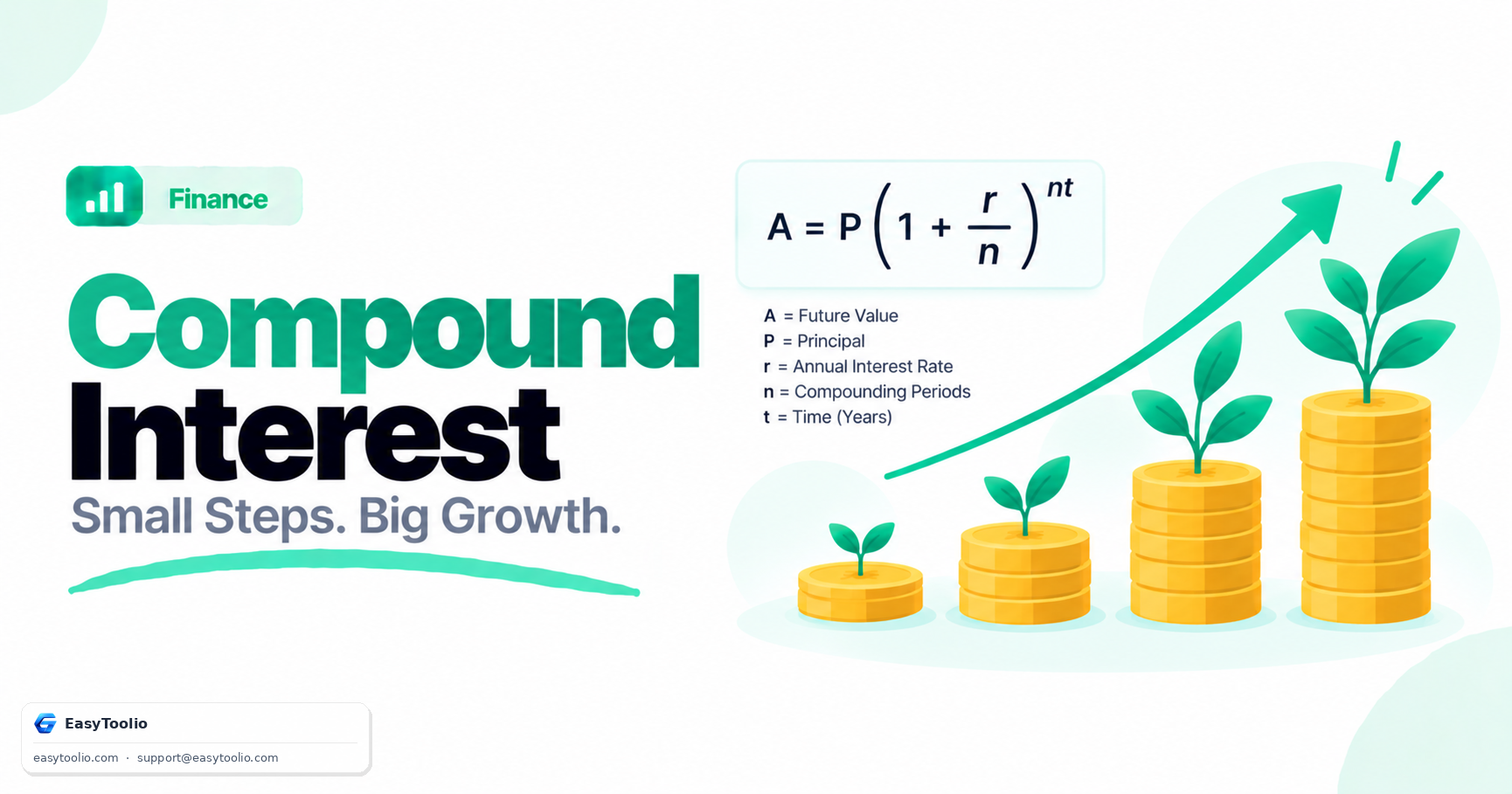
Albert Einstein is often (apocryphally) credited with calling compound interest the "eighth wonder of the world." Whether he said it or not, the math backs it up. A single $10,000 investment at 8% annual return grows to $100,627 in 30 years — with zero additional contributions. That is the power of compounding.
The Compound Interest Formula
The standard formula for compound interest is:
A = P × (1 + r/n)^(n × t)
Where:
- A = Final amount (principal + interest)
- P = Principal (initial investment)
- r = Annual interest rate (as a decimal — e.g. 8% = 0.08)
- n = Number of times interest compounds per year
- t = Time in years
Step-by-Step Example
You invest $5,000 at 7% annual interest, compounded monthly, for 10 years:
- r/n = 0.07 / 12 = 0.005833
- n × t = 12 × 10 = 120
- A = 5,000 × (1.005833)^120 = $10,048
You doubled your money without touching it — purely through compounding.
How Compounding Frequency Affects Growth
The more frequently interest compounds, the more you earn. Here is the impact on $10,000 at 8% over 10 years:
| Compounding Frequency | Times per Year | Final Value |
|---|---|---|
| Annually | 1 | $21,589 |
| Quarterly | 4 | $22,080 |
| Monthly | 12 | $22,196 |
| Daily | 365 | $22,253 |
The difference between annual and daily compounding is $664 over 10 years — meaningful, but time has a far larger impact than compounding frequency.
The Real Variable: Time
Time is the most powerful lever in compound interest. Here is what happens to $10,000 at 8% compounded annually across different time horizons:
| Years | Final Value | Total Interest Earned |
|---|---|---|
| 5 | $14,693 | $4,693 |
| 10 | $21,589 | $11,589 |
| 20 | $46,610 | $36,610 |
| 30 | $100,627 | $90,627 |
| 40 | $217,245 | $207,245 |
Between Year 20 and Year 40, the investment does not simply double — it grows more than 4×. This is the exponential nature of compounding.
The Cost of Waiting
Starting 5 years later is more expensive than most people realise. If two people both invest $10,000 at 8%:
- Person A starts at age 25, stops at 65 → $217,245
- Person B starts at age 30, stops at 65 → $147,853
Person A's 5-year head start earns $69,392 more — more than 6× the original investment.
Compound Interest on Debt
Compounding works against you when it applies to debt. Credit card balances at 22% APR compounded daily grow rapidly if only minimum payments are made:
| Balance | Monthly Min (2%) | Months to Pay Off | Total Interest |
|---|---|---|---|
| $3,000 | $60 | 226 | $5,023 |
| $5,000 | $100 | 246 | $8,661 |
| $10,000 | $200 | 266 | $17,630 |
The same mathematics that builds wealth when you invest works against you aggressively when you carry high-interest debt.
How to Calculate Compound Interest Instantly
Our Compound Interest Calculator lets you model any scenario in seconds:
- Enter principal, annual interest rate, and time horizon
- Choose compounding frequency
- Add optional monthly contributions
- See a year-by-year growth table and final balance
The most powerful financial decision most people can make is starting to invest earlier, not investing more. Run the numbers and see what your timeline looks like.
This article is for educational purposes. Past investment returns do not guarantee future results.
Frequently Asked Questions
Q: What is the formula for compound interest? A: A = P × (1 + r/n)^(n × t), where P is the principal, r is the annual interest rate as a decimal, n is the number of compounding periods per year, and t is the time in years.
Q: Does compounding frequency matter more than time? A: No. On $10,000 at 8% over 10 years, moving from annual to daily compounding only adds $664, while extending the time horizon from 10 to 30 years grows the same investment from $21,589 to $100,627 — time is the dominant factor.
Q: How much more does starting 5 years earlier really matter? A: A person who invests $10,000 at 8% starting at 25 and stopping at 65 ends up with $217,245, versus $147,853 for someone who starts at 30 — a $69,392 difference from just a 5-year head start.