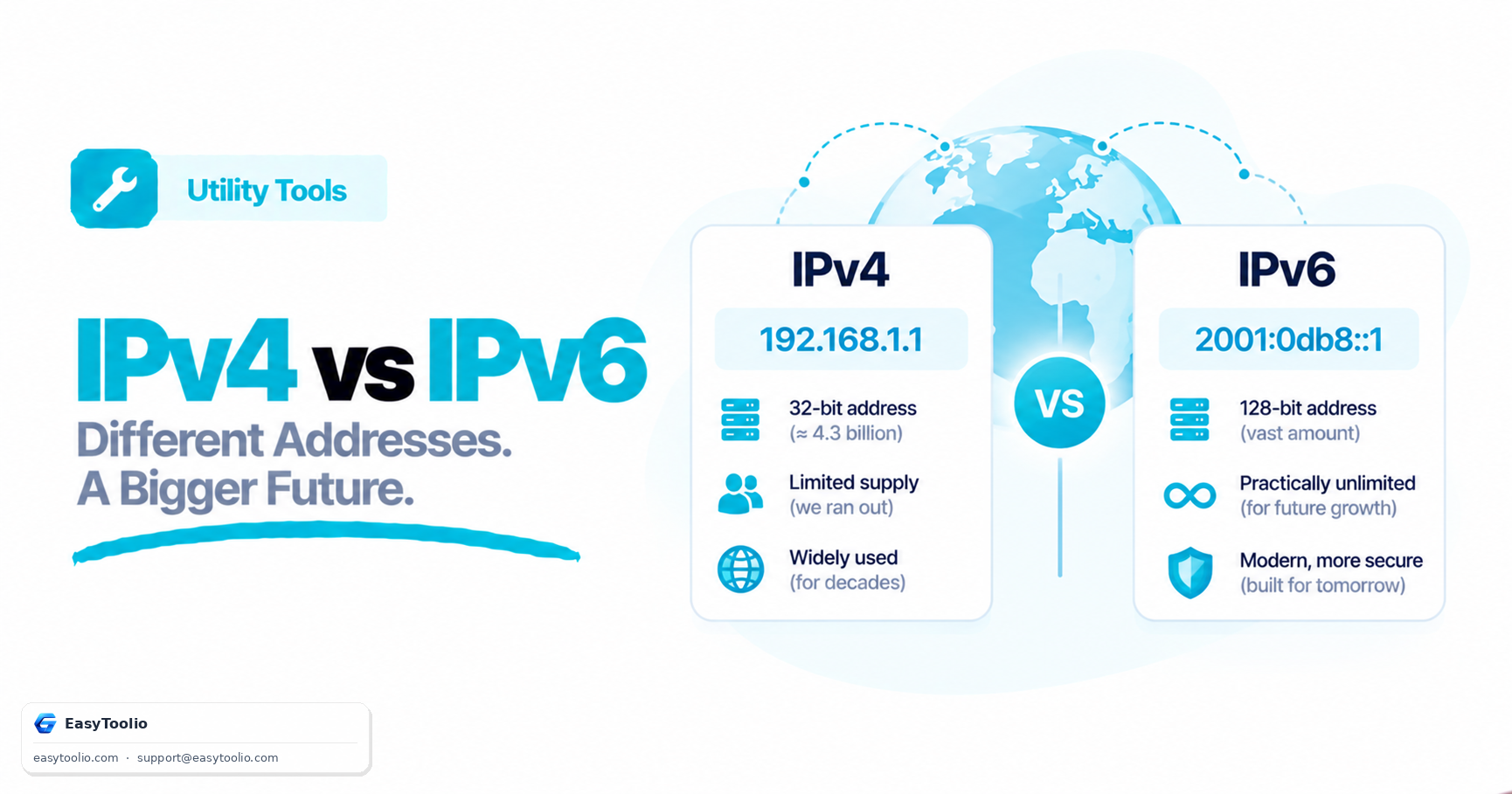
If you have ever glanced at your computer's network settings or run a network diagnostic, you have likely encountered two very different address formats: a simple dot-separated format like 192.168.1.1 and a long, complex sequence of letters and numbers like 2001:0db8:85a3::8a2e:0370:7334.
These are IPv4 and IPv6 — the two generations of the Internet Protocol (IP) that govern how data moves across the globe. Here is an in-depth breakdown of the differences between the two, why we are transitioning, and how they coexist today.
IPv4: The Foundation of the Modern Internet
Developed in the early 1980s, IPv4 (Internet Protocol version 4) has been the backbone of the web for over forty years.
Key Characteristics:
- Address Format: IPv4 uses a 32-bit address space, which is represented in "dotted-decimal" notation. It consists of four numbers separated by periods (e.g.,
172.217.16.142), with each number ranging from0to255(1 byte). - Address Scarcity: A 32-bit space allows for a maximum of 4,294,967,296 unique addresses (2^32).
- The Depletion Crisis: In 1981, 4.3 billion addresses seemed like more than the world would ever need. However, with the rise of smartphones, smart devices, cloud servers, and IoT (Internet of Things) devices, the pool of unallocated IPv4 addresses ran out.
- NAT (Network Address Translation): To combat this exhaustion, engineers introduced NAT. NAT allows a router to act as an intermediary, enabling hundreds of private devices on a home or office network to share a single public IPv4 address. While NAT saved the internet from running out of space, it adds routing complexity and prevents direct peer-to-peer communication.
IPv6: Built for the Infinite Future
Recognizing the limits of IPv4, the Internet Engineering Task Force (IETF) initiated the development of IPv6 in the mid-1990s.
Key Characteristics:
- Address Format: IPv6 uses a 128-bit address space. It is written in hexadecimal and divided into eight groups of four characters separated by colons (e.g.,
2001:0db8:85a3:0000:0000:8a2e:0370:7334). - Address Abbreviation Rules: Because IPv6 addresses are so long, they can be simplified using two rules:
- Omit leading zeros in any hexadecimal group (e.g.,
:0db8:becomes:db8:). - Replace consecutive groups of all zeros with double colons
::(this can only be done once per address to prevent ambiguity).
- Example:
2001:0db8:0000:0000:0000:0000:0000:0001simplifies to2001:db8::1.
- Omit leading zeros in any hexadecimal group (e.g.,
- Address Volume: A 128-bit space allows for 340 undecillion unique addresses (2^128, or 340,282,366,920,938,463,463,374,607,431,768,211,456). This is an practically inexhaustible supply.
Detailed Comparison: IPv4 vs. IPv6
| Feature | IPv4 | IPv6 |
|---|---|---|
| Address Size | 32-bit | 128-bit |
| Address Format | Dotted Decimal (e.g. 192.168.1.1) |
Hexadecimal Colon (e.g. 2001:db8::1) |
| Total Addresses | ~4.3 Billion | ~340 Undecillion |
| Security (IPSec) | Optional (often added later) | Built-in (mandatory in specification) |
| Configuration | Manual or via DHCP | Auto-configuration (SLAAC) or DHCPv6 |
| Header Size | Variable (20 to 60 bytes) | Fixed (40 bytes) for faster routing |
| Packet Size | 576 bytes minimum | 1280 bytes minimum |
| Data Transmission | Unicast, Multicast, Broadcast | Unicast, Multicast, Anycast (No Broadcasts) |
| NAT Support | Required for network sharing | Unnecessary (every device gets a public IP) |
Coexistence: How the Transition Works
Since IPv4 and IPv6 are completely different languages, they cannot directly talk to each other. Because migrating the entire internet overnight is impossible, networks use three main transition mechanisms:
- Dual Stack: Routers, servers, and devices run both IPv4 and IPv6 protocols simultaneously. If a website supports IPv6, the device connects via IPv6; otherwise, it falls back to IPv4.
- Tunneling: Encapsulating IPv6 packets inside IPv4 packets so they can travel across older, IPv4-only networks.
- Translation (NAT64): Translating IPv6 packets to IPv4 packets (and vice-versa) to allow communication between different protocol types.
Most global Internet Service Providers and major mobile networks have adopted Dual Stack architectures, allowing a seamless transition for consumers. If you run an IP check tool, you can verify if your current network provider has successfully assigned you a modern IPv6 address alongside your legacy IPv4 address.
Frequently Asked Questions
Q: Why did the internet run out of IPv4 addresses? A: IPv4's 32-bit address space caps out at 4,294,967,296 addresses, and the explosion of smartphones, IoT devices, and cloud servers used up the unallocated pool far faster than anyone expected in 1981.
Q: Do I need to do anything myself to switch to IPv6? A: Usually not. Most ISPs and mobile networks run Dual Stack, meaning your device and router run IPv4 and IPv6 simultaneously, and connections automatically use IPv6 whenever both ends support it.
Q: How many addresses does IPv6 actually support compared to IPv4? A: About 340 undecillion (2^128), versus roughly 4.3 billion for IPv4 — a practically inexhaustible supply for the foreseeable future.