Most Indians accept an EMI figure from their bank without questioning it. They sign the loan agreement, set up a standing instruction, and watch ₹25,000–₹50,000 leave their account every month for 20 years. But understanding how that number was calculated — and what variables you can change — could save you lakhs of rupees over the life of a loan.
The EMI Formula: How It Actually Works
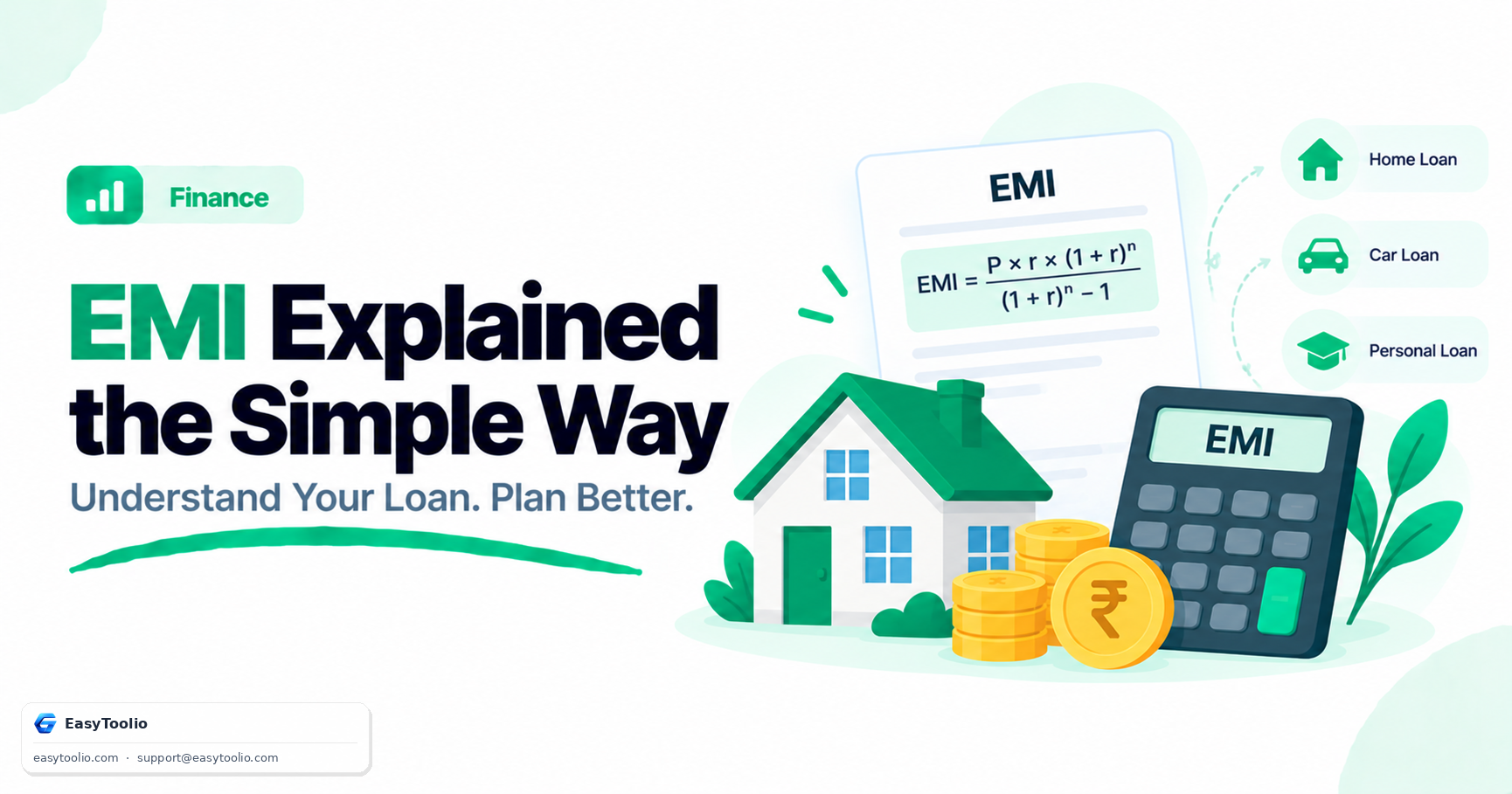
Indian banks use the reducing balance method (also called the diminishing balance method) to calculate EMI. The formula is:
EMI = P × r × (1 + r)^n / [(1 + r)^n – 1]
Where:
- P = Principal loan amount
- r = Monthly interest rate = Annual rate ÷ 12 ÷ 100
- n = Total number of monthly instalments (years × 12)
Example: ₹50 Lakh Home Loan at 8.5% for 20 Years
- r = 8.5 / 12 / 100 = 0.007083
- n = 20 × 12 = 240
- EMI = 5,000,000 × 0.007083 × (1.007083)^240 / [(1.007083)^240 – 1]
- EMI = ₹43,391
You'll repay ₹1,04,13,857 total — ₹54,13,857 in interest alone — on a ₹50 lakh loan.
How the RBI Repo Rate Flows to Your Home Loan
When you see RBI cut the repo rate by 25 basis points (0.25%), it doesn't immediately reduce your EMI. Here's the chain:
- RBI sets the Repo Rate (currently 6.25% as of 2026) — the rate at which banks borrow from RBI.
- Banks add a spread to the repo rate to set their Repo-Linked Lending Rate (RLLR).
- Your home loan rate = RLLR + Credit Risk Premium (based on your CIBIL score).
Current Rate Comparison (June 2026)
| Bank | Home Loan Rate (750+ CIBIL) | Processing Fee |
|---|---|---|
| SBI | 8.50% – 9.15% | ₹10,000 |
| HDFC Bank | 8.65% – 9.30% | 0.5% (min ₹3,000) |
| ICICI Bank | 8.60% – 9.25% | ₹3,000 |
| Kotak Mahindra | 8.70% – 9.40% | ₹10,000 |
| Bank of Baroda | 8.40% – 9.10% | ₹8,500 |
Rates are indicative as of June 2026. Actual rates depend on LTV, credit profile, and property type.
If your loan is a floating rate loan (most are), a 0.25% repo rate cut will reduce your total interest by ₹1.8–₹3.5 lakh on a ₹50L, 20-year loan — but only if your bank passes it through, which they are legally required to do for RLLR-linked loans.
How Amortisation Works: The "Front-Loading" Problem
EMI is fixed, but how it splits between interest and principal changes dramatically over time.
On a ₹50L loan at 8.5% for 20 years, here's the breakdown:
| Year | Interest Paid | Principal Paid | Outstanding Balance |
|---|---|---|---|
| 1 | ₹4,19,374 | ₹1,01,318 | ₹48,98,682 |
| 5 | ₹3,95,000 | ₹1,25,692 | ₹44,82,000 |
| 10 | ₹3,49,000 | ₹1,71,692 | ₹37,24,000 |
| 15 | ₹2,76,000 | ₹2,44,692 | ₹25,98,000 |
| 20 | ₹78,000 | ₹3,42,692 | ₹0 |
In Year 1, 80% of your EMI goes to interest and only 20% reduces the actual loan. This is the front-loading effect of amortisation. By Year 20, this reverses.
What this means practically: If you prepay even ₹1 lakh in Year 3 of a 20-year loan, you knock off roughly 14–18 months from the end — because every rupee of prepayment goes entirely to principal, bypassing future interest.
Strategies to Reduce Total Interest Paid
1. Make One Extra EMI Per Year
Paying 13 EMIs in a year (one extra) on a ₹50L, 20-year loan reduces the tenure by 3.5 years and saves approximately ₹8.2 lakh in total interest.
2. Prepay Windfall Amounts (Bonus, Tax Refund)
Applying your annual bonus (say ₹1–2 lakh) as a partial prepayment in the first 5 years is the highest ROI use of that money — it eliminates years of future compound interest.
3. Choose a Shorter Tenure from the Start
A ₹50L loan at 8.5% for 15 years has a higher EMI (₹49,190) but saves ₹27.2 lakh in total interest versus a 20-year loan.
4. Refinance When Rates Drop by 0.5% or More
If your current rate is 9.5% and a competitor offers 8.75%, refinancing saves ₹5–6 lakh on a typical loan — minus a ~₹35,000 processing fee. The net saving is still significant.
Use the EMI Calculator to Model These Scenarios
Our EMI Calculator lets you model all of these scenarios:
- Enter different interest rates to compare bank offers
- Use the prepayment field to see how a lump-sum prepayment reduces tenure
- Switch between years and months to fine-tune your calculation
- Use the Compare Two Loan Plans feature to put two bank offers side by side
The most important thing you can do before taking a home loan is to understand your own amortisation schedule. Your bank will give you one on request — or you can generate it instantly in our EMI calculator.
Frequently Asked Questions
Q: What is the reducing balance method and why do Indian banks use it? A: It calculates interest only on the outstanding principal each month, not on the original loan amount, so your interest cost shrinks as you repay. Nearly every Indian bank uses this method for EMI calculation, which is why the EMI formula involves the outstanding balance rather than a flat annual rate.
Q: Will my EMI drop automatically when the RBI cuts the repo rate? A: Not immediately — a repo rate cut first has to pass through your bank's Repo-Linked Lending Rate (RLLR), and only floating-rate loans linked to RLLR are legally required to pass it on. On a ₹50L, 20-year loan, a 0.25% cut that does get passed through can cut total interest by roughly ₹1.8–₹3.5 lakh.
Q: How much can paying one extra EMI a year actually save? A: On a ₹50 lakh, 20-year loan at 8.5%, paying 13 EMIs instead of 12 in a year cuts the tenure by about 3.5 years and saves approximately ₹8.2 lakh in total interest, because the extra payment goes entirely toward principal.