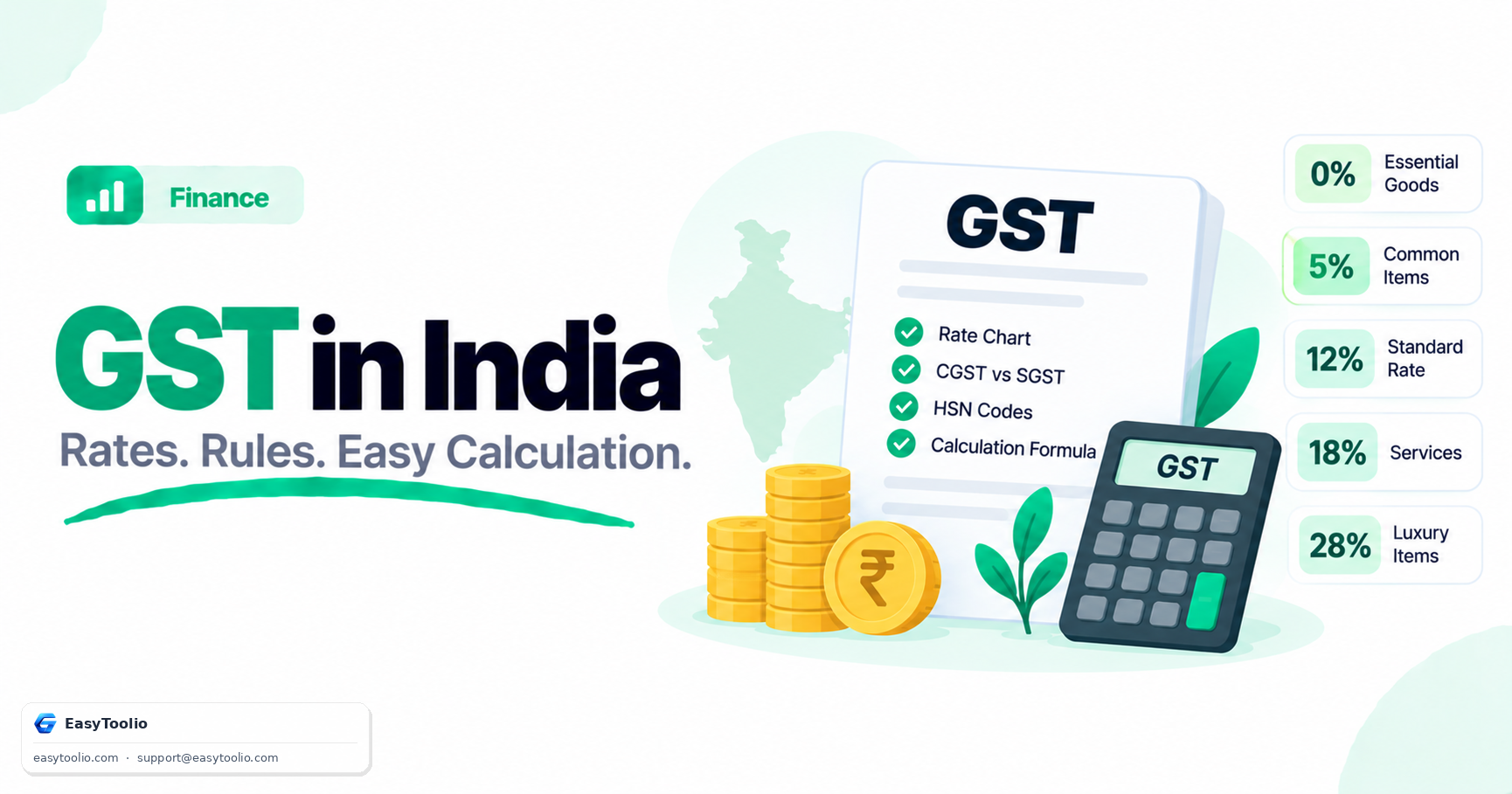
GST — Goods and Services Tax — has been in force in India since July 1, 2017. It replaced 17 central and state taxes and cesses, creating a unified national tax. But for businesses and freelancers, calculating the correct GST on an invoice remains a source of confusion. Is it 18% on software services? 5% on restaurant food? 0% on fresh vegetables?
This guide covers the complete GST rate chart, the CGST/SGST/IGST split, reverse charge, and the exact formulas for adding and removing GST from any price.
The Five GST Slabs
India's GST system has four main rates plus a zero rate:
| Slab | What It Covers (Key Examples) |
|---|---|
| 0% | Fresh vegetables, milk, eggs, bread, educational services, healthcare services |
| 5% | Packaged food, edible oil, footwear (below ₹1,000), economy hotel rooms (below ₹1,000/night) |
| 12% | Processed food, frozen meat, mobile phones, hotel rooms ₹1,000–₹7,500/night |
| 18% | Most services (IT, consulting, advertising), electronics, hotel rooms above ₹7,500/night, restaurant food (AC restaurants) |
| 28% | Luxury and sin goods: cars, motorcycles above 350cc, tobacco, pan masala, aerated drinks, 5-star hotels |
A 3% rate applies to gold, silver, and diamonds. A compensation cess applies on top of the 28% slab for specific goods like tobacco and luxury cars.
CGST, SGST, and IGST: The Split Explained
When a transaction occurs within the same state (intra-state), GST is split equally between the Central Government and the State Government:
- CGST = half of the applicable GST rate → goes to Centre
- SGST = half of the applicable GST rate → goes to State
Example: A Delhi-based business sells a software subscription (18% GST) to a Delhi client.
- CGST = 9%, SGST = 9%, IGST = 0%
When a transaction occurs across states (inter-state), the full tax is collected as IGST by the Centre and then apportioned to the destination state:
Example: A Mumbai-based business sells to a Bangalore client (18% GST).
- CGST = 0%, SGST = 0%, IGST = 18%
The GST Calculation Formulas
Adding GST to a Price (Exclusive of GST)
If your product costs ₹1,000 before tax and GST is 18%:
Tax Amount = Base Price × GST Rate / 100 Tax = ₹1,000 × 18 / 100 = ₹180
Total Invoice Value = Base Price + Tax Amount Total = ₹1,000 + ₹180 = ₹1,180
Removing GST from a Price (Inclusive of GST)
If a price tag says ₹1,180 and you want the pre-GST price (GST is 18%):
Base Price = Total Price / (1 + GST Rate / 100) Base = ₹1,180 / (1 + 18/100) = ₹1,180 / 1.18 = ₹1,000
Tax Paid = Total Price – Base Price Tax = ₹1,180 – ₹1,000 = ₹180
GST for Common Business Scenarios
Freelancers & IT/Software Services
All IT services, software development, consulting, and SaaS products attract 18% GST. If your annual turnover exceeds ₹20 lakh (₹10 lakh for special category states), GST registration is mandatory. Below this threshold, registration is optional but you cannot claim input tax credit (ITC).
Restaurant Owners
- Non-AC restaurants: 5% GST, no ITC allowed
- AC restaurants, hotels, and restaurants in 5-star hotels: 18% GST with ITC
- Swiggy/Zomato delivery (cloud kitchens): 5% GST, collected by the aggregator under reverse charge
E-Commerce Sellers (Amazon, Flipkart)
If you sell through an e-commerce operator, the operator collects 1% TCS (Tax Collected at Source) from your payouts and deposits it with the government. This does not replace your regular GST payments — it is credited against your GST liability.
GSTIN Format and Verification
A GSTIN (GST Identification Number) is a 15-character alphanumeric code:
- Characters 1–2: State code (e.g., 07 = Delhi, 27 = Maharashtra, 29 = Karnataka)
- Characters 3–12: 10-digit PAN of the taxpayer
- Character 13: Entity code (1 = individual/sole proprietor, 2 = partnership, etc.)
- Character 14: Z (default, reserved for future use)
- Character 15: Check digit
You can verify any GSTIN at gst.gov.in → Search Taxpayer.
Calculate GST Instantly
Our GST Calculator supports all five slabs, CGST/SGST split display, and both "add GST" and "remove GST" modes. Enter any amount, select the slab, and get the breakdown in under a second.
Frequently Asked Questions
Q: What is the difference between CGST, SGST, and IGST? A: CGST and SGST are each half the applicable GST rate and apply to transactions within the same state (e.g., 9% + 9% for an 18% rate), while IGST is the full rate charged as a single tax on inter-state transactions. A Delhi-to-Delhi sale splits 9% CGST/9% SGST, but a Mumbai-to-Bangalore sale charges 18% IGST instead.
Q: How do I find the base price if a listed amount already includes GST? A: Use Base Price = Total Price ÷ (1 + GST Rate/100). For a ₹1,180 price tag at 18% GST, that's ₹1,180 ÷ 1.18 = ₹1,000, meaning ₹180 was tax.
Q: What GST rate applies to eating at a restaurant in India? A: Non-AC restaurants charge 5% GST with no input tax credit, while AC restaurants and restaurants inside 5-star hotels charge 18% GST with ITC. Food delivered via Swiggy or Zomato from cloud kitchens is taxed at 5%, collected by the aggregator under reverse charge.