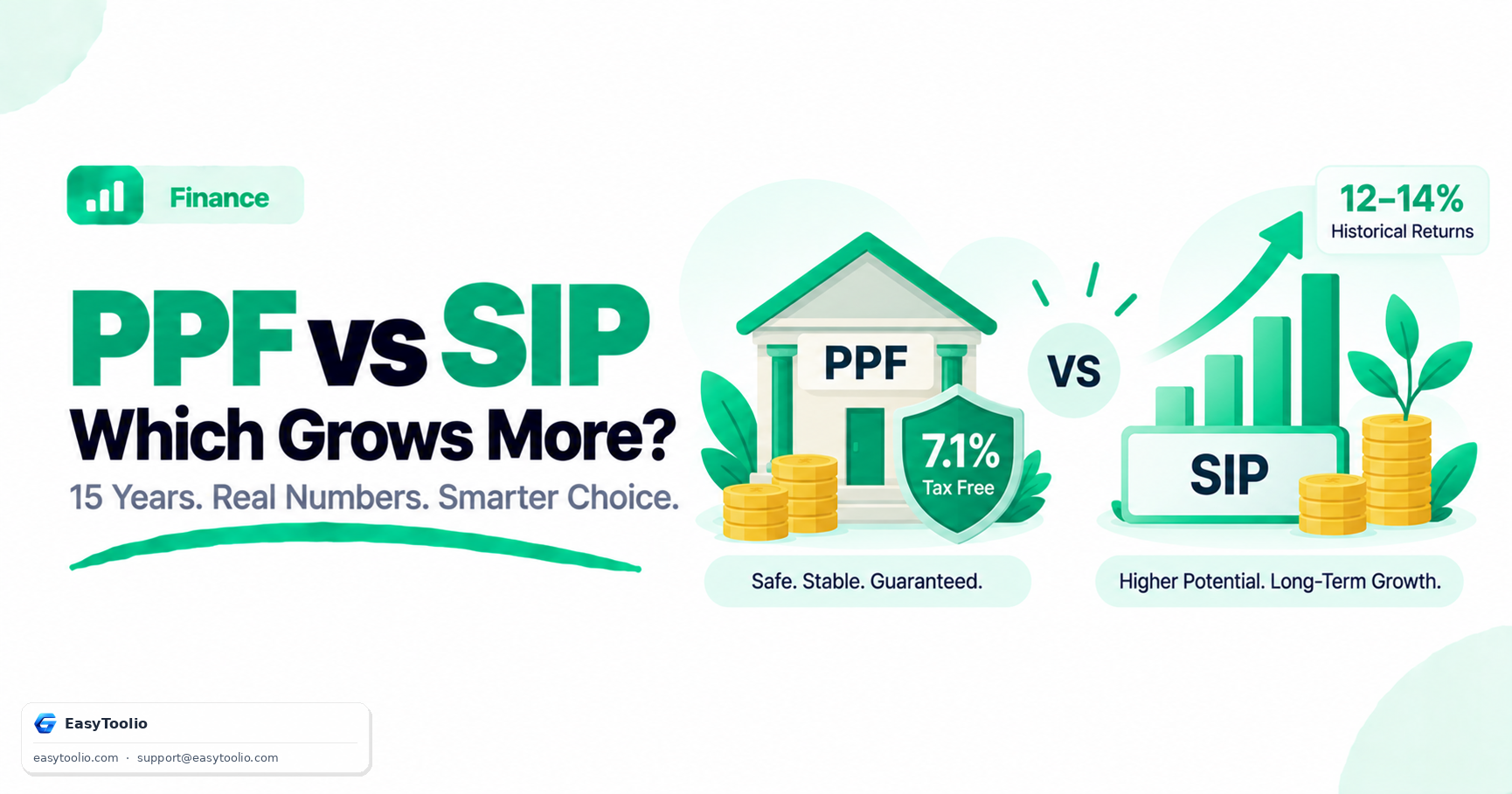
If you have ₹5,000 a month to invest and a 15-year horizon, two options dominate the conversation: the Public Provident Fund (PPF) and a Systematic Investment Plan (SIP) in equity mutual funds.
PPF is guaranteed and tax-free. SIP in equity has historically returned 12–14% CAGR but comes with market risk. After 15 years, which one actually puts more money in your pocket?
The answer is not as simple as picking the higher return rate. Let's look at the complete picture.
Current Rates & Rules (2026)
PPF (Public Provident Fund)
- Current interest rate: 7.1% per annum (set by Government of India, revised quarterly)
- Tenure: 15 years (extendable in blocks of 5 years)
- Investment limit: ₹500 to ₹1.5 lakh per year
- Tax treatment: EEE — contributions deductible under Section 80C, interest tax-free, maturity tax-free
- Withdrawal: Partial after Year 7; full only at maturity
- Risk: Zero — backed by Government of India sovereign guarantee
SIP in Equity Mutual Funds
- Historical returns: 12–14% CAGR over 15-year rolling periods (Nifty 50 index average: ~13.7% over last 20 years)
- Investment limit: No upper limit
- Tax treatment: Long-Term Capital Gains (LTCG) above ₹1 lakh taxed at 10%
- Withdrawal: Flexible — can redeem any time (some ELSS funds have 3-year lock-in for 80C benefit)
- Risk: Market-linked — returns can vary significantly in any given year
The 15-Year Numbers: ₹5,000/Month
Assuming consistent investment of ₹5,000 per month for 15 years (total invested: ₹9 lakh):
| PPF @ 7.1% | SIP @ 12% CAGR | SIP @ 14% CAGR | |
|---|---|---|---|
| Total Invested | ₹9,00,000 | ₹9,00,000 | ₹9,00,000 |
| Maturity Value | ₹15,89,476 | ₹25,22,803 | ₹29,06,820 |
| Wealth Gained | ₹6,89,476 | ₹16,22,803 | ₹20,06,820 |
| Tax on Gains | ₹0 | ~₹1,52,280 | ~₹1,90,682 |
| Net in Hand | ₹15,89,476 | ~₹23,70,523 | ~₹27,16,138 |
SIP tax calculated: gains above ₹1L taxed at 10% LTCG. Actual redemption may span multiple financial years.
Even at a conservative 12% CAGR, SIP puts roughly ₹7.8 lakh more in your hand after 15 years than PPF. At 14%, the gap grows to ₹11.3 lakh.
But Wait: The Real-World Caveats
PPF's Advantages Are Often Underestimated
1. The compounding is annual, but guaranteed. PPF interest compounds annually. More importantly, it is government-guaranteed — you will earn exactly 7.1% (or whatever the current rate is). In years when equity markets drop 20–30% (which happens every 5–7 years), PPF still returns 7.1%.
2. Section 80C deduction adds real value. If you are in the 30% tax bracket, every ₹1.5 lakh invested in PPF saves ₹46,800 in taxes annually. This effective subsidy raises your real PPF return significantly.
3. Disciplined long-term savings. The 15-year lock-in prevents you from redeeming during market panic or for discretionary spending. For many Indians, this illiquidity is a feature, not a bug.
SIP's Risks Are Real
- Sequence of returns risk: If you retire in a market downturn (as happened in 2000, 2008, 2020), your corpus could be 30–40% lower than the average suggests.
- Behavioral risk: Studies show retail investors in India earn 3–4% less than the fund's stated return because they exit during downturns and re-enter near peaks.
- LTCG tax: The 10% LTCG above ₹1L is small but real and reduces net returns.
Who Should Choose What?
| If you... | Consider... |
|---|---|
| Are in the 30% tax bracket | PPF for at least ₹1.5L/year (max Section 80C benefit) |
| Want guaranteed corpus for a specific goal (child's education, down payment) | PPF — certainty matters for fixed goals |
| Have 15+ years and moderate risk appetite | SIP — time smooths out market volatility |
| Are already maxing out 80C via EPF contributions | SIP — no marginal 80C benefit from PPF |
| Want flexibility to withdraw early | SIP (or ELSS after 3-year lock-in) |
The Optimal Strategy: Don't Choose — Combine
Most Indian financial planners recommend a "core + satellite" approach:
- Core (60–70%): PPF + EPF for the guaranteed, tax-free floor
- Satellite (30–40%): Equity SIP for wealth creation beyond the guaranteed floor
This gives you downside protection, Section 80C optimisation, and equity returns over the long term — which has historically beaten PPF by 5–6% CAGR annually.
Model It Yourself
Use our SIP Calculator to model different return rate scenarios. Then use the Compare SIP Plans tool to see how changing the monthly amount or rate affects the final corpus side by side.
For the PPF side, use our Compound Interest Calculator with annual compounding at 7.1% to model your PPF growth accurately.
Frequently Asked Questions
Q: Can I withdraw from PPF before the 15-year maturity period? A: Partial withdrawal is allowed only after the 7th financial year from account opening, and full withdrawal happens only at maturity (extendable in 5-year blocks). This lock-in is what makes PPF a forced long-term savings vehicle rather than a liquid investment.
Q: Is SIP maturity money taxed the same way as PPF? A: No — PPF follows an EEE (Exempt-Exempt-Exempt) structure, so contributions, interest, and maturity are all tax-free, while equity SIP gains above ₹1 lakh are taxed as Long-Term Capital Gains at 10%. In the ₹5,000/month, 15-year example, this tax reduces net SIP returns by roughly ₹1.5–₹1.9 lakh depending on the CAGR.
Q: Should I put all my money in SIP since it historically returns more than PPF? A: Most Indian financial planners recommend a "core + satellite" mix instead — PPF and EPF as a guaranteed, tax-free core (60–70%) and equity SIP as the growth satellite (30–40%). This balances the 0% risk of PPF against SIP's market volatility, which can still swing 20–30% lower in a bad year.