Notification
Go to Home All Tools Compare Glossary Blog Contact
Be the first to rate
Embeddable
Infinite Compounding Modeling

Premium Interactive Compound Interest Calculator.

Unleash the mathematical force of compounding. Model initial capital, recurring contributions, variable compound intervals, and analyze exponential progress instantly.

Estimated Future Value

$0

Total Contributions

$0

Compound Interest

$0

Calculator Currency Select input/output currency
Compounding Interval Frequency interest compounds
$
$0 $250K $500K+
$
Frequency
$0 $12.5K $25K+
%
0.1% 15% 30%
Yrs
1 Year 25 Years 50 Years
Formula Reference

Compound Interest Formula

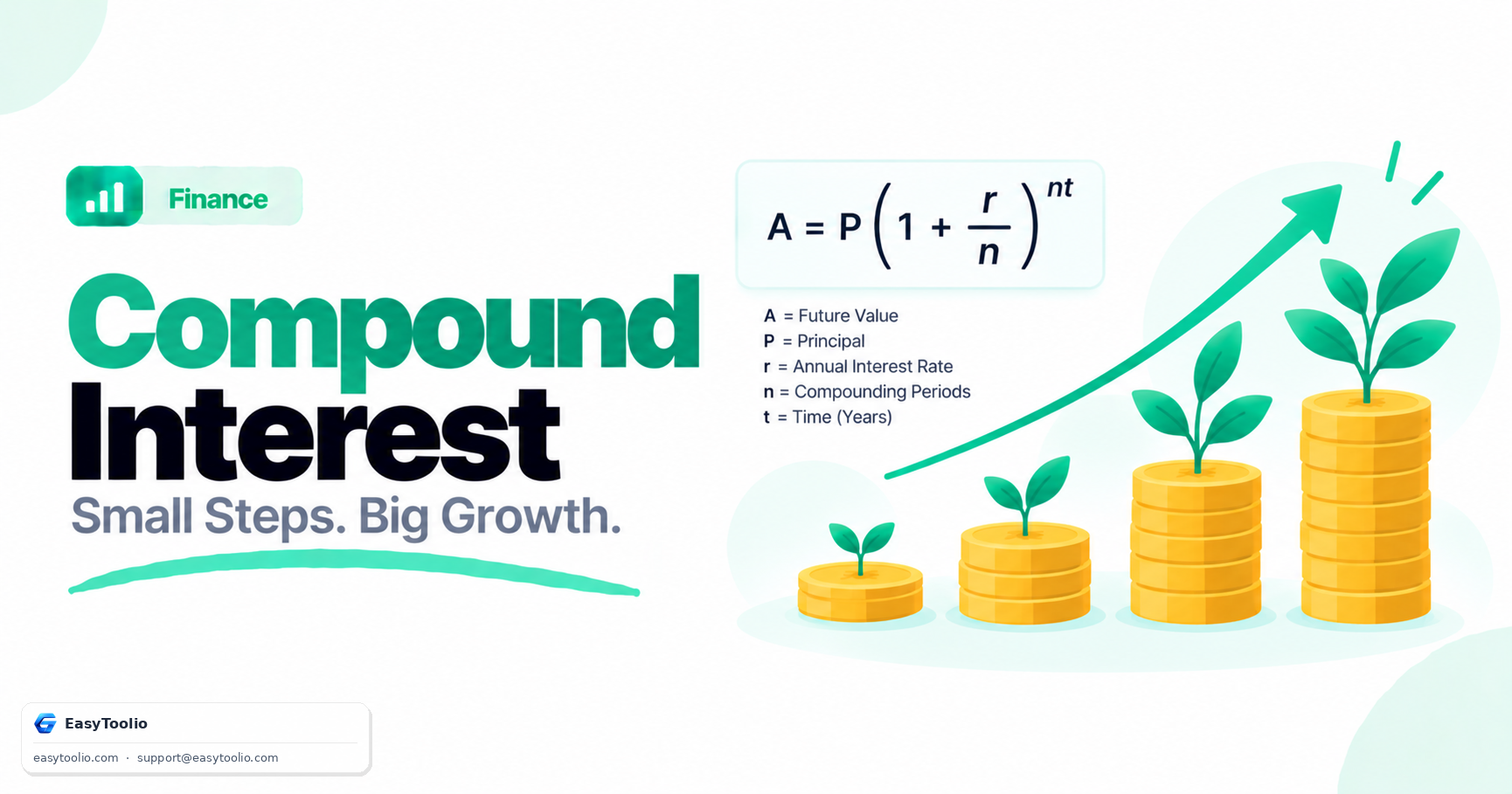
$$A = P \times \left(1 + \frac{r}{n}\right)^{nt}$$
A Final maturity amount (principal + interest)
P Initial principal investment or deposit amount
r Annual nominal interest rate (as a decimal)
n Number of compounding periods per year
t Time period the money is invested for in years
Growth Projection
Compounding Milestones
Double Wealth Point Time to double initial principal
--
Interest Crossover Year interest exceeds annual deposits
--
10x Wealth Milestone Year balance reaches 10x principal
--
Amortization Ledger

Year-by-Year Growth Details

Tap rows on mobile to view individual compounding steps

Year Deposits Made Interest Accrued Accrued Balance
Mathematical Foundation

The Formulas Behind Compounding

Compound interest is mathematically calculated using standardized formulas that account for initial principal, compounding frequency, and regular additions.

1 Standard Compound Interest Formula

Used to calculate growth on a lump-sum investment without any ongoing contributions.

A = P (1 + r / n)n * t

2 Compounding with Regular Contributions

Used when regular, recurring deposits (monthly or yearly) are made to the account.

A = P(1 + r/n)nt + PMT [ ((1 + r/n)nt - 1) / (r/n) ]

Formula Legend & Variables

A Future Value of the investment (Maturity Amount)
P Initial Principal (Starting balance)
r Annual Interest Rate (in decimal form, e.g., 0.08)
n Compounding frequency per year (e.g., 12 for monthly)
t Number of years the money is invested for
Financial Strategy Insights

AI Advisor Wealth Advisor

Compare compounding strategies, project target savings goals, evaluate inflation impacts, or model customized pathways with AI.

Topics this feature will cover:

Double-Wealth Timeline (Rule of 72) Advantage of Starting Early 🎈 Purchasing Power vs. Inflation

Be first to access it when it launches.

We'll notify you the moment AI Advisor goes live. One email, no spam.

Education

Understanding Compound Interest

1 Interest Earns Interest

Compound interest allows your earnings to generate additional earnings over time. Unlike simple interest, returns are calculated on both the original investment and previously accumulated interest, accelerating long-term growth.

2 Time Is Your Greatest Advantage

The longer your money remains invested, the greater the impact of compounding. Even modest investments can grow significantly when given enough time, making early investing one of the most effective wealth-building strategies.

3 Regular Contributions Accelerate Growth

Adding money consistently to an investment account increases the principal available for compounding. Small monthly contributions can dramatically increase the final value of an investment over many years.

4 Compounding Frequency Matters

Interest can be compounded annually, quarterly, monthly, or daily. More frequent compounding generally results in slightly higher returns because interest is added to the balance and begins earning additional interest sooner.

FAQs

Frequently Asked Questions

Compound interest is interest earned on both the original principal amount and any previously accumulated interest. This allows investments and savings to grow faster over time compared to simple interest.

Simple interest is calculated only on the original principal, while compound interest is calculated on both the principal and previously earned interest. As a result, compound interest generates exponential growth over time.

Compounding frequency refers to how often interest is added to the principal balance. Common frequencies include annually, semi-annually, quarterly, monthly, and daily. More frequent compounding generally results in higher returns.

The longer your money remains invested, the more time compound interest has to work. Starting early allows interest to generate additional interest for many years, significantly increasing the final investment value.

Yes. Making regular deposits or investments adds more principal to the account, allowing future interest to be calculated on a larger balance. Consistent contributions can dramatically increase long-term wealth accumulation.

Articles

Related Guides & Insights

Read our in-depth articles and guides related to this tool to help you make smarter decisions.

Workflow Suggestions

Recommended for Your Workflow

Category Showcase

More from Finance

Platform Spotlight

Popular Tools on EasyToolio

Embeddable

Embed This Tool

Add the Compound Interest Calculator to blogs, websites, documentation, tutorials, and online resources using a simple responsive iframe. The embed is free, mobile-friendly, and links back to the full EasyToolio tool page for users who want the complete experience.

Can I embed this tool on my website?

Yes, this tool can be embedded using our free iframe embed code. Copy the code below and paste it into your HTML, CMS block, article, documentation page, or tutorial.

Explore More Tools Like Compound Interest Calculator

Loved the Compound Interest Calculator? Explore our suite of related utilities to boost your productivity even further.