
All Tools Compare Glossary Formulas Blog Contact
Be the first to rate
Back to Formulas
Finance Formula

Compound Interest Formula

Published on July 05, 2026 • Last updated July 05, 2026

Mathematical Equation

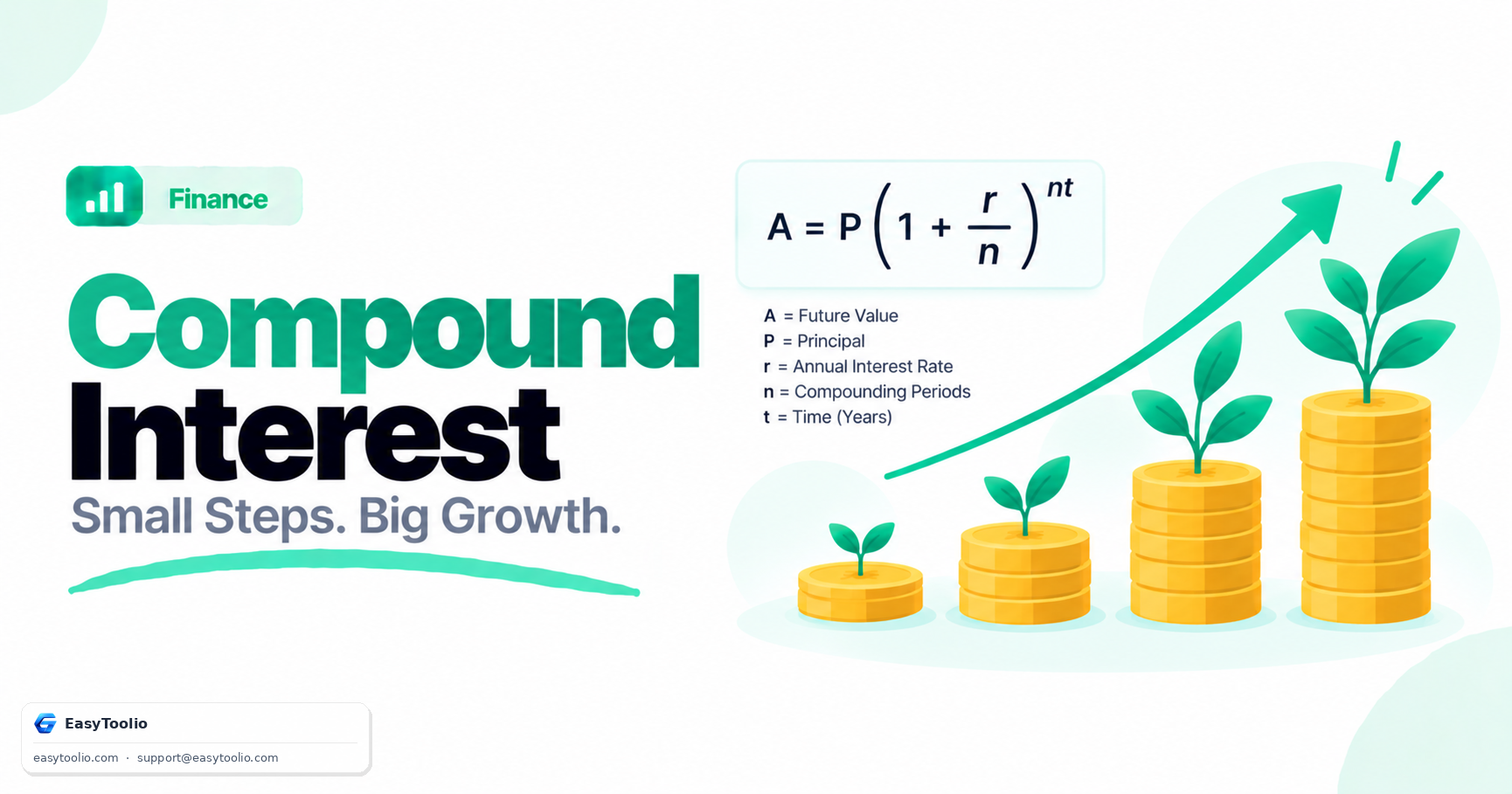
$$A = P \times \left(1 + \frac{r}{n}\right)^{nt}$$

Variable Definitions

A

A

Final maturity amount (principal + interest)

P

P

Initial principal investment or deposit amount

r

r

Annual nominal interest rate (as a decimal)

n

n

Number of compounding periods per year

t

t

Time period the money is invested for in years

Detailed Explanation

Compound interest is the interest calculated on the initial principal, which also includes all of the accumulated interest from previous periods. Unlike simple interest, compound interest allows your money to grow exponentially because you earn interest on interest.

How to Calculate: Step-by-Step

1. Identify the initial principal ($P$). 2. Convert the annual rate ($R$) to decimal ($r = R / 100$). 3. Determine the number of times interest is compounded per year ($n$, e.g. yearly = 1, quarterly = 4, monthly = 12). 4. Identify the tenure in years ($t$). 5. Calculate $1 + r/n$. 6. Raise this value to the power of $(n \times t)$. 7. Multiply the result by $P$ to find the maturity amount ($A$). 8. Subtract the principal $P$ from $A$ to find the interest earned.

Worked Calculation Example

Investing $10,000 for 5 years at an annual interest rate of 6% compounded quarterly: - Principal ($P$) = $10,000 - Annual rate ($r$) = 6% = 0.06 - Compounding frequency ($n$) = 4 times a year - Tenure ($t$) = 5 years - Calculate using the formula: $$A = 10,000 \times \left(1 + \frac{0.06}{4}\right)^{4 \times 5}$$ $$A = 10,000 \times (1.015)^{20}$$ $$(1.015)^{20} \approx 1.346855$$ $$A \approx 10,000 \times 1.346855 = \$13,468.55$$ - Total Compound Interest Earned = $13,468.55 - $10,000 = $3,468.55

Common Use Cases

  • Calculating savings account growth
  • Estimating fixed deposit returns
  • Understanding the cost of credit card debt over time
  • Comparing investment opportunities with different compounding frequencies

Frequently Asked Questions

The Rule of 72 is a quick way to estimate how long it will take to double your money with compound interest. Divide 72 by your annual interest rate to get the approximate number of years (e.g., at 8% return, money doubles in 72/8 = 9 years).

The more frequently interest is compounded, the higher the final return. Compounding monthly yields more than compounding quarterly, which yields more than compounding annually.

Free Forever • No Limits

Your everyday toolkit,
always within reach

Bookmark EasyToolio and access 125 tools whenever you need them. Calculate, decide, generate — all for free.

Try Decision Wheel