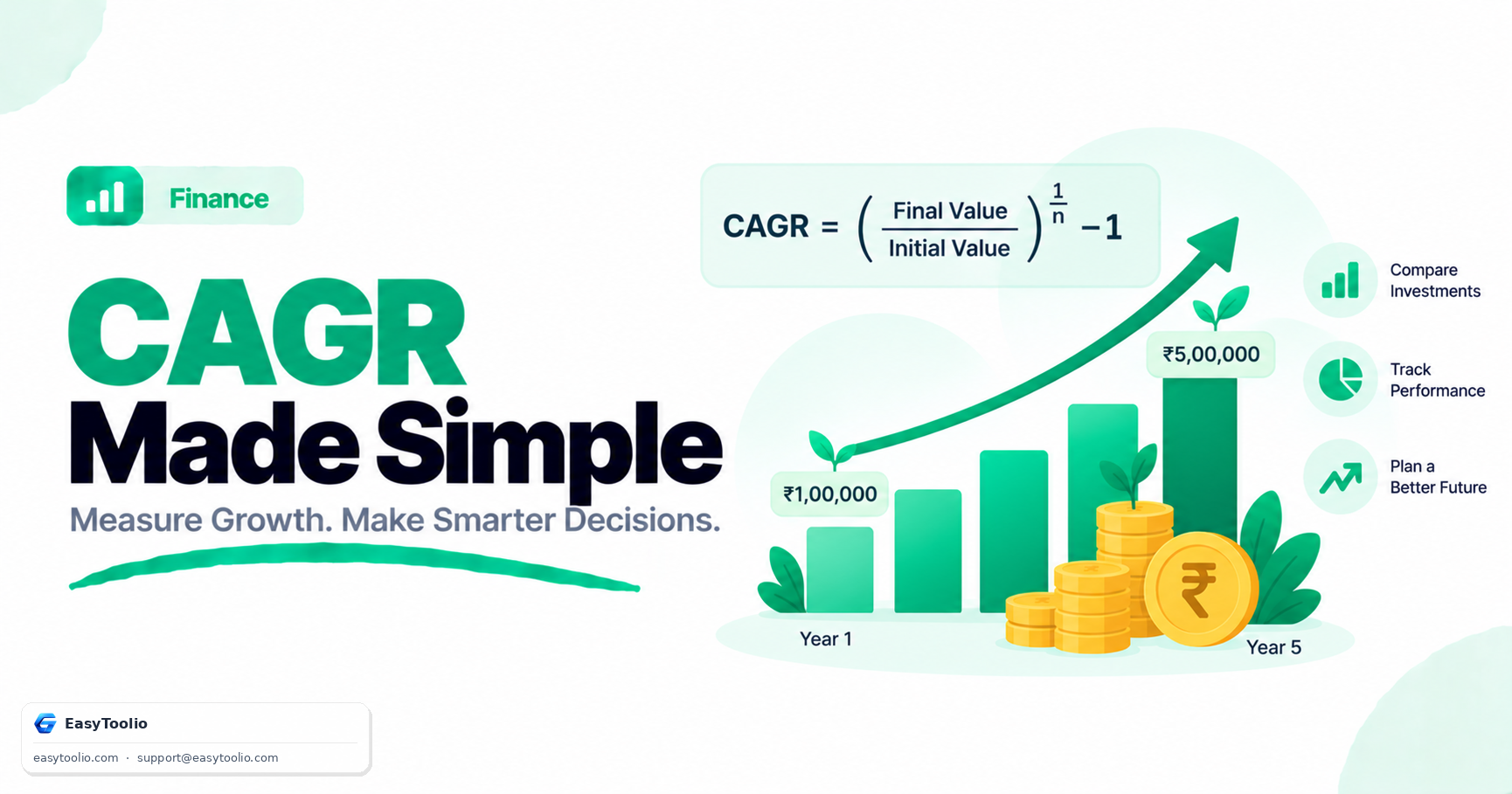
If someone tells you their investment "returned 85% over 5 years," that sounds impressive — but without knowing the annual growth rate, you cannot compare it to any alternative investment or benchmark. That is exactly what CAGR (Compound Annual Growth Rate) solves.
CAGR converts any multi-year return into a single annual percentage — the rate that, if earned consistently each year, would have produced the same total result. It is the most widely used metric in investment analysis, business forecasting, and financial comparison.
The CAGR Formula
CAGR = (Ending Value ÷ Beginning Value)^(1 ÷ Years) − 1
Expressed as a percentage: multiply the result by 100.
Step-by-Step Example
An investment grows from $10,000 to $18,500 over 6 years:
- Step 1: 18,500 ÷ 10,000 = 1.85
- Step 2: 1.85^(1 ÷ 6) = 1.85^0.1667 = 1.1079
- Step 3: 1.1079 − 1 = 0.1079
- CAGR = 10.79% per year
This means the investment grew at an average compounded rate of 10.79% annually — even if individual years varied between −5% and +30%.
CAGR vs Average Annual Return: A Critical Difference
These two calculations often give very different results — and the difference matters enormously.
Example: A $10,000 investment performs as follows over 3 years:
- Year 1: +50% → Portfolio = $15,000
- Year 2: −40% → Portfolio = $9,000
- Year 3: +22% → Portfolio = $10,980
Simple average annual return: (50 − 40 + 22) ÷ 3 = +10.7% per year CAGR: (10,980 ÷ 10,000)^(1/3) − 1 = 3.2% per year
The "average return" of 10.7% looks great. The CAGR of 3.2% tells the true story — the actual compound growth was modest because the large loss in Year 2 disproportionately destroyed value. Losses hurt more than equivalent gains help (because gains must be larger to recover from a loss).
Historical CAGR Benchmarks
These reference CAGRs help you evaluate whether a specific investment has outperformed or underperformed:
| Asset / Index | Approximate CAGR (20-Year) | Notes |
|---|---|---|
| US Inflation (CPI) | ~3.0% | Purchasing power floor |
| 10-Year US Treasury | ~3.5% | "Risk-free" benchmark |
| Gold | ~8.0% | Volatile but positive long-term |
| S&P 500 (with dividends) | ~10.5% | Widely cited equity benchmark |
| Global equity (MSCI World) | ~8.0% | International diversification |
| Real estate (US, average) | ~4.5% | Excludes rental income |
| Bitcoin (2015–2025) | ~90%+ | Extreme volatility, high risk |
Historical returns do not guarantee future results.
Calculating CAGR for Revenue / Business Metrics
CAGR is equally important in business contexts. If a startup's revenue grows from $2M to $18M over 4 years:
CAGR = (18 ÷ 2)^(1/4) − 1 = 9^0.25 − 1 = 1.732 − 1 = 73.2%
A 73.2% revenue CAGR is outstanding and would be the headline figure in any investor pitch.
Common business metrics tracked with CAGR:
- Annual revenue growth
- User/customer base growth
- Market size projections
- Earnings per share (EPS) growth
What CAGR Cannot Tell You
CAGR is a powerful tool with real limitations:
1. It hides volatility. Two investments with identical CAGRs can have completely different risk profiles. One might grow smoothly; the other might swing wildly. CAGR says nothing about the journey, only the destination.
2. It assumes a straight compounding path. In reality, markets do not compound at a fixed rate each year. CAGR is retrospective — it describes what happened, not what will happen.
3. It does not account for contributions or withdrawals. If you add money during the investment period, CAGR on the original principal alone misrepresents your true return. In those cases, use XIRR (Extended Internal Rate of Return).
4. It can be cherry-picked. By choosing a favourable start and end date, any investor or company can show impressive CAGR figures. Always examine the full period and ensure the start and end points are meaningful, not hand-picked.
Using CAGR to Compare Investments
CAGR is most powerful when comparing investments of different sizes and durations:
| Investment | Start Value | End Value | Years | CAGR |
|---|---|---|---|---|
| Property A | $200,000 | $310,000 | 5 yrs | 9.2% |
| Property B | $450,000 | $810,000 | 8 yrs | 7.6% |
| Index fund | $50,000 | $128,000 | 10 yrs | 9.8% |
Despite the different absolute values and time periods, CAGR reveals the index fund delivered the best annualised return.
Calculate Any CAGR Instantly
Use our CAGR Calculator to calculate the compound annual growth rate between any two values over any time period. You can also use the Compound Interest Calculator to project forward — given a starting amount and a target CAGR, see what your investment will be worth in any future year.
This article is for informational purposes. Investment decisions should account for individual risk tolerance, tax implications, and personal financial goals.
Frequently Asked Questions
Q: What is the formula for CAGR? A: CAGR = (Ending Value ÷ Beginning Value)^(1 ÷ Years) − 1, expressed as a percentage. For example, an investment growing from $10,000 to $18,500 over 6 years has a CAGR of 10.79%.
Q: Why is CAGR different from the average annual return? A: Average annual return simply averages each year's percentage gain or loss, which can overstate real performance. In the worked example with returns of +50%, −40%, and +22%, the simple average was 10.7% while the true CAGR was only 3.2%, because a large loss disproportionately reduces compounded value.
Q: What is a good CAGR to compare my investment against? A: It depends on the asset class — the 20-year benchmarks cited include roughly 10.5% for the S&P 500 with dividends, 8.0% for gold and global equities, and about 3.0% for US inflation. Comparing your CAGR to the relevant benchmark shows whether you truly outperformed.