Notification
Go to Home All Tools Compare Glossary Blog Contact

CAGR Calculator

Calculate the Compound Annual Growth Rate (CAGR) of an investment from its starting value, ending value, and holding period.

✓ Embeddable
Calculator Currency Select currency for display metrics
$
$1K $250K $500K+
$
$1K $250K $500K+
Years
1 Year 25 Years 50 Years
How to Use

Instructions

  • Input the initial/starting investment value.
  • Input the final/ending value of the investment.
  • Define the tenure period in years.
  • View the calculated Compound Annual Growth Rate (CAGR) percentage.
Timeline Progression

Growth Schedule Breakdown

Period Starting Balance Annual Growth Ending Value Total Gain
CAGR Analysis Breakdown
Compound Annual Growth Rate (CAGR)

0.00%

Initial Investment $0
Final Ending Value $0
Absolute Growth $0
Total Absolute Return % 0%
Total Duration 0 Years
Annual CAGR Rate 0.00%
Target Comparison

CAGR vs. Benchmark Rate

Compare actual growth against a target return benchmark

%
Actual Ending Value $0
Benchmark Target Value $0
Outperformance Surplus +$0
Purchasing Power

Inflation Impact Analysis

%
Future Face Value $0
Real Value (Inflation Adjusted) $0
Visual Progression

Compounded vs. Linear Growth

Compounded Curve
Linear progress
Investment Metrics Guide

CAGR Calculator – Compound Growth Rate Guide

The Compound Annual Growth Rate (CAGR) measures the geometric mean return of an investment over a multi-year time horizon, assuming profits are reinvested annually.

What is a CAGR Calculator?

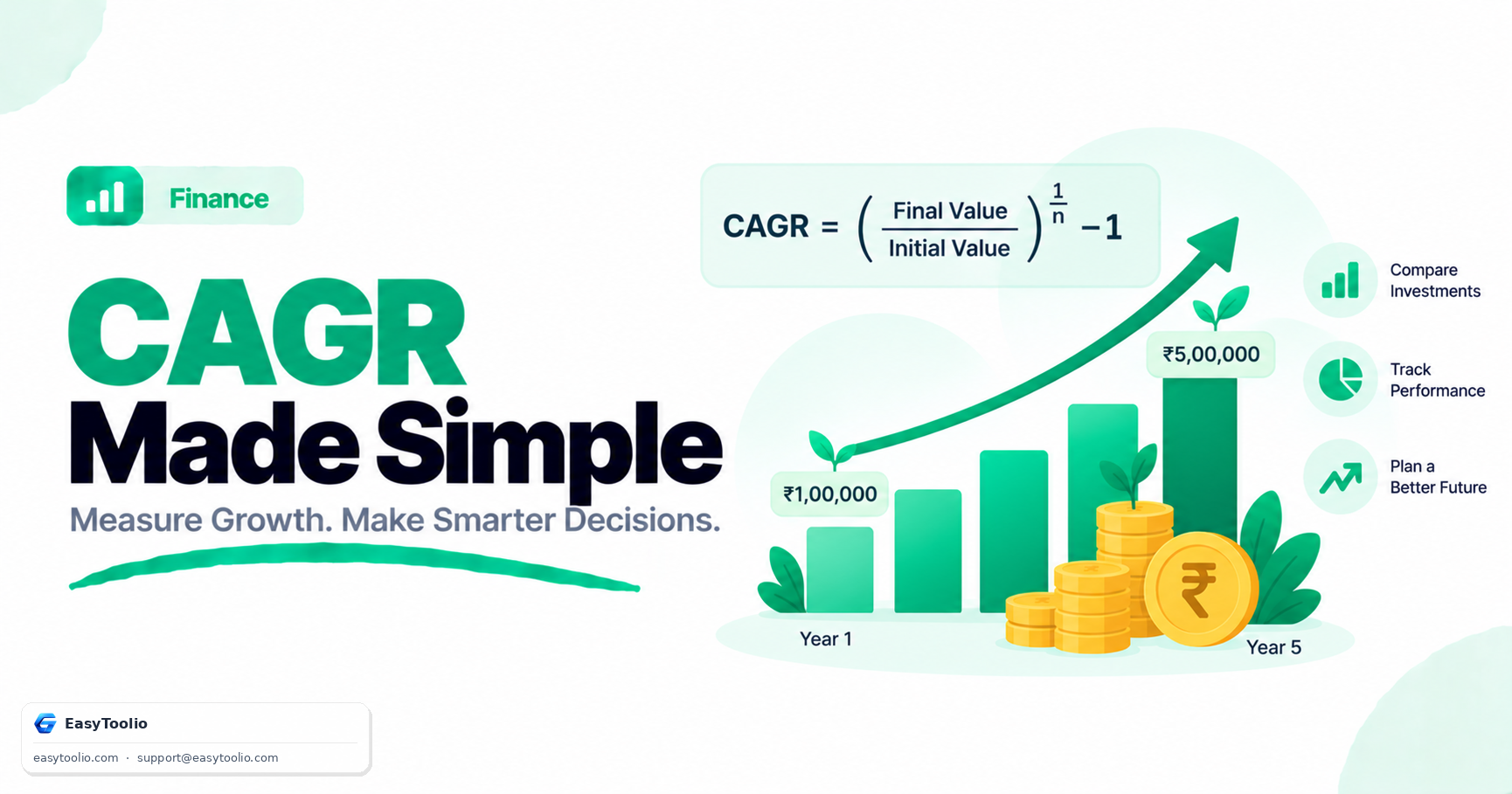
An essential financial tool that calculates annualized investment growth using the formula CAGR = (End Value / Start Value)^(1/n) - 1 across variable time periods.

Key Benefits of Using CAGR

  • Smooths Out Volatility: Provides a single constant annual growth rate despite market fluctuations.
  • Asset Comparison: Easily compare performance between stocks, mutual funds, real estate, and bonds.
  • Benchmark Evaluation: Test if your portfolio beat Nifty 50 or S&P 500 benchmark CAGR.

How CAGR Is Calculated (Live Example)

Calculated for an initial investment of ₹1,00,000 growing to an ending value of ₹2,50,000 over 5 years:

Initial Value ₹1,00,000
Final Value ₹2,50,000
Time Horizon 5 Years
Annualized CAGR 20.11% p.a.
Absolute Profit Gain: ₹2,50,000 − ₹1,00,000 = ₹1,50,000 (+150% Absolute Gain)
CAGR Growth Math: (₹2,50,000 / ₹1,00,000)^(1/5) − 1 = 2.5^0.2 − 1 = 20.11% per annum
Compounding Takeaway: The investment compounded at an equivalent annual rate of 20.11% each year.
Initial Capital: ₹1,00,000 Absolute Gain: ₹1,50,000 (+150%) Annualized CAGR: 20.11%
1

Enter Start & End Values

Input starting principal capital and final current portfolio balance.

2

Set Duration

Select investment duration in years or fractional months.

3

View CAGR & Chart

Review annualized CAGR %, benchmark comparison surplus, and year-by-year growth ledger.

Formula Reference

Lumpsum Mutual Fund Formula

The Lumpsum Mutual Fund Formula calculates the future value of a one-time upfront investment based on compound interest. It models how capital appreciates over time when 100% of th...

$$A = P \times \left(1 + \frac{r}{n}\right)^{n \cdot t}$$
View Full Formula, Step-by-Step Guide & Worked Examples

EasyToolio

Premium Financial Calculator Report

Report: CAGR Analysis

Input parameters

Starting Value: $0
Ending Value: $0
Duration Years: 0 Years

Calculation Results

CAGR Rate: 0.00%
Absolute Growth: $0
Total return %: 0.00%

Growth Progression

Period Starting Value Annual Growth Ending Value Total Gain
EasyToolio Advanced CAGR Financial Arithmetic Platform. No login required.
Investment Analyst

AI Advisor Financial Advisor

Ask AI
Education

Understanding CAGR Growth

01

What CAGR Really Measures

Compound Annual Growth Rate (CAGR) represents the average annual growth rate of an investment over a specific period. It assumes growth occurs at a steady rate, making it easier to compare investments with different performance histories.
02

Why Investors Use CAGR

CAGR helps investors evaluate long-term performance without being distracted by short-term market fluctuations. It provides a single growth rate that summarizes how an investment has performed over multiple years.

03

Comparing Different Investments

CAGR is useful for comparing stocks, mutual funds, business revenue, and other assets over similar time periods. A higher CAGR generally indicates stronger growth, though risk and volatility should also be considered.

04

CAGR Does Not Show Volatility

While CAGR is an excellent measure of long-term growth, it does not reflect yearly ups and downs. Two investments can have the same CAGR while experiencing very different levels of volatility during the investment period.

Good to know

Questions, answered

Quick answers about how this tool works.

CAGR stands for Compound Annual Growth Rate. It measures the average annual growth rate of an investment over a specific period, assuming profits are reinvested and growth occurs at a steady rate.

Average annual return simply averages yearly returns, while CAGR accounts for compounding. CAGR provides a more accurate picture of long-term investment performance by showing the consistent annual growth rate required to reach the ending value.

Yes. If an investment loses value over time, the CAGR will be negative. A negative CAGR indicates that the ending value is lower than the starting value over the measurement period.

A good CAGR depends on the asset type and market conditions. For many long-term stock market investments, a CAGR between 8% and 12% is often considered strong, though actual results can vary significantly.

Yes. CAGR is commonly used to measure growth in revenue, profits, customer base, website traffic, and other business metrics over multiple years. It helps compare growth rates across different periods or companies.

Related Glossary Terms

1 Terms

Popular Tools on EasyToolio

Swipe
Embeddable

Embed this tool

Add CAGR Calculator to a blog, site, or docs page with a free responsive iframe. No signup.

All widgets

What do you need to work out next?

Search 190+ free tools by name, or pick a category below. Every one runs instantly in your browser — no signup, nothing to install.

More Finance tools