New vs Old Tax Regime: Which Saves You More Income Tax in 2026?
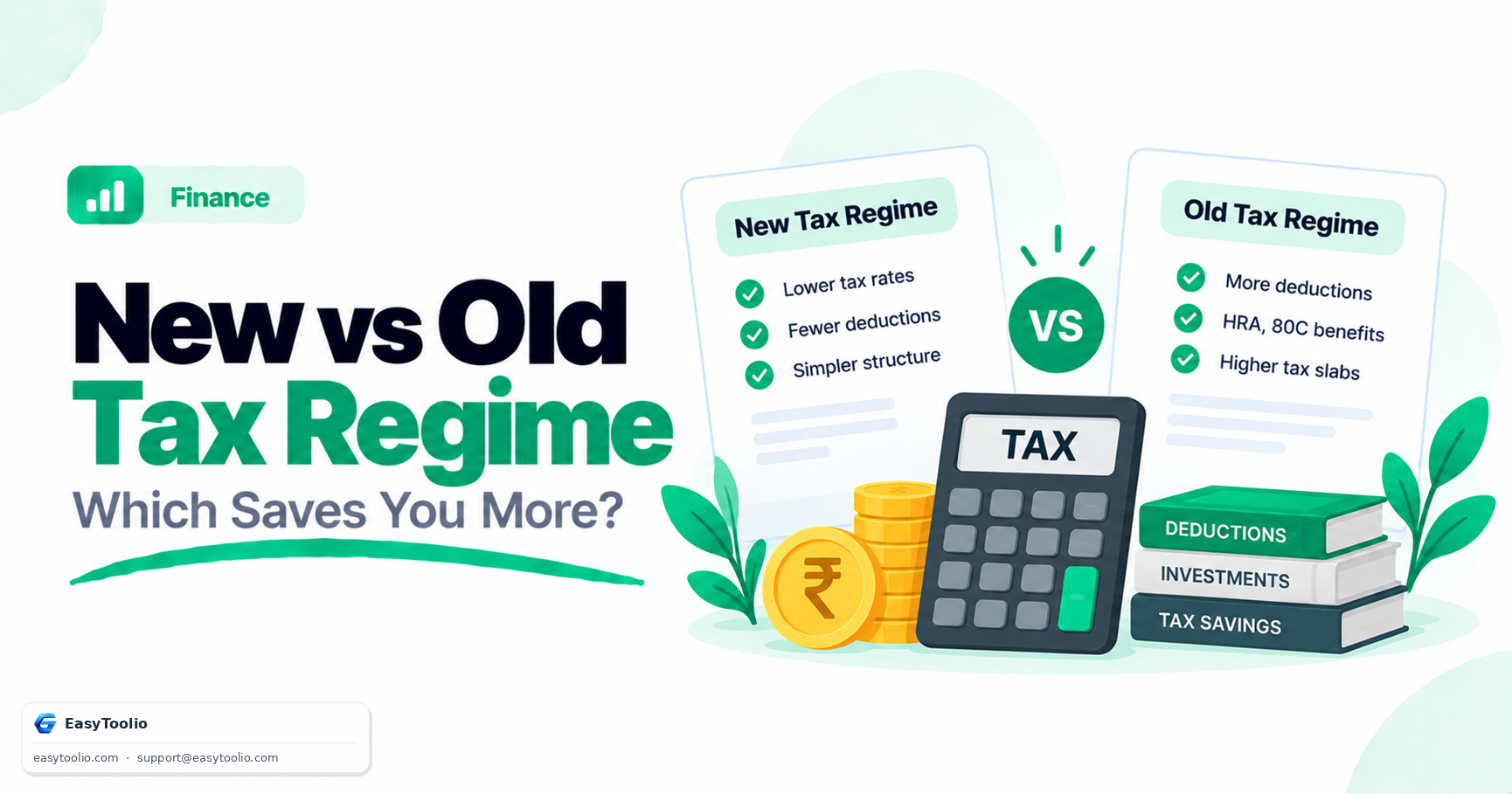
The new regime has lower slab rates but almost no deductions. The old regime taxes you more per slab but rewards HRA, 80C, and home loan interest. Here is how to pick correctly.
Compare income tax outgo under Old Tax Regime (with 80C, HRA, 24b deductions) vs New Tax Regime (lower tax slabs). Find which regime saves you more tax.
Age only affects Old Regime slabs. New Regime slabs are the same for everyone.
Capped at ₹1.5 Lakh (PPF, ELSS, EPF, Life Insurance, etc.)
Capped at ₹1 Lakh (self/family/parents premium)
Capped at ₹2 Lakh (self-occupied property)
No cap applied here — enter your combined HRA exemption, 80TTA/80TTB, 80G, etc.
Based on your inputs, this regime results in a lower tax liability.
The Old Tax Regime is India's original income tax structure, retained as an optional choice alongside the New Regime. It uses wider tax slabs starting at a nil rate up to ₹2.5 Lakh (₹3 Lakh for senior citizens, ₹5 Lakh for super senior citizens), followed by 5%, 20%, and 30% bands.
Its main advantage is the wide range of deductions and exemptions it allows — Section 80C investments (up to ₹1.5 Lakh), Section 80D health insurance premiums, home loan interest under Section 24(b), House Rent Allowance (HRA) exemption, and more. Taxpayers with substantial eligible deductions often find the Old Regime works out cheaper despite its higher headline rates.
The New Tax Regime is the default regime for FY 2025-26 (AY 2026-27). It offers a nil rate up to ₹4 Lakh, then 5%, 10%, 15%, 20%, 25%, and 30% in ₹4 Lakh steps up to ₹24 Lakh and beyond — generally lower rates and wider bands than the Old Regime.
In exchange for the lower rates, it strips away most exemptions and deductions. It still allows the standard deduction for salaried employees (₹75,000) and the employer's NPS contribution under Section 80CCD(2), but not HRA, 80C, 80D, or home loan interest. A generous Section 87A rebate makes net taxable income up to ₹12 Lakh effectively tax-free, with marginal relief just above that threshold.
| Net Income Bracket | Tax Rate |
|---|---|
| Up to ₹2,50,000 | Nil |
| ₹2,50,001 – ₹5,00,000 | 5% |
| ₹5,00,001 – ₹10,00,000 | 20% |
| Above ₹10,00,000 | 30% |
Senior citizens (60-80): Nil up to ₹3L. Super senior citizens (80+): Nil up to ₹5L. 5% and 20%/30% bands otherwise follow the same structure.
| Net Income Bracket | Tax Rate |
|---|---|
| Up to ₹4,00,000 | Nil |
| ₹4,00,001 – ₹8,00,000 | 5% |
| ₹8,00,001 – ₹12,00,000 | 10% |
| ₹12,00,001 – ₹16,00,000 | 15% |
| ₹16,00,001 – ₹20,00,000 | 20% |
| ₹20,00,001 – ₹24,00,000 | 25% |
| Above ₹24,00,000 | 30% |
Same slabs apply to all age groups under the New Regime — age-based exemption only applies under the Old Regime.
Both regimes offer a Section 87A rebate that can bring your tax bill to zero, but the thresholds are very different. Under the Old Regime, the rebate applies only when net taxable income is at or below ₹5,00,000 — cross that line by even ₹1, and you owe tax on the full slab-computed amount with no cushion. Under the New Regime, the threshold is much higher at ₹12,00,000, and it comes with marginal relief to smooth the transition just above that line.
Marginal relief works like this: if your net taxable income is, say, ₹12,05,000 (just ₹5,000 over the threshold), the ordinary slab calculation would produce a base tax of roughly ₹60,750 — an enormous jump for ₹5,000 of extra income. Marginal relief caps the tax so it never exceeds the amount of income over ₹12 Lakh, so the tax here is capped at ₹5,000 (plus 4% cess, ₹5,200 total) instead of the full ₹60,750 (plus cess). The Old Regime has no equivalent provision above its ₹5 Lakh threshold.
The New Regime is built around fewer exemptions in exchange for lower rates, but it does not remove every benefit. Salaried employees still get the flat standard deduction (₹75,000), and an employer's contribution to your NPS account under Section 80CCD(2) remains deductible in both regimes — since it is treated as a business expense for the employer rather than a personal tax-saving deduction.
Most other common deductions and exemptions do not carry over: Section 80C investments (PPF, ELSS, life insurance, EPF, home loan principal), Section 80D health insurance premiums, HRA exemption, and home loan interest under Section 24(b) on a self-occupied property are all unavailable under the New Regime. This is why taxpayers who rely heavily on these deductions need to run the numbers before assuming the New Regime's lower rates automatically mean lower tax.
The Old Regime tends to come out ahead once your total eligible deductions become large relative to your income. Common situations include: a substantial HRA claim from paying high rent in a metro city, significant home loan interest on a self-occupied property (up to the ₹2 Lakh cap under Section 24b), and maxed-out Section 80C (₹1.5 Lakh) plus Section 80D (up to ₹1 Lakh) investments and premiums.
When several of these apply simultaneously, total deductions can easily cross ₹4-5 Lakh a year, which is often enough to offset the New Regime's lower slab rates and higher rebate threshold. See the "Real-World Examples" section below for a worked calculation showing exactly this scenario.
Salaried individuals with no business or professional income generally have the flexibility to choose between the Old and New Regime each financial year when filing their return — you are not locked into whichever regime you picked previously, and can re-evaluate annually as your income, investments, HRA, or home loan situation changes.
Taxpayers with business or professional income face more restricted switching rules and should confirm the current provisions with a tax advisor or the Income Tax Department before assuming they can switch as freely as salaried taxpayers.
There is no single answer — it depends entirely on how much you can legitimately claim in deductions relative to your income. Use the calculator above to check your own numbers.
Priya is a salaried employee earning a gross annual salary of ₹12,00,000. She invests ₹1,50,000 under Section 80C and pays ₹25,000 in health insurance premiums (Section 80D), with no home loan.
New Regime: ₹12,00,000 − ₹75,000 standard deduction = ₹11,25,000 net income. This is below the ₹12 Lakh rebate threshold, so the entire base tax is rebated under Section 87A. Final tax = ₹0.
Old Regime: ₹12,00,000 − ₹50,000 standard deduction − ₹1,50,000 (80C) − ₹25,000 (80D) = ₹9,75,000 net income. Tax works out to ₹12,500 (5% slab) + ₹95,000 (20% slab) = ₹1,07,500, plus 4% cess (₹4,300) = ₹1,11,800.
Result: Priya saves ₹1,11,800 by choosing the New Regime, purely because her net income falls under the ₹12 Lakh rebate threshold.
Arjun earns a gross salary of ₹16,00,000. He pays rent and a home loan, claiming ₹1,50,000 (80C), ₹50,000 (80D), ₹2,00,000 home loan interest (Section 24b), and a further ₹3,00,000 in combined HRA exemption and other deductions.
New Regime: ₹16,00,000 − ₹75,000 standard deduction = ₹15,25,000 net income. Tax is ₹20,000 (5%) + ₹40,000 (10%) + ₹48,750 (15% on the remaining ₹3,25,000) = ₹1,08,750, plus 4% cess (₹4,350) = ₹1,13,100.
Old Regime: ₹16,00,000 − ₹50,000 standard deduction − ₹1,50,000 − ₹50,000 − ₹2,00,000 − ₹3,00,000 = ₹8,50,000 net income. Tax is ₹12,500 (5%) + ₹70,000 (20% on ₹3,50,000) = ₹82,500, plus 4% cess (₹3,300) = ₹85,800.
Result: Arjun saves ₹27,300 by choosing the Old Regime, because his large HRA, home loan interest, and maxed-out 80C/80D deductions outweigh the New Regime's lower slab rates.

Common questions about choosing between the Old and New Income Tax Regime.
The New Tax Regime is currently the default regime. If you do not explicitly opt for the Old Regime while filing your return (where eligible), your tax will be computed under the New Regime automatically.
Taxpayers with significant deductions — a large HRA claim, home loan interest under Section 24(b), substantial Section 80C investments (PPF, ELSS, life insurance), and health insurance premiums under 80D — often end up paying less tax under the Old Regime despite its higher slab rates.
Taxpayers with few or no deductions — for example, those without a home loan, minimal 80C investments, and no HRA claim — usually pay less tax under the New Regime because of its lower slab rates and higher rebate threshold, even without claiming any exemptions.
Salaried individuals without business income can choose between the Old and New Regime each financial year when filing their return. Those with business or professional income have more restricted switching rules, so it is worth checking current rules if that applies to you.
Under the New Regime, tax is effectively reduced to zero for net taxable income up to ₹12,00,000, with marginal relief tapering the benefit just above that threshold. Under the Old Regime, the rebate only brings tax to zero for net taxable income up to ₹5,00,000, with no marginal relief above it.
The New Regime still allows a few benefits, including the standard deduction for salaried employees and employer contributions to NPS under Section 80CCD(2), but it excludes most other common deductions like Section 80C, 80D, HRA exemption, and home loan interest under Section 24(b).
For salaried taxpayers, the standard deduction is a flat amount subtracted from gross salary before tax is calculated, and it differs between the two regimes — the New Regime's standard deduction is higher than the Old Regime's, which partly offsets the loss of other deductions.
Dig deeper into your specific tax situation with these focused tools.
Full detailed calculator with surcharge, HRA sub-calculator, and complete deduction breakdown.
Work out your exact HRA exemption to plug into the Old Regime.
See your actual monthly take-home after tax and deductions.
Browse the full library of side-by-side financial comparison tools.
Compare secured Car Loans against unsecured Personal Loans. Analyze interest rates, EMIs, processing fees, and total repayment costs.
Compare two loan options side-by-side. Evaluate EMI amounts, total interest payable, and total cost to choose the most cost-effective loan.
Compare two Fixed Deposit plans to find the best returns. Analyze different interest rates, compounding frequencies, and tenure options.
Plain-language explainers that sit next to this tool.
The new regime has lower slab rates but almost no deductions. The old regime taxes you more per slab but rewards HRA, 80C, and home loan interest. Here is how to pick correctly.
HRA can shield a big chunk of your salary from tax — but only if you calculate it correctly and keep the old regime. Here is the exact formula, with worked numbers.
A ₹12 LPA offer rarely means ₹1 lakh a month in your account. Here is exactly where the difference between CTC and in-hand salary goes, with a full breakdown table.
Whether you are comparing a job offer, negotiating pay, or calculating contractor rates, converting between hourly and annual salary is a daily financial need. This guide covers the exact formulas, common mistakes, and a gross-to-net overview for budgeting.
Search 190+ free tools by name, or pick a category below. Every one runs instantly in your browser — no signup, nothing to install.
Tap a star to rate us instantly.