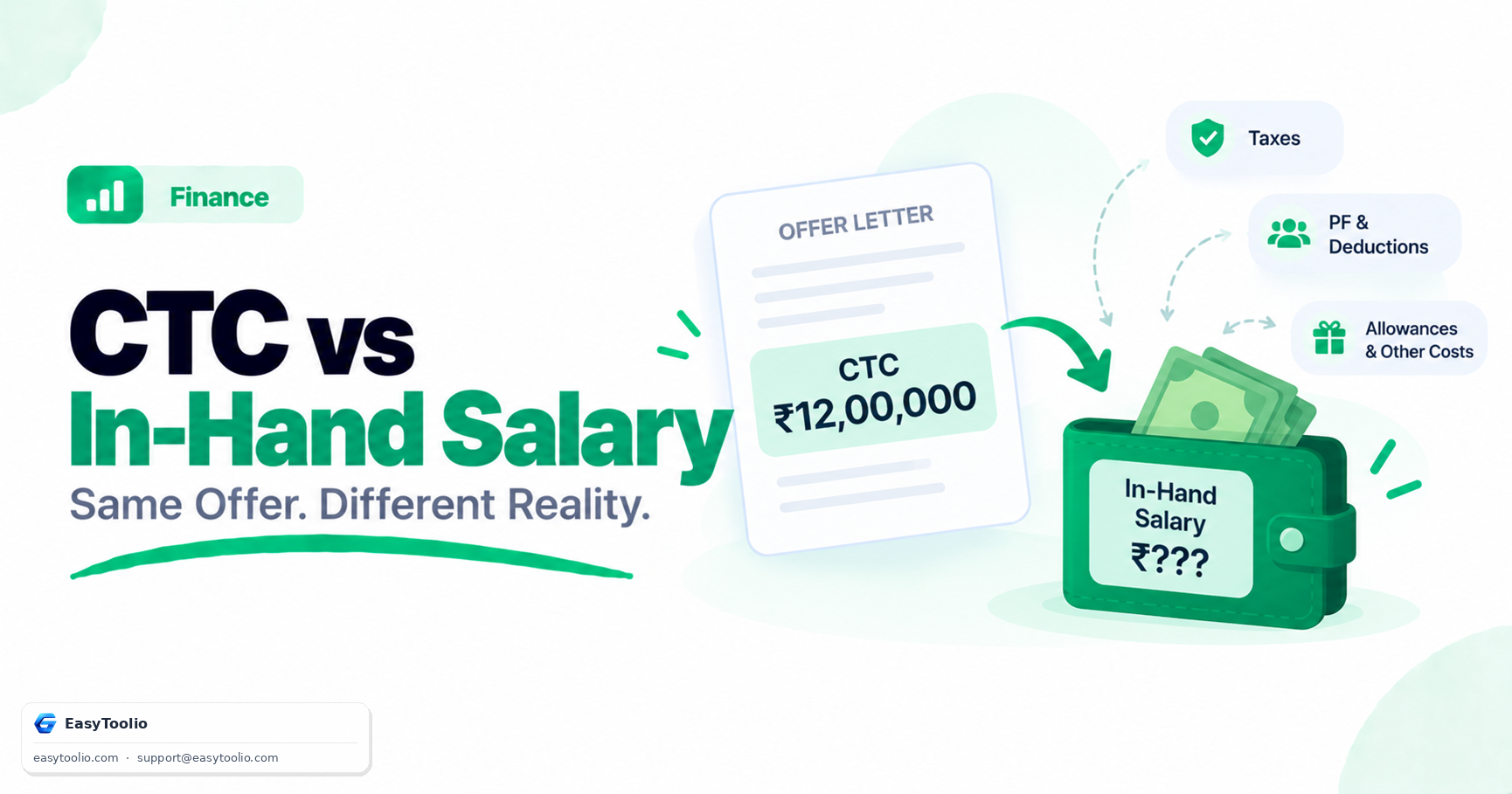
"₹12 LPA" sounds like ₹1,00,000 a month. In reality, most employees at that CTC see somewhere between ₹80,000 and ₹90,000 land in their bank account each month — and the gap confuses almost everyone who's ever compared two job offers. Understanding exactly where that difference goes is one of the most useful things you can learn before negotiating or accepting an offer.
What CTC Actually Includes
Cost to Company (CTC) is the total amount your employer spends on you annually — and it includes far more than what shows up as monthly cash in your account. A typical CTC structure includes:
- Basic salary — usually 35–50% of CTC
- House Rent Allowance (HRA) — commonly 40–50% of basic
- Special allowance — a balancing figure that fills the gap to reach the total CTC
- Employer's EPF contribution — 12% of basic salary, paid by the company into your EPF account (this is part of CTC but you don't receive it as cash each month)
- Gratuity provision — typically estimated at ~4.81% of basic salary per year, set aside for a benefit you'd only receive after 5 years of service (or on exit)
- Insurance premiums — employer-paid group health/accident insurance premiums, a real cost to the company but not cash to you
- Other perquisites — meal cards, telephone reimbursement, LTA, and similar benefits, some taxable and some not
Several of these components — employer PF, gratuity provision, insurance premiums — never appear in your monthly bank credit. They either accrue for years before you can access them, or they're a cost the company bears without any cash changing hands to you at all.
Full Breakdown: A Sample ₹12 LPA Package
Here's how a ₹12,00,000 annual CTC package might realistically break down:
| Component | Annual | Monthly |
|---|---|---|
| Basic salary | ₹4,80,000 | ₹40,000 |
| HRA | ₹2,40,000 | ₹20,000 |
| Special allowance | ₹3,84,312 | ₹32,026 |
| Employer PF contribution | ₹57,600 | ₹4,800 |
| Gratuity provision | ₹23,088 | ₹1,924 |
| Employer-paid insurance | ₹15,000 | ₹1,250 |
| Total CTC | ₹12,00,000 | ₹1,00,000 |
What Actually Reaches Your Payslip as Gross Pay
Only Basic + HRA + Special Allowance count as your gross monthly cash salary: ₹40,000 + ₹20,000 + ₹32,026 = ₹92,026/month (₹11,04,312/year). Employer PF, gratuity provision, and insurance premiums — worth ₹95,688/year combined — never show up in this figure at all.
Deductions From Gross Pay to Reach In-Hand Salary
| Deduction | Approximate Monthly Amount |
|---|---|
| Employee PF contribution (12% of basic) | ₹4,800 |
| Professional tax (varies by state) | ₹200 |
| TDS (income tax, new regime, after standard deduction) | ₹3,700 |
| Total deductions | ≈₹8,700 |
Final In-Hand Salary
₹92,026 (gross) − ₹8,700 (deductions) ≈ ₹83,300/month, or roughly ₹9,99,600/year — about 17% lower than the ₹12,00,000 CTC figure on the offer letter.
Why Two Offers With the Same CTC Can Pay Very Differently
This is where CTC becomes genuinely misleading if you don't check the structure. Two ₹12 LPA offers can have very different real take-home pay:
- Offer A: Higher fixed cash component (basic + HRA + special allowance), lower employer PF/gratuity provision, minimal perks → higher monthly in-hand salary
- Offer B: Lower fixed cash component, but padded with a large employer PF match, higher gratuity provision, expensive insurance add-ons, or a variable/bonus component bundled into "CTC" → lower monthly in-hand salary, even though the CTC number on paper looks identical
Employers sometimes also fold joining bonuses, ESOPs, or performance bonus targets into the advertised CTC figure — inflating the headline number well beyond what you're guaranteed to actually receive.
How to Quickly Estimate Real Take-Home Pay Before Accepting an Offer
- Ask for the fixed-pay breakup, not just the CTC number — specifically the basic salary, HRA, and any allowances that make up guaranteed monthly cash.
- Subtract employer PF and gratuity provision from CTC to estimate your actual gross annual cash salary — this alone typically closes 8–10% of the CTC-to-in-hand gap.
- Subtract employee PF (12% of basic) and estimated professional tax (a few hundred rupees a month depending on your state) from that gross figure.
- Estimate TDS using the current tax regime slabs on your gross taxable salary after standard deduction — this is usually the single largest deduction after PF.
- Ignore variable pay, joining bonuses, and ESOPs when comparing offers on a monthly cash-flow basis — treat them as bonus upside, not guaranteed income.
Rather than doing this arithmetic manually for every offer, run the numbers instantly through the In-Hand Salary Calculator, or use the Salary Calculator to convert between CTC, gross, and net pay under either tax regime.
Frequently Asked Questions
Q: Why is my in-hand salary lower than my CTC even though I have no loans or big deductions? A: CTC includes components that never reach your bank account each month — employer's EPF contribution, gratuity provision, and insurance premiums — plus your own EPF deduction, professional tax, and TDS are subtracted from your gross cash salary. On a typical ₹12 LPA package, this combination alone can reduce in-hand pay by roughly 15–20% below the CTC figure.
Q: Can two job offers with the identical CTC have different take-home pay? A: Yes. If one offer allocates more of the CTC to fixed cash (basic, HRA, special allowance) and the other allocates more to employer PF, gratuity provision, insurance, or bundled bonuses/ESOPs, the two can differ significantly in actual monthly in-hand salary despite an identical headline CTC number.
Q: What is the fastest way to estimate my real take-home pay from an offer letter? A: Ask for the fixed cash breakup (basic + HRA + allowances), subtract employer PF and gratuity provision to get your true gross cash salary, then subtract your own PF contribution, professional tax, and estimated TDS. Running these numbers through the In-Hand Salary Calculator gives an instant, accurate estimate without manual calculation.