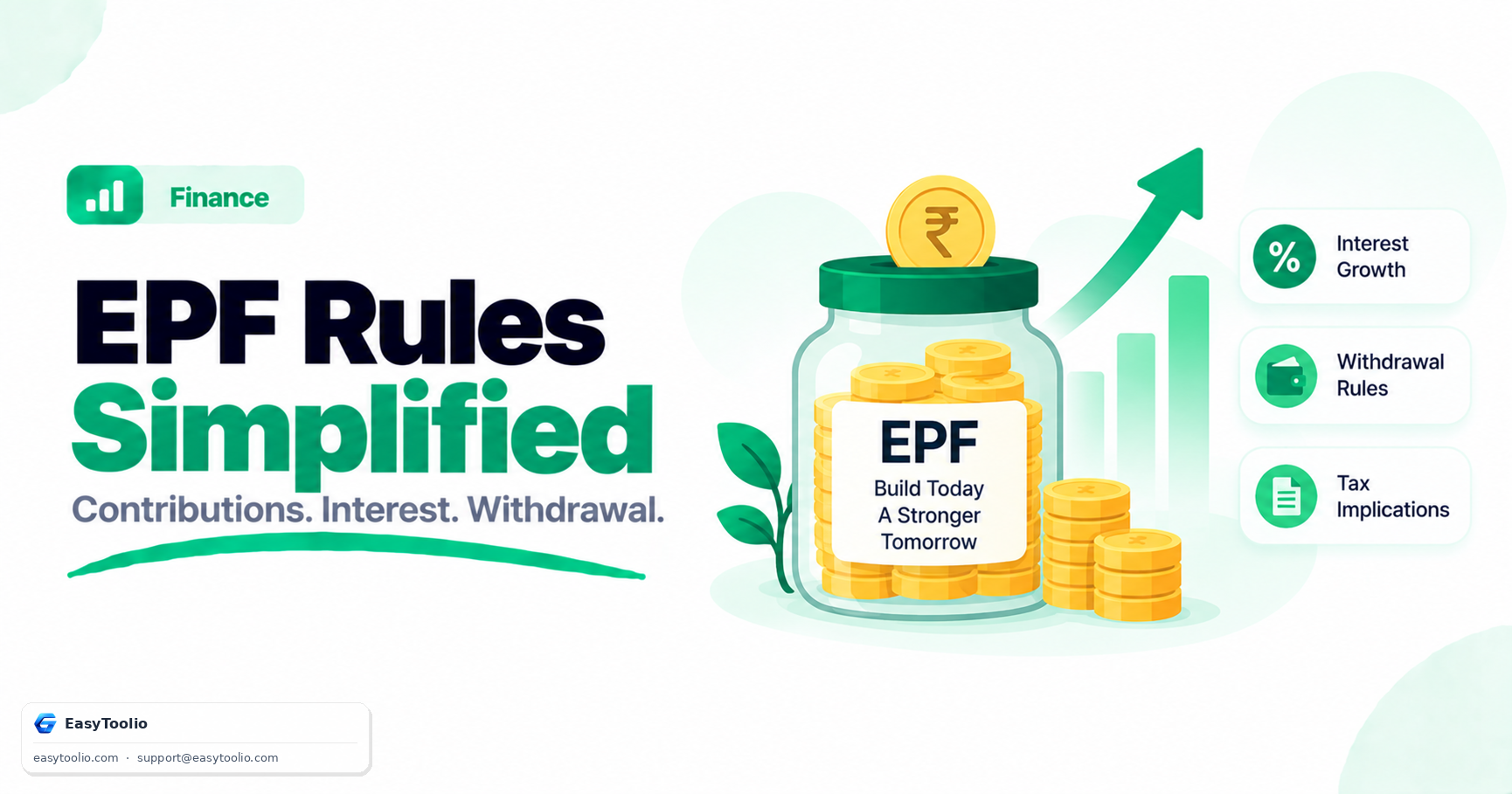
Every salaried employee in India watches 12% of their basic salary disappear into EPF every month — but few understand how that money actually grows, when they can withdraw it tax-free, and what happens to it when they change jobs. Given that EPF often becomes one of the largest components of a salaried employee's retirement corpus, it's worth understanding properly.
How EPF Contributions Actually Work
Under the Employees' Provident Fund scheme, both you and your employer contribute:
- Employee contribution: 12% of basic salary + dearness allowance, deducted from your salary and credited fully to your EPF account
- Employer contribution: Also 12% of basic + DA, but this is split — 8.33% goes to the Employees' Pension Scheme (EPS), capped at a wage ceiling of ₹15,000/month (so EPS contribution is capped at roughly ₹1,250/month), and the remaining amount goes into your EPF account
This means your EPF account actually grows from your full 12% contribution plus whatever portion of the employer's 12% doesn't go to EPS — typically around 3.67% of basic salary once the EPS cap kicks in for higher earners.
Current EPF Interest Rate and How It's Credited
The EPFO declares an interest rate annually, and it has hovered in the 8.1%–8.25% range in recent years. Interest is computed monthly on the running balance but credited to your account only once a year, at the end of the financial year. This is why your EPF passbook may show a "0" interest figure for most of the year and a lump-sum interest credit appearing later.
Because EPF interest is compounded annually and is fully tax-free (as long as withdrawal rules are respected), it functions as one of the most reliable long-term compounding instruments available to salaried Indians.
Full vs Partial Withdrawal Rules
The 5-Year Continuous Service Rule
The single most important EPF rule: if you withdraw your EPF balance after 5 years of continuous service, the withdrawal is completely tax-free. "Continuous service" includes time with previous employers if your EPF was transferred via UAN rather than withdrawn — the 5-year clock doesn't reset with every job change, as long as you transfer instead of withdrawing.
Exceptions That Allow Tax-Free Withdrawal Before 5 Years
- Medical treatment for self or family (serious illness) — no minimum service period required
- Home purchase or construction — allowed after a shorter minimum service period, with limits on how much can be withdrawn
- Higher education for self or children — after a minimum service period
- Marriage of self, children, or siblings — after a minimum service period
- Termination due to ill health, discontinuation of employer's business, or other reasons beyond the employee's control
Full vs Partial Withdrawal
- Partial withdrawal: Allowed for specific purposes above without leaving your job, subject to caps (e.g., a percentage of your own contribution with interest)
- Full withdrawal: Allowed after 2 months of continuous unemployment, or at retirement (58 years for pension purposes, though EPF withdrawal itself can happen earlier under certain conditions)
How Premature EPF Withdrawal Is Taxed
If you withdraw your EPF balance before completing 5 years of continuous service (and don't fall under an exception), the withdrawal becomes taxable:
- Employee's own contribution: If you had claimed it as a Section 80C deduction in earlier years, that deduction gets reversed and added back to your taxable income in the year of withdrawal
- Employer's contribution + interest on it: Taxed as "Income from Salary"
- Interest on your own contribution: Taxed as "Income from Other Sources"
- TDS: Deducted at 10% if PAN is furnished and the withdrawal exceeds ₹50,000, or at the maximum marginal rate (roughly 34.6% for AY purposes) if PAN is not furnished
This is a meaningful tax hit, which is exactly why the EPFO and tax law nudge you toward transferring your PF rather than withdrawing when you switch jobs.
What Happens to EPF When You Switch Jobs
| Action | Effect on 5-Year Clock | Tax Treatment |
|---|---|---|
| Transfer via UAN to new employer's EPF account | Continuous service preserved — clock keeps running | No tax impact; interest continues tax-free |
| Withdraw on leaving the job | Clock resets; if under 5 years total, withdrawal is taxable | TDS may apply as described above |
Since your Universal Account Number (UAN) stays the same for life regardless of employer, transferring is usually a simple online process through the EPFO member portal, and it is almost always the better financial decision compared to withdrawing.
Worked Example: EPF Growth Over a 30-Year Career
Assume a 25-year-old starts with a basic salary of ₹30,000/month, receives an 8% annual increment, and both employee and (non-EPS-capped portion of) employer contributions grow accordingly, compounding at an assumed 8.25% average EPF interest rate:
| Career Stage | Approximate Basic Salary | Approximate EPF Corpus |
|---|---|---|
| Year 5 | ₹44,000/month | ₹3.8 lakh |
| Year 10 | ₹65,000/month | ₹11.2 lakh |
| Year 20 | ₹1,40,000/month | ₹52 lakh |
| Year 30 | ₹3,02,000/month | ₹1.68 crore |
These figures are illustrative and will vary with actual salary growth, the EPS cap, and the year-to-year interest rate, but they show why EPF — often dismissed as "just a mandatory deduction" — can realistically become a retirement corpus in the crore range over a full career, entirely through compounding.
Model Your Own EPF Growth
Use the EPF Calculator to project your own corpus based on your actual basic salary, expected increments, and years to retirement. Since gratuity is another employer-funded retirement benefit that compounds alongside your EPF, it's worth checking the Gratuity Calculator too, to see your full retirement benefit picture rather than EPF alone.
Frequently Asked Questions
Q: Is EPF withdrawal always tax-free? A: Only if you withdraw after 5 years of continuous service (which can include time with previous employers if transferred via UAN), or under specific exceptions like serious medical treatment. Withdrawal before that, without an exception, triggers tax on the employer's contribution, reversal of your 80C deduction, and TDS.
Q: Should I withdraw my EPF or transfer it when I change jobs? A: Transferring via your UAN is almost always the better choice, since it preserves your continuous service clock for the 5-year tax-free withdrawal rule and keeps your interest compounding without any tax event. Withdrawing resets that clock and can create an avoidable tax liability.
Q: What is the current EPF interest rate and how is it credited? A: EPF interest has recently been in the 8.1%–8.25% range, declared annually by the EPFO. It is computed monthly on your running balance but credited to your account only once a year at financial year-end, which is why your passbook often shows the interest as a single annual lump sum.