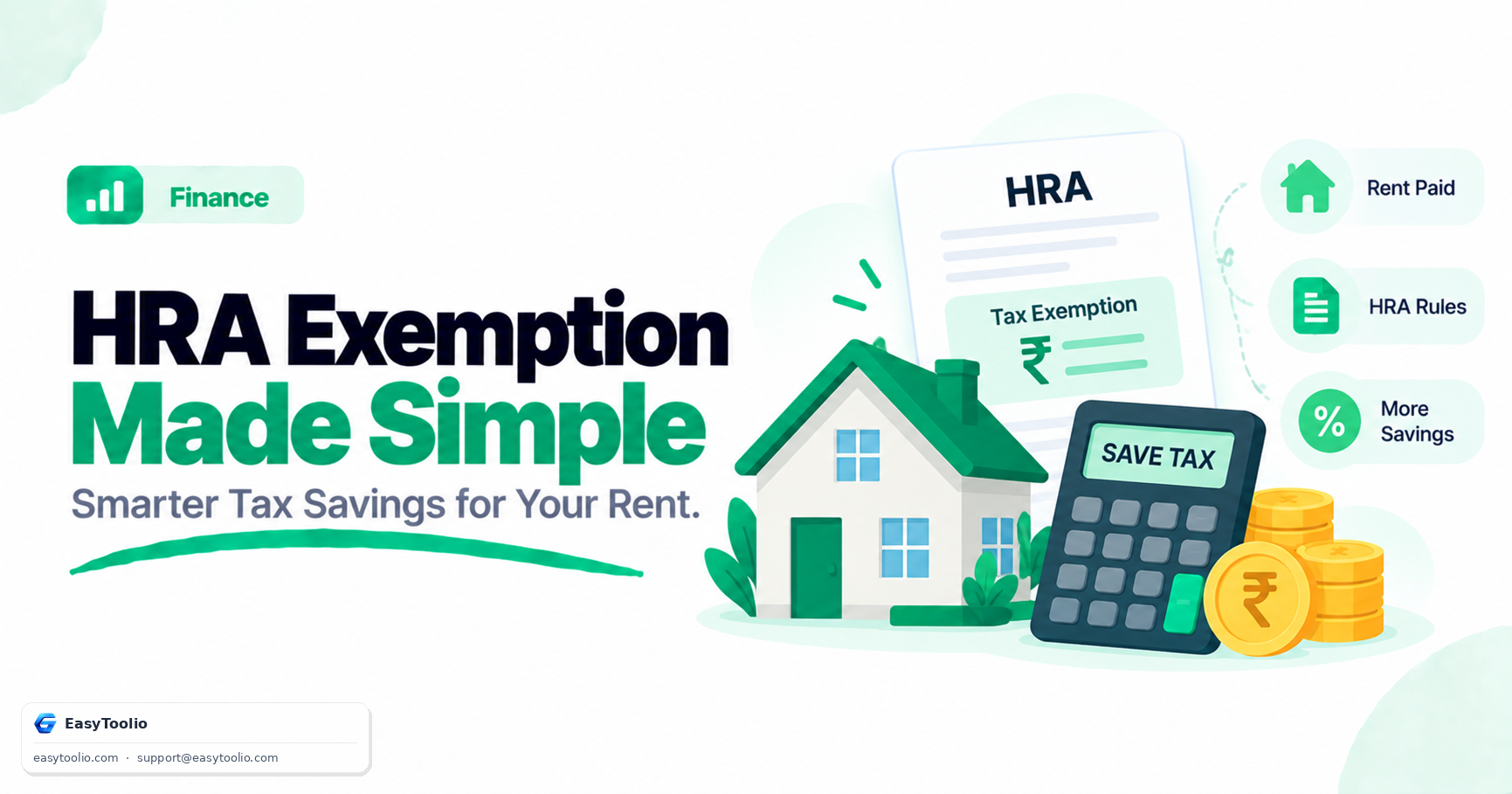
Every salaried employee with a House Rent Allowance component sees a line on their payslip that quietly reduces their tax bill — if they claim it correctly. HRA exemption is one of the largest tax breaks available to salaried Indians, yet a surprising number of people either under-claim it out of confusion or over-claim it and get caught during an income tax scrutiny.
This guide walks through exactly how HRA exemption is calculated under Section 10(13A), with real salary numbers, so you can claim precisely what you're entitled to — no more, no less.
What Is HRA Exemption Under Section 10(13A)?
House Rent Allowance (HRA) is a salary component most employers pay to help cover an employee's rent. Under Section 10(13A) of the Income Tax Act, read with Rule 2A, a portion of the HRA you receive is exempt from tax if you actually live in rented accommodation and pay rent for it.
The exemption is not automatically the full HRA amount you receive — it is the lowest of three specific values, calculated using your basic salary, actual rent paid, and the city you live in.
Use the HRA Exemption Calculator to get this number instantly once you understand the formula below.
The Exact 3-Way Formula
HRA exemption = minimum of the following three amounts:
- Actual HRA received from your employer during the year
- Rent paid minus 10% of basic salary (basic + dearness allowance, if DA is part of retirement benefits)
- 50% of basic salary if you live in a metro city (Delhi, Mumbai, Kolkata, Chennai), or 40% of basic salary for any other (non-metro) city
Whichever of these three figures is the smallest becomes your tax-exempt HRA. The remaining HRA you received is added back to your taxable salary.
Worked Example: A Bengaluru-Based Employee
Let's take a salaried employee working in Bengaluru (a non-metro city for this rule, even though it's a major IT hub) with:
- Basic salary: ₹50,000/month → ₹6,00,000/year
- HRA received: ₹25,000/month → ₹3,00,000/year
- Actual rent paid: ₹22,000/month → ₹2,64,000/year
| Component | Calculation | Annual Value |
|---|---|---|
| 1. Actual HRA received | ₹25,000 × 12 | ₹3,00,000 |
| 2. Rent paid − 10% of basic | ₹2,64,000 − (10% of ₹6,00,000 = ₹60,000) | ₹2,04,000 |
| 3. 40% of basic (non-metro) | 40% × ₹6,00,000 | ₹2,40,000 |
| Exempt HRA (lowest of the three) | ₹2,04,000 |
Here, ₹2,04,000 is exempt from tax, and the remaining ₹96,000 (₹3,00,000 − ₹2,04,000) gets added to taxable salary as "HRA taxable component."
Now compare the same employee in a metro city (say Mumbai) with the same figures — the 50% metro rate applies instead of 40%, giving a metro cap of ₹3,00,000, so the exemption would still be capped at ₹2,04,000 in this case since rule 2 is the binding constraint. Metro status only helps when rent is high relative to basic salary.
HRA Exemption Only Works Under the Old Tax Regime
This is the single most important thing to understand: HRA exemption under Section 10(13A) is available only if you opt for the old tax regime. The new tax regime (the current default regime for most taxpayers) does away with almost all exemptions and deductions, including HRA, in exchange for lower slab rates.
If your employer auto-applies the new regime for TDS purposes and you actually pay significant rent, you may be losing out on a meaningful exemption. You need to actively inform your employer (or claim it while filing your ITR) to use the old regime and claim HRA.
Documentation You Need
To claim HRA exemption safely and defend it if questioned, keep:
- Rent receipts for each month, signed by the landlord, ideally with a revenue stamp for cash payments above ₹5,000/month
- A signed rental agreement stating the monthly rent and tenancy period
- PAN of the landlord — mandatory if annual rent paid exceeds ₹1,00,000 (i.e., roughly ₹8,334/month or more). If the landlord doesn't have a PAN, a declaration from them is required instead.
- Bank transfer proof (NEFT/UPI/cheque) is far safer than cash payments, since it creates an audit trail
Common Mistakes That Get HRA Claims Rejected
-
Claiming HRA while living in a self-owned house. HRA exemption requires you to actually pay rent for the accommodation you live in. If you own the house you live in, HRA exemption cannot be claimed at all — regardless of how much HRA your employer pays you.
-
Paying "rent" to a spouse. The Income Tax Department has repeatedly disallowed HRA claims where rent is shown as paid to a spouse, since a genuine landlord-tenant relationship typically doesn't exist within a marriage, and the arrangement is viewed as a device to reduce tax rather than a real transaction. Paying rent to parents, on the other hand, is generally accepted if the property is genuinely owned by them and the arrangement is properly documented (with rent actually transferred and reported as rental income by the parent).
-
No supporting documents for cash rent. If you're ever asked to justify an HRA claim during scrutiny and can produce no bank trail, no signed receipts, and no agreement, the exemption is very likely to be disallowed and can trigger a tax demand with interest.
-
Forgetting the landlord's PAN threshold. Employees who pay more than ₹1 lakh a year in rent but don't submit the landlord's PAN to their employer often find their HRA exemption denied at the payroll stage, forcing them to claim it later directly in their ITR instead.
Quick Reference Table
| City Type | Examples | HRA Exemption Ceiling (Rule 3) |
|---|---|---|
| Metro | Delhi, Mumbai, Kolkata, Chennai | 50% of basic salary |
| Non-metro | Bengaluru, Pune, Hyderabad, Ahmedabad, all other cities | 40% of basic salary |
Run your own numbers through the HRA Exemption Calculator and then check the overall tax impact with the Income Tax Calculator to see how the exemption changes your final tax outgo under the old regime.
Frequently Asked Questions
Q: Can I claim HRA exemption if I live in a self-owned house? A: No. HRA exemption under Section 10(13A) requires you to actually pay rent for accommodation you live in; if you own the house you reside in, the exemption cannot be claimed even if HRA appears in your salary structure.
Q: Is HRA exemption available under the new tax regime? A: No, HRA exemption is available only under the old tax regime. The new tax regime removes most exemptions and deductions, including HRA, in exchange for lower slab rates, so you must actively opt for the old regime to claim it.
Q: When is landlord's PAN mandatory for an HRA claim? A: Landlord PAN becomes mandatory when your annual rent paid exceeds ₹1,00,000 (about ₹8,334 a month or more). Without it, your employer may deny the exemption at payroll, though you can still claim it later while filing your ITR with proper documentation.