Notification
Go to Home All Tools Compare Glossary Blog Contact
Be the first to rate
Embeddable
Financial Year 2025-26 Planner

Income Tax Calculator.

Calculate your tax liability under the Old and New tax slabs for FY 2025-26 (AY 2026-27). Plan your deductions, check Section 87A rebates, HRA exemptions, and marginal relief.

Taxpayer Profile

Age Group Bracket
Are you a Salaried Employee? Automatically applies Standard Deduction (₹75k New, ₹50k Old)

Income Sources

₹0 ₹25L ₹50L ₹75L ₹1Cr
₹0 ₹5L ₹10L ₹15L ₹20L

Deductions & Exemptions (Old Regime Only)

Use Interactive HRA Calculator? Enable to calculate HRA Exemption based on rent & basic salary
(Max ₹1.5L)
Includes PPF, ELSS Mutual Funds, Life Insurance, EPF, Home Loan Principal, National Savings Certificate (NSC)
(Max ₹1L)
Premium paid for medical health policies (Self/Family/Parents)
(Max ₹2L)
(Max ₹10k)
Formula Reference

Income Tax Formula

$$\text{Net Taxable Income} = \text{Gross Income} - \text{Deductions}$$ $$\text{Total Tax} = \text{Slab Tax} - \text{Rebate} + \text{Cess\ (4\%)}$$
Gross Income Total income from Salary, House Property, Capital Gains, and Other Sources
Deductions Deductible savings and expenditures (e.g., Sec 80C, 80D, HRA for Old regime, Standard Deduction)
Slab Tax Progressive tax computed by applying tax bracket rates to taxable income
Rebate Section 87A rebate for taxable income below specified limits
Cess Health and Education Cess of 4% applied to the calculated tax liability
Optimizing Strategy

Tax Liability Breakdown
Old Regime Tax

₹0

New Regime Tax

₹0

Gross Annual Income
₹0 ₹0
Standard Deduction
-₹0 -₹0
HRA Exemption
-₹0 -₹0
Section 80C Exemption
-₹0 -₹0
Section 80D Exemption
-₹0 -₹0
Home Loan Interest (24b)
-₹0 -₹0
Savings Interest Deduction
-₹0 -₹0
Other Exemption/Excl.
-₹0 -₹0
Net Taxable Income
₹0 ₹0
Tax (Incl. 87A Rebate/Relief)
₹0 ₹0
Surcharge & Relief
₹0 ₹0
Health & Education Cess (4%)
₹0 ₹0
Effective Tax Rate
0.00% 0.00%
Visual Slabs Breakdown
Tax Calculation Ledger

Old Regime Slabs Details

Tax Slab Rate Taxable Income Tax Amount
Tax Calculation Ledger

New Regime Slabs Details

Tax Slab Rate Taxable Income Tax Amount

Understanding Indian Income Tax (FY 2025-26)

What is an Income Tax Calculator?

An Income Tax Calculator is a premium interactive online tool designed to estimate your tax liability based on the latest rules, rates, and exemptions introduced by the Ministry of Finance for the Financial Year 2025-26 (Assessment Year 2026-27). This utility calculates the taxable portion of your salary, capital gains, rental income, or interest, and details how much tax is payable under both the Old Tax Regime and the New Tax Regime.

How Does the Income Tax Calculator Work?

The calculator uses dynamic formulas to evaluate your tax liabilities automatically as you enter your details:

  • Step 1: Input Gross Income: Sum of your Gross Salary, Income from House Properties, Capital Gains, and Interest Income.
  • Step 2: Apply Deductions (Old Regime): Exclude exemptions like standard deduction (₹50,000), House Rent Allowance (HRA), Section 80C investments (PPF, ELSS, EPF, Home Loan principal), and Section 80D health insurance premiums.
  • Step 3: Apply Standard Deduction (New Regime): Automatically subtracts a flat standard deduction of ₹75,000 for salaried employees.
  • Step 4: Compute Slabs & Rebates: Calculates slab tax, adds Section 87A rebate (up to ₹12 Lakh under the New Regime), adds surcharge/marginal relief, and levies a 4% Health & Education Cess.
  • Step 5: Compare & Decide: Presents a clear side-by-side analysis, indicating which regime saves you more money.

The Tax Calculation Slabs (FY 2025-26)

For FY 2025-26, the tax brackets differ significantly. The New Tax Regime remains the default choice and offers lower tax slabs:

New Tax Regime Slabs (FY 2025-26)
Net Income Bracket Tax Rate
Up to ₹4,00,000 Nil
₹4,00,001 – ₹8,00,000 5%
₹8,00,001 – ₹12,00,000 10%
₹12,00,001 – ₹16,00,000 15%
₹16,00,001 – ₹20,00,000 20%
₹20,00,001 – ₹24,00,000 25%
Above ₹24,00,000 30%
Old Tax Regime Slabs (Below 60 years)
Net Income Bracket Tax Rate
Up to ₹2,50,000 Nil
₹2,50,001 – ₹5,00,000 5%
₹5,00,001 – ₹10,00,000 20%
Above ₹10,00,000 30%

Worked Tax Comparison Examples

Example 1: Salaried Professional Earning ₹12.5 Lakh

Suppose you earn a gross salary of ₹12,50,000, have ₹1,50,000 in Section 80C investments, and ₹25,000 in Section 80D Health Insurance:

  • New Tax Regime: Gross Salary ₹12.5 Lakh – ₹75,000 Standard Deduction = ₹11,75,000 Net Income. Since net taxable income is below the ₹12 Lakh rebate threshold, you get a full rebate under Section 87A. Net Tax = ₹0.
  • Old Tax Regime: Gross Salary ₹12.5 Lakh – ₹50,000 Standard Deduction – ₹1,50,000 (80C) – ₹25,000 (80D) = ₹10,25,000 Net Income. Tax on ₹10.25L is ₹1,20,000 + 30% of ₹25,000 = ₹1,27,500 + 4% Cess = ₹1,32,600.
  • Result: You save ₹1,32,600 by selecting the New Tax Regime!

Example 2: High-Exemption Household Earning ₹16 Lakh

Suppose you earn ₹16,00,000, pay rent (HRA exemption ₹2,00,000), declare ₹1,50,000 (80C), ₹50,000 (80D), and ₹2,00,000 Home Loan Interest:

  • New Tax Regime: Gross Income ₹16.0L – ₹75,000 Standard Deduction = ₹15,25,000 Net Income. Tax is calculated as ₹60,000 + 15% of ₹3,25,000 = ₹1,08,750 + 4% Cess = ₹1,13,100.
  • Old Tax Regime: Gross Income ₹16.0L – ₹50,000 Std. Deduction – ₹2,00,000 (HRA) – ₹1,50,000 (80C) – ₹50,000 (80D) – ₹2,00,000 (Home Loan) = ₹9,50,000 Net Income. Tax is ₹1,02,500 + 4% Cess = ₹1,06,600.
  • Result: You save ₹6,500 by selecting the Old Tax Regime!

Key Structural Differences (At a Glance)

Feature Old Tax Regime New Tax Regime (Default)
Standard Deduction ₹50,000 ₹75,000
87A Rebate Threshold ₹5,00,000 (Net Income) ₹12,00,000 (Net Income)
87A Marginal Relief No Yes
HRA & 80C/80D Exemptions Allowed Not Allowed
Max Surcharge Rate 37% (Over ₹5 Crore) 25% (Over ₹2 Crore)
Tax Optimization

AI Tax Advisor Strategist

Get personalized advice on how to structure your salary, maximize HRA, choose between regimes, or apply 80C/80D.

Topics this feature will cover:

🇮🇳 New Regime 87A rebate 🏠 How HRA Exemption works 📈 80C vs New Regime slabs

Be first to access it when it launches.

We'll notify you the moment AI Advisor goes live. One email, no spam.

FAQs

Frequently Asked Questions

For the Financial Year 2025-26, the standard deduction for salaried individuals and pensioners has been increased to ₹75,000 under the New Tax Regime. Under the Old Tax Regime, the standard deduction remains at ₹50,000.

The New Tax Regime is the default tax regime in India for FY 2025-26. If you wish to file your taxes under the Old Tax Regime, you must actively opt out of the New Regime when filing your income tax return.

Under the New Tax Regime for FY 2025-26, a tax rebate under Section 87A is available for resident individuals whose net taxable income does not exceed ₹12,000,000. This rebate is up to ₹60,000, making taxable income up to ₹12 lakh completely tax-free.

Marginal relief prevents a sudden increase in tax when taxable income marginally exceeds ₹12 Lakh. If your income is slightly above ₹12 Lakh, your tax is capped at the amount exceeding ₹12 Lakh. For example, if taxable income is ₹12,05,000, the tax is capped at ₹5,000 instead of the standard slab tax of ₹60,750.

Slabs under the New Tax Regime are: Up to ₹4 Lakh: Nil; ₹4 Lakh to ₹8 Lakh: 5%; ₹8 Lakh to ₹12 Lakh: 10%; ₹12 Lakh to ₹16 Lakh: 15%; ₹16 Lakh to ₹20 Lakh: 20%; ₹20 Lakh to ₹24 Lakh: 25%; Above ₹24 Lakh: 30%.

For individuals under 60 years under the Old Regime: Up to ₹2.5 Lakh: Nil; ₹2.5 Lakh to ₹5 Lakh: 5%; ₹5 Lakh to ₹10 Lakh: 20%; Above ₹10 Lakh: 30%. For Senior Citizens (60-80), exemption is up to ₹3 Lakh, and for Super Senior Citizens (80+), it is up to ₹5 Lakh.

The New Tax Regime allows very few deductions. Key eligible deductions include the Standard Deduction of ₹75,000 (for salaried/pensioners), employer contribution to NPS under Section 80CCD(2), and deduction for Agniveer Corpus Fund under Section 80CCH.

Under the Old Tax Regime, you can claim Section 80C (up to ₹1.5 Lakh for PPF, EPF, ELSS, LIC, Home Loan Principal), Section 80D (Health Insurance up to ₹1 Lakh depending on age), HRA exemption, LTA exemption, and Section 24b (Home Loan Interest up to ₹2 Lakh).

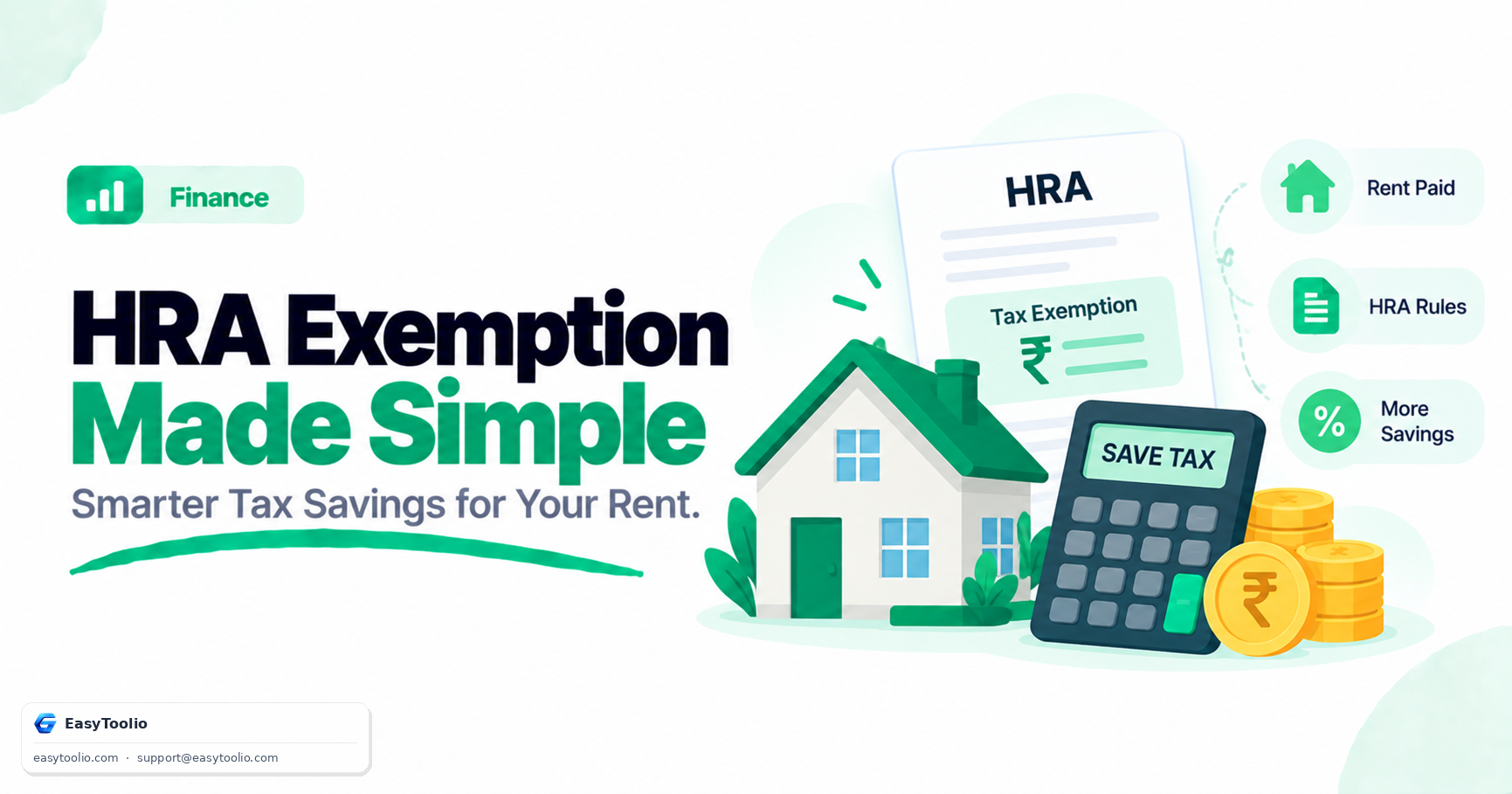
HRA tax exemption is the minimum of three values: (1) Actual HRA received, (2) Rent paid minus 10% of basic salary + DA, or (3) 50% of basic salary for metro cities (40% for non-metro cities). HRA exemption is only available under the Old Tax Regime.

Yes, under the New Tax Regime, the maximum surcharge rate is capped at 25% for taxable incomes exceeding ₹2 Crore (including above ₹5 Crore). In the Old Tax Regime, the surcharge is up to 37% for incomes exceeding ₹5 Crore.

A Health and Education Cess of 4% is applied to the sum of your income tax liability and any applicable surcharge. This cess is collected to fund national health and education programs and applies under both regimes.

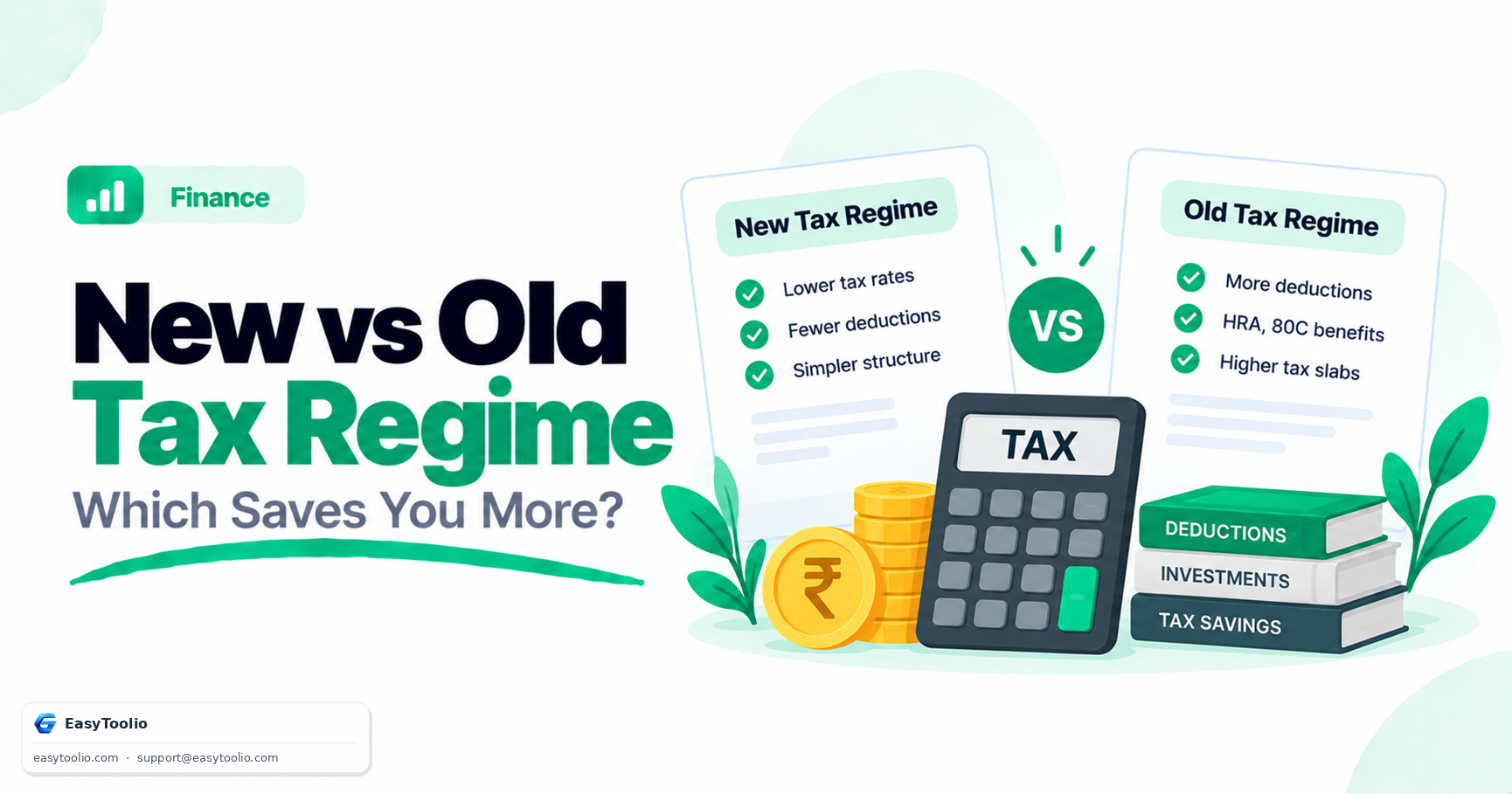
It depends on your deductions. If you have significant investments under Section 80C, high rent (HRA), health insurance, and home loan interest, the Old Tax Regime may yield lower tax. If you have few or no investments, the New Tax Regime, with its lower tax slabs and higher ₹12 Lakh rebate threshold, is usually better.

Articles

Related Guides & Insights

Read our in-depth articles and guides related to this tool to help you make smarter decisions.

Workflow Suggestions

Recommended for Your Workflow

Category Showcase

More from Finance

Platform Spotlight

Popular Tools on EasyToolio

Embeddable

Embed This Tool

Add the Income Tax Calculator to blogs, websites, documentation, tutorials, and online resources using a simple responsive iframe. The embed is free, mobile-friendly, and links back to the full EasyToolio tool page for users who want the complete experience.

Can I embed this tool on my website?

Yes, this tool can be embedded using our free iframe embed code. Copy the code below and paste it into your HTML, CMS block, article, documentation page, or tutorial.

Explore More Tools Like Income Tax Calculator

Check out our other financial tools to plan your taxes, calculate interest returns, or track billing amounts.