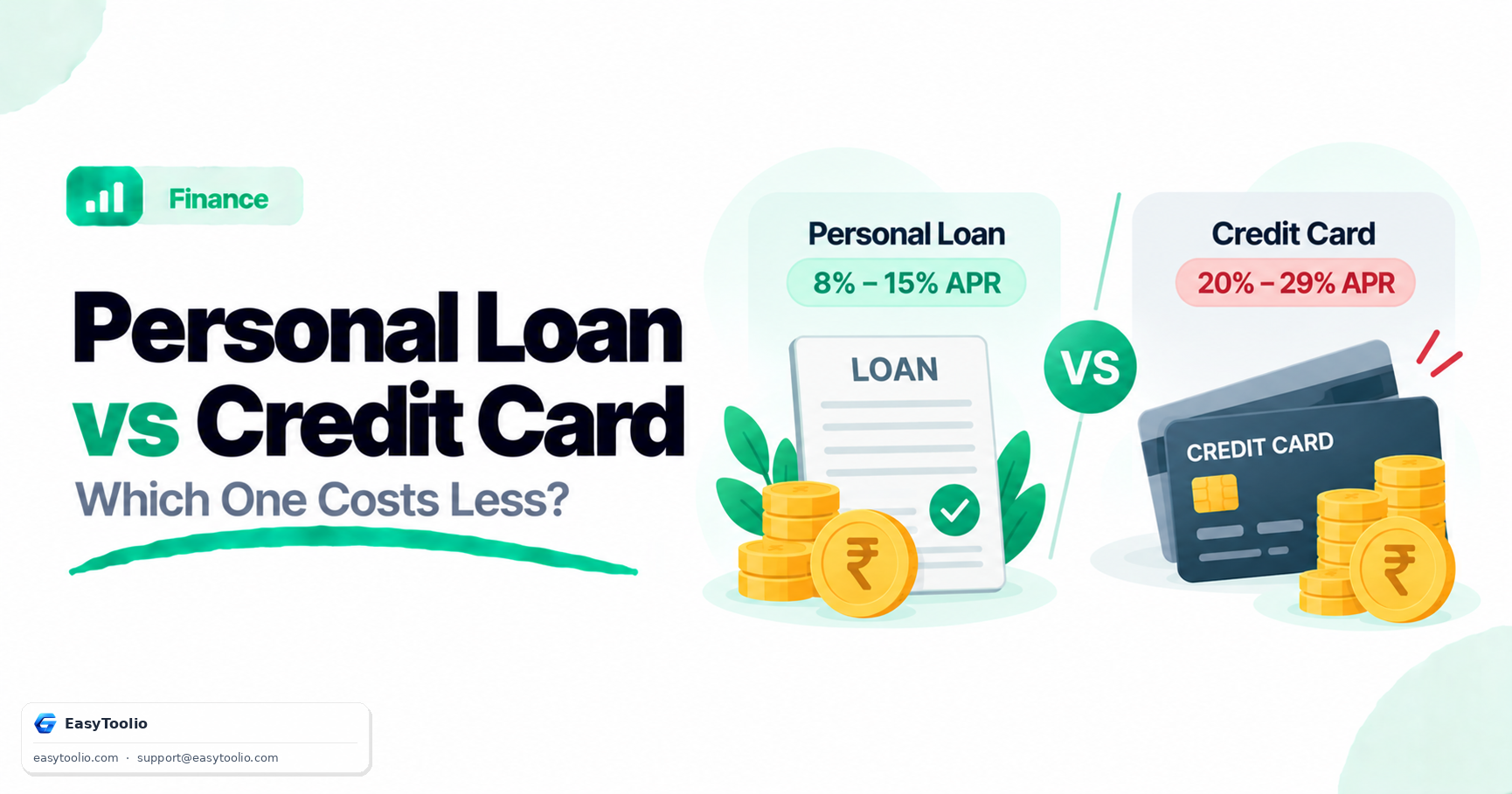
When you need to borrow money, two options dominate for most consumers: a personal loan or a credit card. On the surface, the right choice seems obvious — personal loans usually have lower interest rates. But the full comparison is more nuanced, and the wrong choice can cost you significantly more than necessary.
The Fundamental Difference
| Feature | Personal Loan | Credit Card |
|---|---|---|
| Interest Rate | 6–25% APR (fixed) | 18–29% APR (variable) |
| Payment Structure | Fixed monthly instalments | Flexible (minimum payment required) |
| Balance Payoff | Forced — paid on schedule | Revolving — can carry balance indefinitely |
| Best Use Case | Large, defined expenses | Short-term, varied spending |
| Approval Factor | Credit score + income | Credit score primary |
The Real Math: $5,000 in Debt
Let's compare what happens to a $5,000 balance under different scenarios:
Scenario A: Personal Loan at 12% APR, 36 Months
Monthly payment: $166 Total interest: $974 Total paid: $5,974
Scenario B: Credit Card at 22% APR, Minimum Payments Only (2% of balance)
- Month 1 minimum: $100
- Takes approximately 236 months (nearly 20 years) to pay off
- Total interest: $8,105
- Total paid: $13,105
Scenario C: Credit Card at 22% APR, Fixed $166/Month Payment
- Payoff in approximately 37 months
- Total interest: $1,135
- Total paid: $6,135
The comparison reveals something important: the credit card rate alone is not the determining factor — the payment discipline is. Paying a fixed amount on a credit card at 22% costs only $161 more than a personal loan at 12% over the same period. But if you make minimum payments, the credit card costs $7,131 more in interest.
When a Personal Loan Is the Better Choice
1. Debt consolidation: Combining multiple high-rate credit card balances into a single personal loan at a lower rate is one of the most effective debt reduction strategies. A 12% personal loan replacing three cards at 22–26% saves hundreds in monthly interest.
2. Large, one-time expenses: Medical bills, home repairs, or a car purchase — a fixed personal loan forces accountability and predictable payoff.
3. You have poor payment discipline: A personal loan enforces repayment. There is no minimum-payment trap; you pay the amortised amount every month and the loan ends on schedule.
4. Interest rate difference is large: If your credit card charges 24% and you qualify for a personal loan at 8%, the saving is dramatic — especially on balances above $3,000.
When a Credit Card Is the Better Choice
1. 0% introductory APR offers: Many premium credit cards offer 0% on purchases or balance transfers for 12–21 months. If you can fully pay the balance before the promotional period ends, this is genuinely free credit.
2. Small, short-term borrowing: If you will pay off the balance in 1–2 months, a credit card charge costs nothing in interest — whereas a personal loan has origination fees (typically 1–8% of the loan amount).
3. Rewards on spending: For purchases you can pay off immediately, credit card cashback or travel rewards effectively create a negative interest rate — you earn money for spending.
The True Cost Comparison at Different Rates
$5,000 borrowed, repaid in 36 months with fixed payments:
| APR | Monthly Payment | Total Interest |
|---|---|---|
| 8% (excellent credit personal loan) | $157 | $650 |
| 12% (good credit personal loan) | $166 | $974 |
| 18% (credit card, paid promptly) | $181 | $1,500 |
| 22% (average credit card) | $190 | $1,847 |
| 28% (high-rate credit card) | $206 | $2,414 |
Calculate Your Options
Use our Loan Calculator to model a personal loan with any amount, rate, and term. Compare the monthly payment and total interest against your current credit card rate to make an informed decision before borrowing.
APRs shown are representative and vary by credit score, lender, and market conditions.
Frequently Asked Questions
Q: Is a personal loan always cheaper than a credit card? A: Not necessarily — payment discipline matters more than the rate alone; on $5,000 of debt, a 12% APR personal loan costs $974 in interest, while a 22% APR credit card paid with the same fixed $166/month costs only $1,135, a difference of just $161.
Q: Why is making only minimum payments on a credit card so costly? A: Paying just the 2% minimum on a $5,000 balance at 22% APR takes roughly 236 months (nearly 20 years) to pay off and costs $8,105 in interest, versus $974 for a personal loan repaid over 36 months.
Q: When does a credit card make more sense than a personal loan? A: When you qualify for a 0% introductory APR offer and can repay the balance within the promotional period (typically 12–21 months), or when borrowing a small amount you'll pay off in 1–2 months and want to avoid the personal loan's 1–8% origination fee.