One of the most frequent financial mistakes made by e-commerce store owners, retailers, and contractors is confusing Profit Margin with Markup. While both metrics measure the relationship between product cost and selling price, calculating them against the wrong denominator results in underpriced inventory, eroded profits, and cash flow deficits.
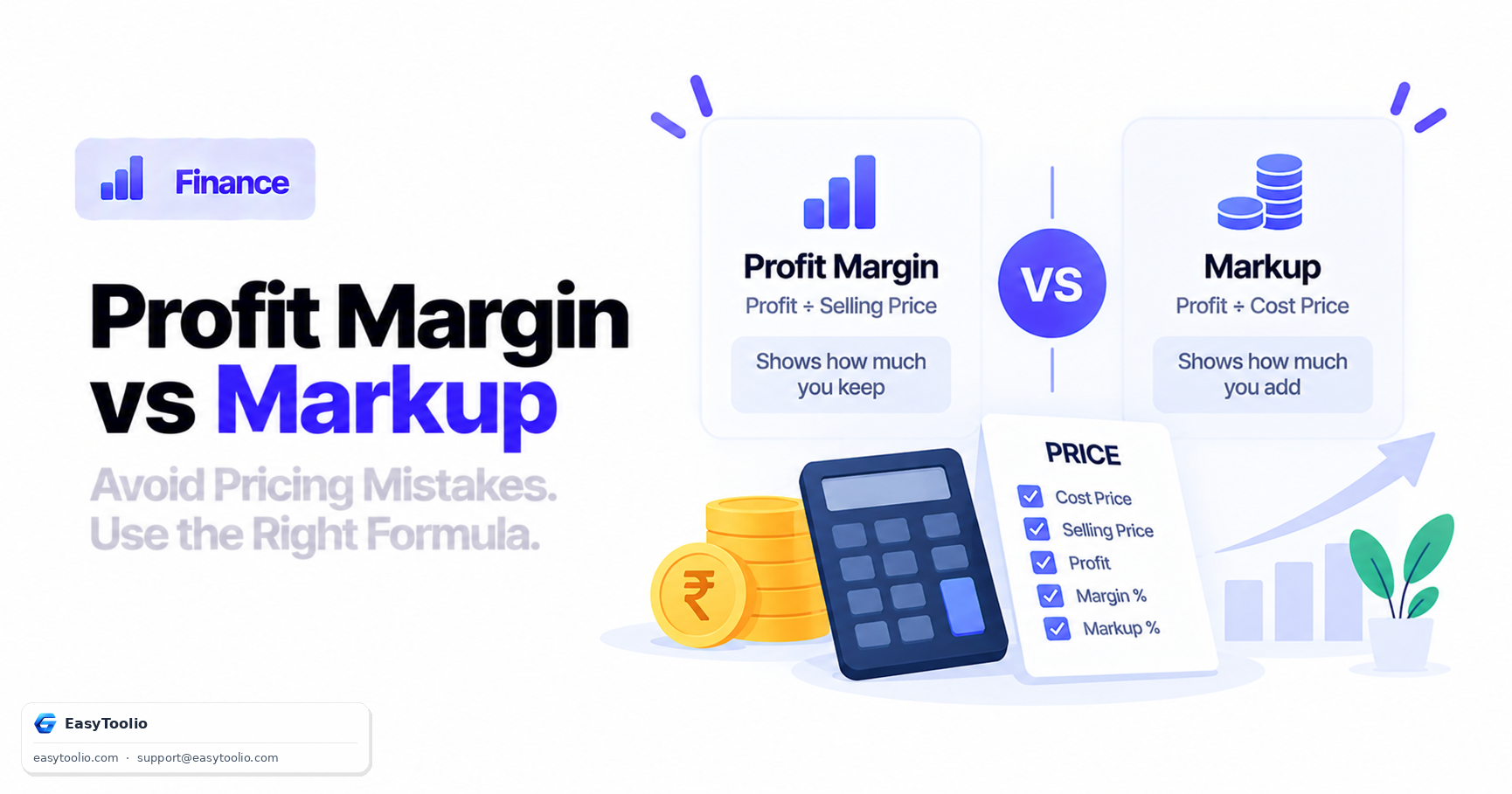
Direct Answer: Markup calculates the percentage added on top of the product's wholesale cost (Gross Profit ÷ Cost). Profit Margin calculates the percentage of the final selling price that represents profit (Gross Profit ÷ Revenue). A 50% markup does not equal a 50% profit margin; a 50% markup yields exactly a 33.3% profit margin.
Disclaimer: Pricing strategies and conversion tables in this article are provided for accounting instruction only and do not replace personalized accounting counsel.
1. Formulas & The Pricing Confusion
Understanding the mathematical denominator difference:
1. Profit Margin Formula:
Profit Margin (%) = ((Selling Price - Cost) ÷ Selling Price) × 100
2. Markup Formula:
Markup (%) = ((Selling Price - Cost) ÷ Cost) × 100
3. Conversion Formulas:
Margin = Markup ÷ (1 + Markup) | Markup = Margin ÷ (1 - Margin)
To instantly calculate gross margin on your actual cost and price, use the Profit Margin Calculator, and model clearance or promotional price adjustments with the Discount Calculator.
2. The Costly Pricing Mistake Example
Imagine a retailer buys a item for $80 wholesale cost and desires a 20% profit margin.
-
Incorrect Method (Adding 20% Markup): Price = $80 + (20% × $80) = $80 + $16 = $96.00 Actual Profit Margin achieved: ($96 - $80) ÷ $96 = $16 ÷ $96 = 16.67% (Target missed!).
-
Correct Method (Using Margin Formula): Required Markup = 0.20 ÷ (1 - 0.20) = 0.20 ÷ 0.80 = 0.25 (25% Markup Required) Correct Price = $80 × 1.25 = $100.00 Actual Profit Margin achieved: ($100 - $80) ÷ $100 = $20 ÷ $100 = 20.00% (Target hit!).
3. Quick Reference Conversion Table
| Desired Markup | Equivalent Profit Margin | Example Cost | Example Selling Price | Gross Dollar Profit |
|---|---|---|---|---|
| 15.0% | 13.0% | $100.00 | $115.00 | $15.00 |
| 25.0% | 20.0% | $100.00 | $125.00 | $25.00 |
| 33.3% | 25.0% | $100.00 | $133.33 | $33.33 |
| 50.0% | 33.3% | $100.00 | $150.00 | $50.00 |
| 66.7% | 40.0% | $100.00 | $166.67 | $66.67 |
| 100.0% (Keystone) | 50.0% | $100.00 | $200.00 | $100.00 |
For setting commercial prices inclusive of tax, check values on the GST Calculator, and determine the operational sales volume needed to cover overhead on the Break-Even Calculator.
4. Margin & Markup by Business Type
"Good" margin and markup figures vary enormously by industry, largely driven by inventory turnover speed, spoilage risk, and competitive pricing pressure. These are illustrative reference ranges only — always benchmark against your own category and suppliers:
| Business Type | Typical Markup Range | Typical Gross Margin Range | Why |
|---|---|---|---|
| Grocery / Supermarket | 15%–25% | 13%–20% | High volume, low margin, fast inventory turnover |
| Restaurants (Food Cost %) | 200%–300% (i.e., 3–4x food cost) | 65%–75% | Covers labor, rent, and spoilage on top of ingredient cost |
| General Retail Apparel | 100% (Keystone) or higher | 50%+ | Seasonal markdowns and returns erode headline margin |
| E-commerce (Dropshipping) | 30%–50% | 23%–33% | Lower overhead, but competitive price pressure from marketplaces |
| SaaS / Software | Not typically "marked up" from a COGS base | 70%–85% gross margin | Near-zero marginal cost per additional customer |
Note that "food cost percentage" in restaurants is essentially the inverse of profit margin measured against ingredient cost, not total price — this is a common source of confusion between industries that use markup-style versus margin-style benchmarks.
5. How Discounting Erodes Margin Faster Than It Erodes Markup
Because margin and markup use different denominators, a flat percentage discount off the selling price cuts into profit margin far more aggressively than the discount percentage itself suggests. Using the $100 cost / $125 price example (20% margin) from the table above:
- Applying a 10% discount: New Price = $125 × 0.90 = $112.50
- New Profit = $112.50 - $100 = $12.50
- New Margin = $12.50 ÷ $112.50 = 11.1% (down from 20.0% — nearly cut in half by a 10% price discount)
This is why retailers who plan seasonal sales need to model discounts against their margin, not just their markup, before setting the reduced price — the Discount Calculator can be used alongside the margin formula above to check the resulting profit before a promotion goes live.
6. Frequently Asked Questions (FAQs)
Is a 50% markup the same as a 50% profit margin?
No. A 50% markup on a $100 cost item produces a $150 selling price, but the resulting profit margin is only 33.3% ($50 profit ÷ $150 price). Margin and markup are only numerically equal at 0%; they diverge more as the percentage increases.
Which should I use when setting retail prices — margin or markup?
Decide your target profit margin first, since that is the percentage of revenue you actually keep. Then convert it to the required markup using Markup = Margin ÷ (1 - Margin) to determine the multiplier to apply to your cost price, as shown in the worked pricing-mistake example above.
Why do wholesalers typically talk in markup while retailers talk in margin?
Wholesale and manufacturing pricing conversations are usually anchored to unit cost (making markup the natural language), while retail financial reporting is built around total revenue (making margin the natural language for P&L analysis, since gross margin as a percentage of revenue rolls up cleanly into overall business profitability).
What is "keystone pricing" and why is it called that?
Keystone pricing refers to a 100% markup — doubling the wholesale cost to set the retail price. It is common in apparel, jewelry, and specialty retail, and produces exactly a 50% gross profit margin, since Margin = Markup ÷ (1 + Markup) = 1.00 ÷ 2.00 = 50%.
How do I convert an existing profit margin percentage into a markup percentage without redoing the math from scratch?
Use the direct conversion formula: Markup = Margin ÷ (1 - Margin). For example, a business currently earning a 30% profit margin is applying a markup of 0.30 ÷ (1 - 0.30) = 0.30 ÷ 0.70 = 42.9%. This conversion is useful when comparing your own pricing language (often expressed in margin) against a supplier's or competitor's pricing language (often expressed in markup), since the two numbers are never directly interchangeable at face value.