
Direct Answer: The Bottom-Line Impact for Retailers
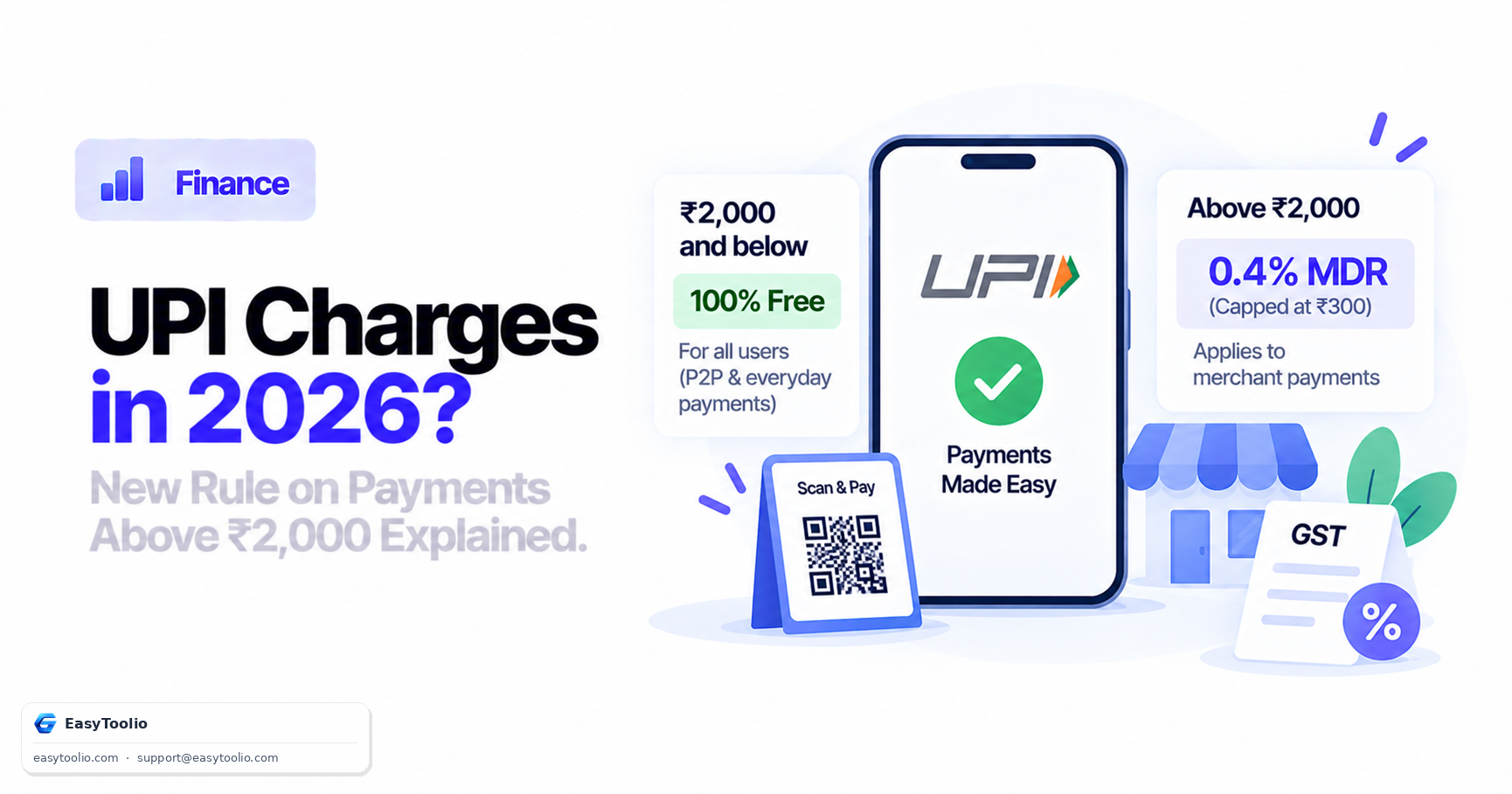
If you run a retail shop, grocery store, or small trading business, the majority of everyday consumer bills (under ₹2000) will continue to settle into your bank account with zero processing fees (₹0 MDR). For ticket sizes above ₹2000, you will incur a 0.4% deduction, capped at ₹300 per transaction starting 15 October 2026.
The ₹1 Lakh Monthly Exemption for Small Merchants and Street Vendors
If you're a small merchant, kirana shop, or street vendor accepting UPI QR payments into a personal savings bank account rather than a business current account, you are exempt from MDR entirely on up to ₹1,00,000 in combined monthly UPI receipts. This directly protects the smallest sellers — cart vendors, home-based businesses, and gig workers — from the new fee. Once your monthly UPI QR collections cross ₹1,00,000, or if you operate through a registered current account, standard P2M MDR rates apply above the ₹2000 per-transaction threshold.
Check your merchant/QR registration type in your payment app's business dashboard (PhonePe Business, Google Pay for Business, Paytm Merchant, BharatPe) to verify whether your terminal profile is classified under the zero-MDR category.
Flat-Fee Sectors: Does Your Business Qualify?
If you sell in an essential or thin-margin category — railways, telecom, insurance, fuel retail, or agricultural inputs — you pay a flat ₹5 per transaction instead of the 0.4% rate, no matter how large the bill. This matters most for high-ticket essential purchases: a ₹40,000 bulk fuel purchase or a ₹1,00,000 insurance premium both cost the merchant just ₹5 in MDR, not ₹160–₹400.
Recurring Payments and Subscriptions Stay MDR-Free
If your business collects recurring dues via UPI Autopay — gym memberships, tuition fees, SaaS subscriptions, rent — those mandate-based debits are excluded from the new MDR altogether, so moving customers to Autopay can reduce your effective payment-processing costs on recurring revenue.
GST on MDR Charges: What Your Accountant Needs to Know
While payment processing services in India traditionally attract an 18% GST rate on fee components, whether GST will specifically apply to this newly announced 0.4% UPI MDR framework has not yet been formally confirmed by the GST Council or CBIC. If standard financial service tax provisions apply, payment aggregators may invoice 18% GST on the MDR amount itself (e.g., ₹3.60 GST on a ₹20 MDR charge).
Input Tax Credit (ITC) & Advisory: Registered businesses may be eligible to claim any GST paid on merchant fees as an Input Tax Credit (ITC) against their output tax liability, provided a valid tax invoice with their GSTIN is issued by the payment provider. Because formal tax guidelines on this new rule are still emerging, always consult your Chartered Accountant or tax advisor to determine the exact accounting treatment for your business.
Should You Increase Retail Prices or Surcharge Customers?
Do not add a direct surcharge at the counter. Under RBI regulations, asking a customer to pay extra for choosing UPI QR code is illegal and risks terminal deactivation. Instead, evaluate your overall gross margins using our Kirana Wholesale Margin Calculator to factor all digital payment costs into baseline unit pricing.
Where the Fee Money Goes
NPCI has stated the revenue funds UPI infrastructure, cybersecurity, and customer-service investment, with 5% of total MDR collections ring-fenced specifically to support small-merchant digital payment adoption — a fund shopkeepers themselves may eventually benefit from.
Check Your Net Settlement Instantly
Calculate your net proceeds on any bill amount using the UPI MDR Calculator, which factors in the ₹2,000 exemption, 0.4% rate, and ₹300 maximum cap.
Frequently Asked Questions
I'm a small shopkeeper — do I need to register for the exemption? Check your business dashboard as described above; confirm directly with your bank or payment provider since implementation details can vary.
Can I pass the MDR cost on to customers as a surcharge? No. RBI/NPCI merchant agreements prohibit surcharging customers for choosing to pay via UPI.
Does GST apply on top of the MDR I'm charged? Not formally confirmed at the time of writing — confirm the exact treatment, and your ITC eligibility, with your Chartered Accountant.
How do I calculate my exact monthly MDR cost? Use the UPI MDR Calculator for individual transactions, and the Kirana Wholesale Margin Calculator to see how the fee affects your overall margins.
Related Reading
- UPI Charges 2026: New Rule on Payments Above ₹2,000 Explained
- Is UPI Still Free? What the New MDR Rule Means for You
- UPI vs Card Payments 2026: Which Is Cheaper for Merchants Now?
Merchant Notice: Based on the 15 September 2026 Ministry of Finance framework effective 15 October 2026. Last verified against official sources on 16 September 2026. This article does not constitute formal legal or tax advice — confirm your settlement terms directly with your payment provider and a qualified tax advisor.