Every mutual fund investor eventually asks the same question: should I invest my money all at once, or spread it out over time? The answer is not a matter of opinion — it depends on market timing, the source of your money, and how much volatility you can stomach. This guide breaks down both strategies with real numbers so you can decide with confidence.
Lumpsum vs SIP: The Core Difference
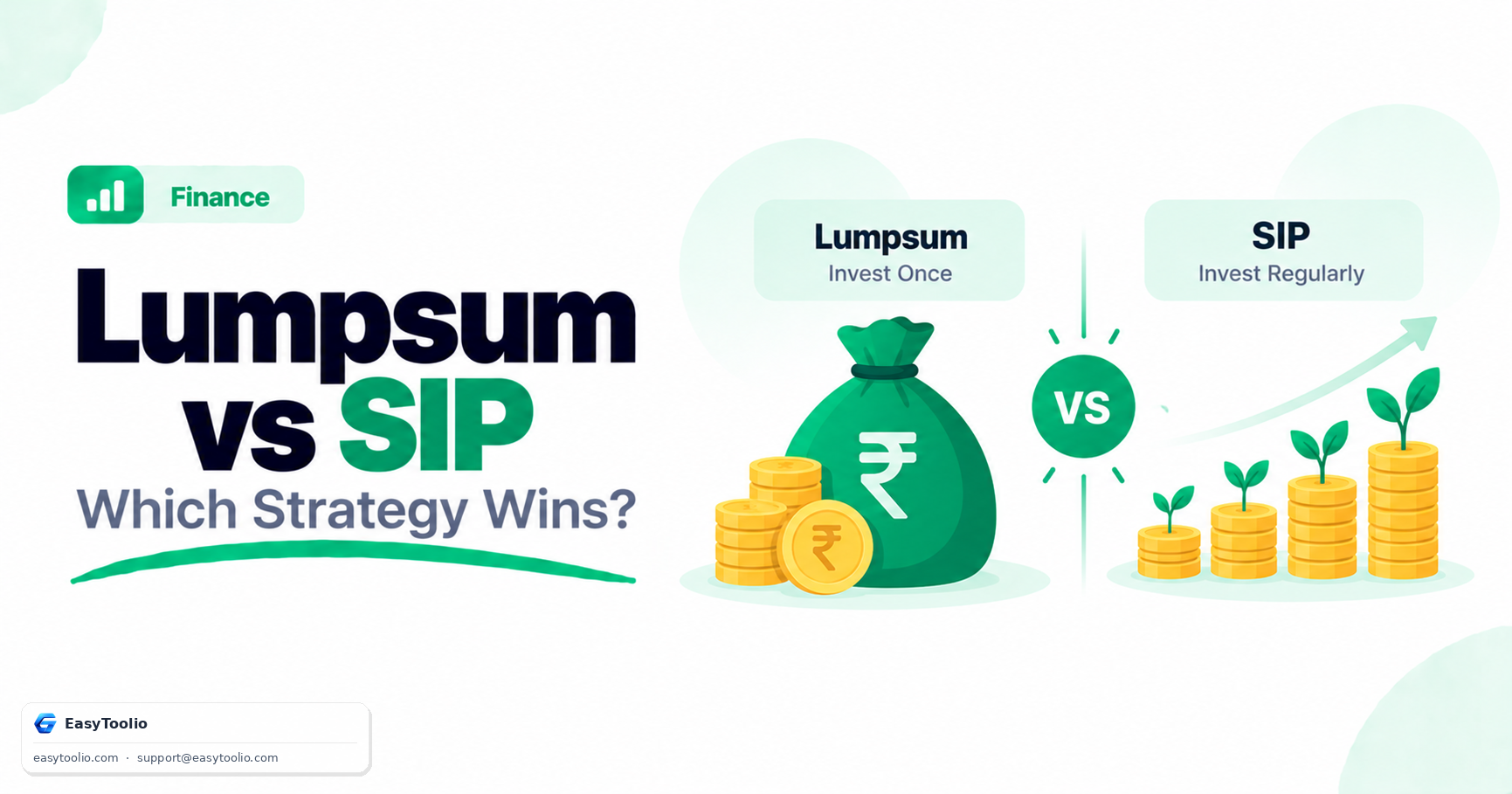
Lumpsum investing means putting a large sum of money into a mutual fund in one go — for example, investing a ₹6 lakh bonus on a single day.
SIP (Systematic Investment Plan) means investing a smaller, fixed amount at regular intervals — usually monthly — over an extended period, letting the same ₹6 lakh flow in as ₹50,000 a month over 12 months.
Both routes eventually put the same rupee amount to work. The difference lies in when that money is exposed to the market and how it compounds from there. You can model either scenario with the Lumpsum Calculator or the SIP Calculator before committing real money.
Why SIP Works: Rupee-Cost Averaging
SIP's biggest strength is rupee-cost averaging. Because you invest a fixed amount every month regardless of the fund's Net Asset Value (NAV), you automatically buy more units when prices are low and fewer units when prices are high. Over a volatile year, this smooths out your average purchase cost and reduces the damage of investing right before a crash.
Why Lumpsum Works: Full-Time Compounding
Lumpsum's biggest strength is that the entire amount starts compounding from day one. If the market is already undervalued or on a sustained upward run, delaying any portion of your investment through monthly instalments means part of your money misses out on early gains. Money invested via SIP in month 11 has only one month to grow before the comparison point, while a lumpsum investment has been compounding for the full period.
Worked Example: ₹6 Lakh, Two Strategies, Two Market Conditions
Assume you have ₹6,00,000 to invest, either as one lumpsum or as a 12-month SIP of ₹50,000. We compare the ending value after exactly 12 months under two scenarios.
Scenario A: Rising Market (steady +15% annual growth, low volatility)
| Strategy | Amount Invested | Average Entry Point | Value After 12 Months |
|---|---|---|---|
| Lumpsum (Day 1) | ₹6,00,000 | Lowest NAV of the year | ≈ ₹6,90,000 |
| SIP (12 instalments) | ₹6,00,000 | Blended, generally higher | ≈ ₹6,48,000 |
In a steadily rising market, lumpsum wins because every rupee gets the maximum possible compounding time. The later SIP instalments barely have time to grow.
Scenario B: Volatile/Choppy Market (net flat for the year, but swings of ±10% along the way)
| Strategy | Amount Invested | Average Entry Point | Value After 12 Months |
|---|---|---|---|
| Lumpsum (Day 1) | ₹6,00,000 | Whatever the NAV was that day — could be a peak | ≈ ₹5,85,000 |
| SIP (12 instalments) | ₹6,00,000 | Averaged across highs and lows | ≈ ₹6,15,000 |
In a choppy, directionless market, SIP wins because rupee-cost averaging lowers your effective purchase price, so even a flat year can end up net positive once units bought cheap during dips are counted.
What Historical Data Shows
Long-term data on the Nifty 50 and Sensex over the last two decades shows a consistent pattern: lumpsum has historically outperformed SIP in strong bull phases (like 2003–2007 or the post-2020 recovery), while SIP has historically outperformed lumpsum in sideways or bear-heavy phases (like 2010–2013 or 2018–2020). Over very long horizons (15+ years) spanning multiple market cycles, the two strategies tend to converge closer together than most investors expect, because the compounding advantage of lumpsum and the averaging advantage of SIP partially cancel out.
The Practical Rule of Thumb
You rarely need to guess which regime the market is in. Instead, base your decision on the source of your money:
- Windfall money (bonus, inheritance, matured FD, sale of property): Since this is a one-time amount, consider a lumpsum investment — but only if valuations are not clearly stretched. If markets look expensive, you can also do a "lumpsum via STP" — park the money in a liquid fund and transfer it into equity over 6–12 months, which behaves like a short SIP.
- Regular salary income: SIP is the natural fit. You do not have ₹6 lakh sitting idle; you have ₹50,000 a month coming in, so SIP simply matches your cash flow while giving you the averaging benefit for free.
Frequently Asked Questions
Q: Is lumpsum riskier than SIP? A: Yes, in the short term. A lumpsum invested right before a market fall has no averaging cushion, whereas an SIP spreads that entry risk across several months.
Q: Can I combine lumpsum and SIP? A: Yes — many investors use a lumpsum-via-STP approach, parking a windfall in a liquid fund and moving it into equity in monthly tranches, which behaves similarly to a SIP while keeping the money invested somewhere productive from day one.
Q: Which strategy gives better returns over 20+ years? A: Over very long horizons spanning multiple bull and bear cycles, lumpsum and SIP returns tend to converge, since lumpsum's early compounding advantage and SIP's averaging advantage roughly offset each other.