Direct Answer: What Changed with UPI Charges in 2026?
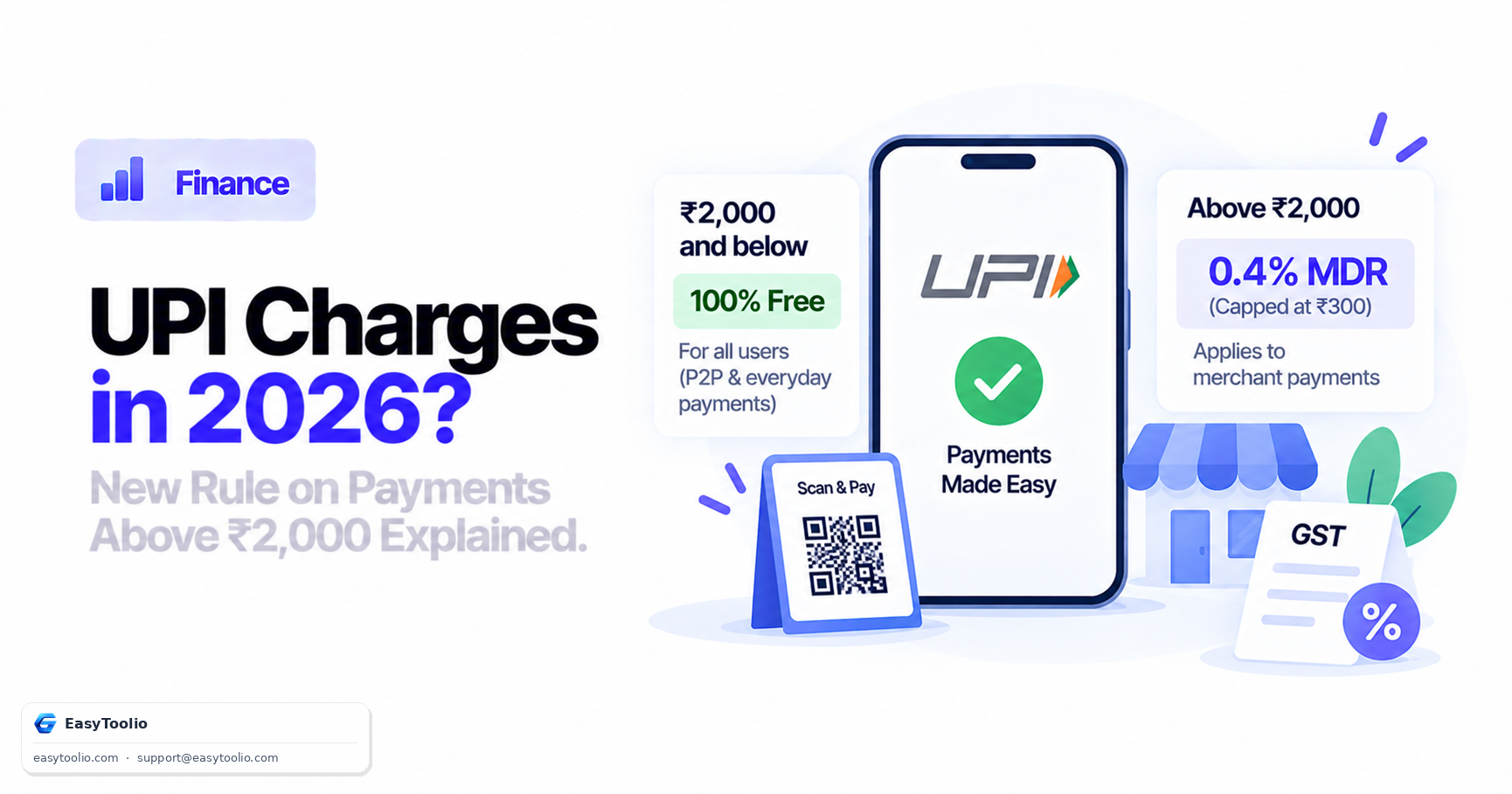
Starting 15 October 2026, commercial UPI merchant payments (P2M) exceeding ₹2000 will attract a 0.4% Merchant Discount Rate (MDR), strictly capped at ₹300 per transaction. All peer-to-peer (P2P) transfers between individuals, as well as merchant payments of ₹2000 or less, remain 100% free with zero charges.
Is UPI Still Free for Regular Consumers?
Yes, absolutely. As a customer scanning a QR code or sending money from your bank account via PhonePe, Google Pay, Paytm, or BHIM, you will not pay a single paisa in extra fees. Under Reserve Bank of India (RBI) and National Payments Corporation of India (NPCI) directives, merchants are prohibited from adding any surcharge or convenience fee to retail customers paying via UPI.
Who Actually Pays the 0.4% UPI MDR?
The fee is paid by the merchant or business that receives the payment. When a customer purchases goods worth ₹5,000 via UPI QR code:
- Customer pays: ₹5,000 (no deduction or surcharge).
- 0.4% MDR: ₹20 (deducted during settlement).
- Merchant receives: ₹4,980 credited to their bank account.
Example Breakdown of 2026 UPI MDR Charges
| Transaction Amount | MDR Applicable | Charge Amount | Net Merchant Payout | Effective Rate |
|---|---|---|---|---|
| ₹1,500 | Zero MDR (≤ ₹2,000) | ₹0.00 | ₹1,500.00 | 0.00% |
| ₹2,000 | Zero MDR (Threshold) | ₹0.00 | ₹2,000.00 | 0.00% |
| ₹5,000 | 0.4% Standard Rate | ₹20.00 | ₹4,980.00 | 0.40% |
| ₹20,000 | 0.4% Standard Rate | ₹80.00 | ₹19,920.00 | 0.40% |
| ₹75,000 | Cap Point (₹300) | ₹300.00 | ₹74,700.00 | 0.40% |
| ₹1,00,000 | Capped at ₹300 Max | ₹300.00 | ₹99,700.00 | 0.30% |
Special MDR Rates for Essential Services and Capital Markets
Not every merchant category pays the standard 0.4% rate — the framework carves out two lower tiers:
Essential and thin-margin sectors — railways, telecom, insurance, fuel retail, agricultural inputs, and specified utility payments — pay a flat ₹5 per transaction (not a percentage) on any P2M payment above ₹2000, no matter how large the bill. A ₹50,000 electricity bill and a ₹3,000 mobile recharge both attract the same flat ₹5 fee in this category.
Capital-markets transactions — buying mutual funds or securities, or paying stockbrokers and dealers via UPI — attract a much lower 0.02% rate, capped at ₹300. Because the rate is so low, the ₹300 cap only applies on payments above roughly ₹15,00,000, so almost every retail mutual fund or brokerage UPI payment costs well under ₹100 in fees.
Which UPI Payments Are Completely Exempt from MDR?
Four categories pay zero MDR under the new framework:
- All peer-to-peer (P2P) transfers — any amount, sent to a friend, family member, or personal contact.
- Any P2M payment of ₹2000 or less — the vast majority of everyday retail and grocery purchases.
- Small merchants and street vendors receiving via personal bank accounts (P2PM) — exempt up to ₹1,00,000 in combined monthly UPI QR receipts, protecting kirana stores, cart vendors, and gig-economy sellers.
- UPI Autopay mandates — recurring standing instructions for subscriptions, SIPs, insurance premiums, and EMIs processed through Autopay are not subject to the new MDR.
Why Was This Rule Introduced?
The MDR framework was notified under the Payment and Settlement Systems Act, 2007, following recommendations from the UPI Steering Committee. According to the Ministry of Finance and NPCI, the fee funds continued investment in UPI infrastructure, innovation, cybersecurity, and customer service — costs previously absorbed through government budgetary incentives paid to banks and payment apps. NPCI estimates the rule affects only around 4% of all P2M UPI transactions; the remaining 96%, along with every P2P transfer, stays free. 5% of total MDR collections are earmarked for a dedicated fund supporting small-merchant digital payment adoption.
Calculate Your Exact Settlement Now
Rather than calculating transaction fees manually, use our free, real-time UPI MDR Calculator to see your exact deductions, net payout, and effective fee percentage across any invoice amount.
Frequently Asked Questions
Does this affect UPI Lite or offline UPI payments? The published framework applies to standard P2M UPI transactions above the threshold; confirm treatment of UPI Lite and offline modes directly with your bank, as these were not explicitly detailed in the initial notification.
Will my UPI Autopay SIP or insurance premium get more expensive? No — Autopay mandates are excluded from the new MDR, so recurring SIP, insurance, and subscription debits are unaffected.
Does the ₹2000 threshold apply per transaction or per day? Per transaction. Each individual payment is evaluated independently against the ₹2000 threshold.
Can a merchant split a large bill into smaller payments to avoid the fee? That runs against the intent of the rule and may violate merchant agreements with the payment provider. For legitimate bill-splitting among multiple people, use the Split Bill Calculator instead.
Where can I read the official notification? See the PIB press release, the Department of Financial Services FAQ, and the NPCI FAQ.
Related Reading
- UPI MDR for Shopkeepers: How Much Will You Actually Pay Now?
- Is UPI Still Free? What the New MDR Rule Means for You
- UPI vs Card Payments 2026: Which Is Cheaper for Merchants Now?
Regulatory Disclaimer: This article is based on the Ministry of Finance and NPCI announcement dated 15 September 2026, with the new MDR framework scheduled to take effect from 15 October 2026. Last verified against official sources on 16 September 2026. This is an evolving policy subject to official revisions — verify current rates with your acquiring bank or the official NPCI/DFS circulars linked above before making financial decisions.