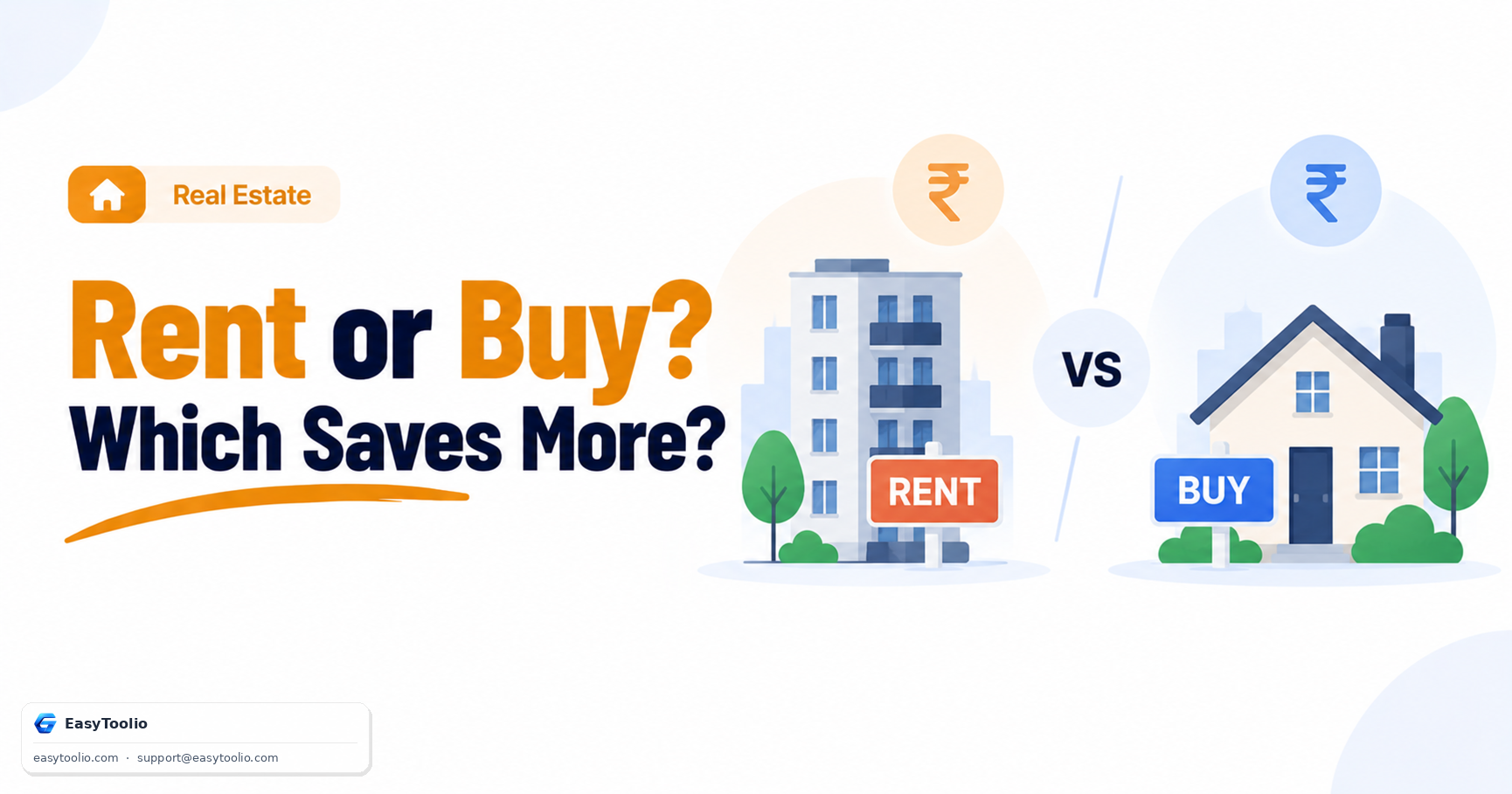
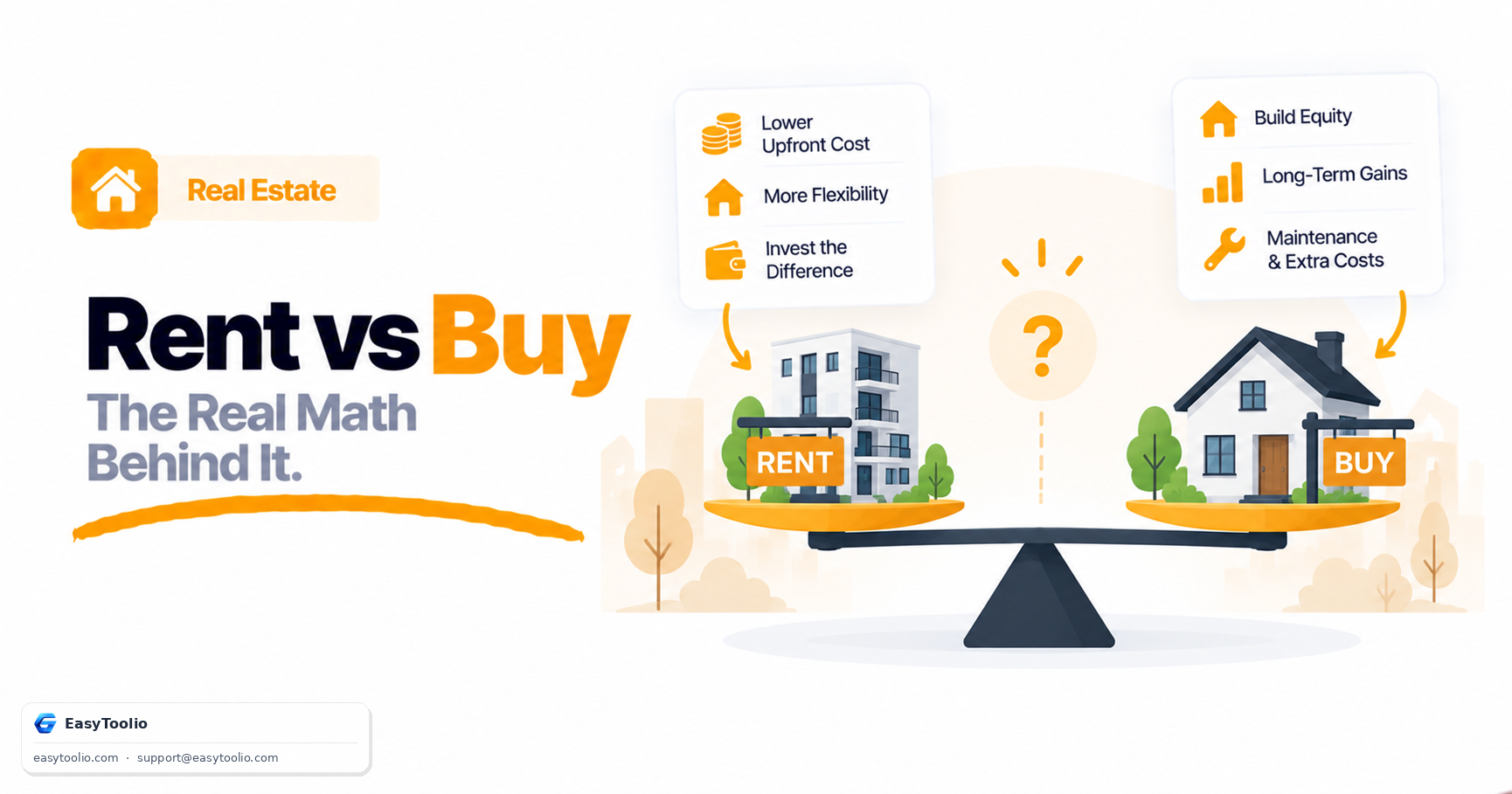
"Rent is throwing money away" is one of the most repeated pieces of financial advice — and one of the least useful, because it ignores half the equation. Buying a home also has costs beyond the mortgage payment (property tax, insurance, maintenance, and the opportunity cost of your down payment), and renting frees up capital that can be invested elsewhere. The only way to answer "should I rent or buy?" honestly is to compare the total cost of ownership against the total cost of renting plus investing the difference, over a realistic time horizon.
Direct Answer: Buying is not automatically "cheaper" than renting just because a mortgage eventually ends in ownership. The correct comparison adds mortgage principal and interest, property tax, insurance, and maintenance (typically 1–2% of the home's value per year) to the buyer's side, and adds the opportunity cost of the down payment invested elsewhere; on the renter's side, it adds monthly rent plus the investment growth of whatever capital was not spent on a down payment and closing costs. Whichever total is lower — evaluated at a specific time horizon, not "forever" — is the financially better option at that horizon.
1. What the Buyer's Side of the Ledger Actually Contains
Buying a home commits you to more than principal and interest:
| Cost Component | Typical Basis | Notes |
|---|---|---|
| Mortgage Principal + Interest | Loan amount, rate, term | The amortizing payment most people budget around |
| Property Tax | % of assessed value, annual | Varies heavily by state/municipality |
| Homeowners Insurance | Annual premium | Mandatory under most mortgages |
| Maintenance & Repairs | ~1%–2% of home value / year | Roof, HVAC, plumbing, appliances — easy to underestimate |
| Opportunity Cost of Down Payment | Down payment × expected investment return | The return that capital would have earned if invested instead |
| Closing Costs | One-time, ~2%–5% of price | Often forgotten in "monthly payment" comparisons |
Renters skip all of the above except one line: rent, plus whatever return their unspent down-payment capital earns if actually invested rather than spent.
2. The Core Comparison Formula
Total Cost of Owning (Year n) = Σ (Mortgage P&I + Property Tax + Insurance + Maintenance) - Equity Built - Home Appreciation
Total Cost of Renting (Year n) = Σ Rent Paid - Investment Growth of (Down Payment + Closing Cost Savings)
The comparison is not "monthly mortgage vs. monthly rent" — it is net cost after equity and appreciation on one side, and after invested opportunity cost on the other. A rent-vs-buy calculator effectively runs both sides of this ledger for you across a chosen number of years so you don't have to build a spreadsheet from scratch.
3. The Break-Even Horizon Concept
Because buying carries large upfront costs (down payment, closing costs) that renting does not, buying almost always looks worse in year one and better after enough years have passed for equity and appreciation to outweigh those upfront costs. The break-even horizon is the number of years at which the total cost of owning drops below the total cost of renting-and-investing.
Year 1–2:  Renting usually wins (buyer absorbs closing costs + low equity gained)
Year 3–7:  Crossover zone — depends heavily on appreciation rate, rent growth, and mortgage rate
Year 8+:   Buying usually wins IF the buyer stays put and the local market appreciates near/above historical trend
If you expect to move (job relocation, lifestyle change) before reaching that break-even year, renting is often the lower-cost choice even in a market where buying "wins" over the long run.
4. Why Appreciation Rate and Rent Growth Rate Change the Answer
Two assumptions swing the outcome more than any other input:
- Home appreciation rate: A higher assumed appreciation rate shortens the break-even horizon because it builds paper equity faster. A lower or flat appreciation assumption (or a declining local market) can push the break-even point out indefinitely, or make renting the better choice at every horizon.
- Rent growth rate: If rents in your area rise faster than general inflation, a fixed (or slower-rising) mortgage payment becomes relatively cheaper each year, shortening the break-even horizon in favor of buying. If rent growth is modest, renting stays competitive for longer.
Because neither of these is knowable in advance with precision, the honest approach is to test a range of appreciation and rent-growth assumptions rather than anchor on a single optimistic number.
5. Worked Example (Illustrative, Not a Universal Benchmark)
Assume a buyer puts 20% down on a home, versus a renter who invests that same down payment and the difference between the mortgage-related costs and rent each month. Running the two ledgers above year by year — mortgage P&I + tax + insurance + maintenance minus equity and appreciation, against rent minus invested opportunity cost — produces a crossover point specific to that buyer's local property tax rate, maintenance assumptions, rent level, and market appreciation trend. Because every one of those inputs is local and personal, there is no single "right" answer that applies nationally; the calculation has to be run with your own numbers.
Run your own numbers with the rent-vs-buy-calculator, compare monthly EMI against rent directly using compare-home-loan-vs-rent, estimate investment-property returns with property-roi-calculator, and factor in one-time purchase costs with stamp-duty-calculator.
6. Frequently Asked Questions (FAQs)
Does a rent-vs-buy calculator account for tax deductions on mortgage interest?
A thorough rent-vs-buy calculator lets you factor in mortgage-interest tax treatment where applicable, but tax rules vary by jurisdiction and by whether you itemize deductions at all, so always confirm the specific treatment with a tax professional or your local tax authority rather than assuming a universal deduction.
Is buying always better if I plan to stay for 30 years?
Staying for the full loan term removes the "what if I have to sell early" risk, but it does not guarantee buying wins financially — a very low appreciation market, high property taxes, or high maintenance costs can still make renting-and-investing the better outcome even over three decades. Long holding periods reduce risk; they do not eliminate the need to run the math.
Should I include maintenance costs even for a brand-new home?
Yes. Even new construction requires ongoing maintenance (landscaping, HVAC servicing, eventual appliance replacement), and skipping this line item is one of the most common ways rent-vs-buy comparisons understate the true cost of ownership.
References: Consumer Financial Protection Bureau — homeownership cost guidance; U.S. Bureau of Labor Statistics, Consumer Expenditure Survey (housing cost components).