Buying paint by guesswork almost always ends one of two ways: you run out mid-wall and have to hunt for a matching batch, or you overbuy and end up storing half-used cans for years. Both problems disappear once you understand the simple area-and-coverage math that paint estimation actually relies on.
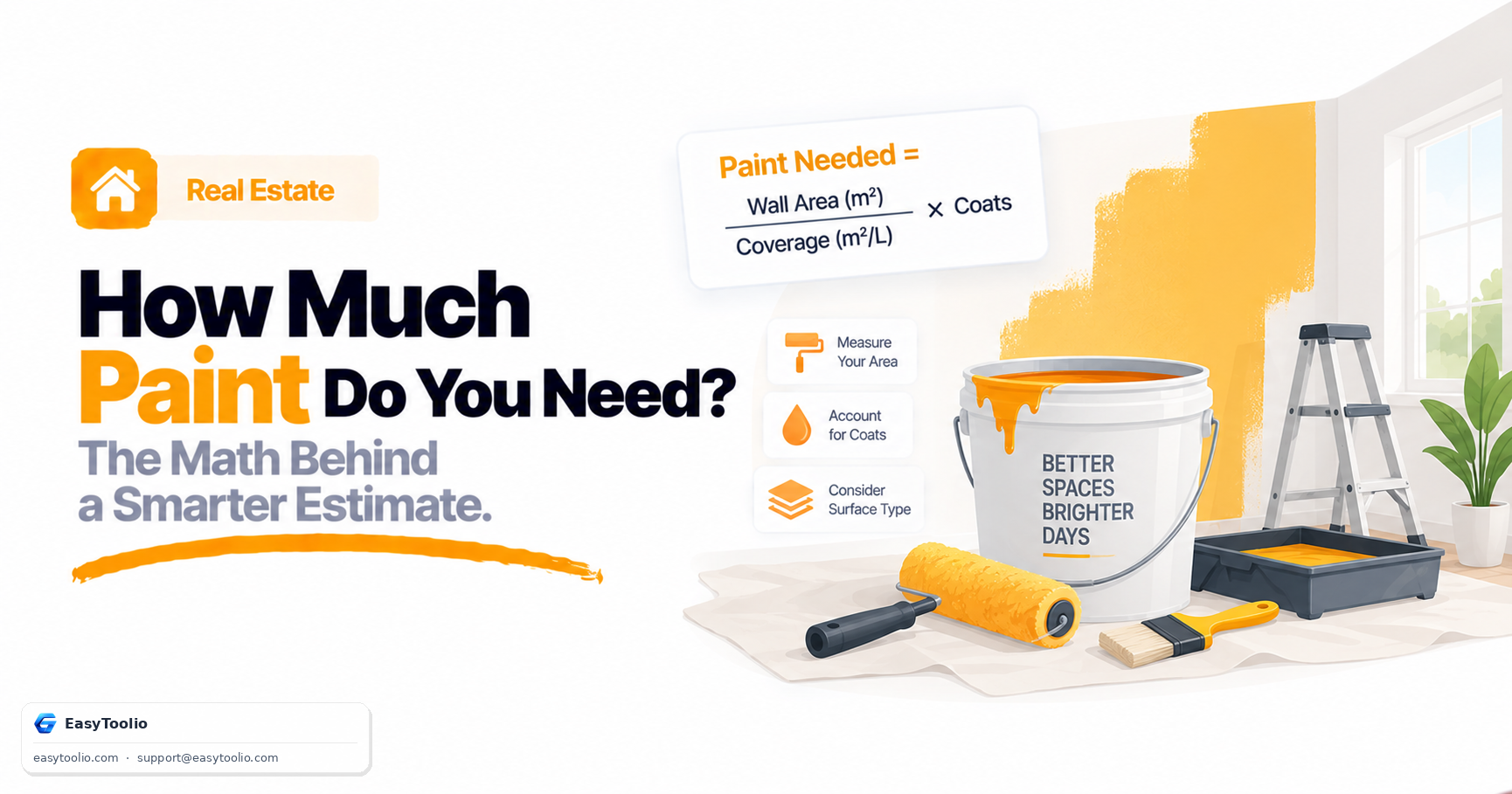
Direct Answer: The amount of paint you need is calculated by first finding your total wall area (perimeter × height, minus the area of doors and windows), then dividing that number by the coverage rate per liter stated on the paint can — and finally multiplying by the number of coats, since almost every wall needs at least two coats to look right.
1. Step One: Calculating Wall Area
The starting point is the paintable surface area of the room, not the floor area.
Gross Wall Area = Room Perimeter × Wall Height
Net Paintable Area = Gross Wall Area - Total Door and Window Area
Worked example: A room measuring 12 ft. × 10 ft. with a wall height of 9 ft. has a perimeter of:
2 × (12 + 10) = 44 ft.
Gross Wall Area = 44 × 9 = 396 sq. ft.
If the room has one door (21 sq. ft.) and one window (12 sq. ft.), subtract both:
Net Paintable Area = 396 - 21 - 12 = 363 sq. ft.
2. Step Two: Applying the Coverage Rate
Every paint can states a coverage rate, typically expressed as square feet (or square meters) covered per liter, per coat. This figure is set by the manufacturer and varies by product line — a premium emulsion and a basic economy paint will not cover the same area from the same liter.
Paint Required per Coat (Liters) = Net Paintable Area ÷ Coverage Rate per Liter
Worked example continued: If the can states a coverage rate of 120 sq. ft. per liter per coat:
363 ÷ 120 = 3.02 liters per coat
3. Step Three: Why One Coat Is Never Enough
Paint manufacturers almost universally recommend two coats for finished, even coverage — and for good reason:
- The first coat is absorbed unevenly. Raw plaster, primer, or a previous darker color absorbs paint at different rates across the surface, leaving visible patchiness after just one coat.
- Color depth builds up over layers. A single coat frequently looks streaky or translucent in bright light, especially with lighter base colors covering a darker existing wall.
- Manufacturer coverage figures already assume multiple coats in their total-liters-per-can guidance — buying based on a single-coat calculation will leave you short.
Total Paint Required = Paint Required per Coat × Number of Coats
Worked example concluded: For 2 coats:
3.02 × 2 = 6.04 liters total
Since paint is sold in fixed can sizes (1L, 4L, 10L, 20L), you'd round up to the nearest practical combination — for example, one 4L can plus one 1L can plus a bit of contingency, rather than buying in exact fractional liters.
4. Why Real-World Coverage Rarely Matches the Can Label
The coverage rate printed on a paint can is measured under controlled conditions — typically a smooth, primed, non-porous surface. Real walls vary, and the actual amount of paint absorbed can differ meaningfully from the stated figure:
| Surface Condition | Effect on Coverage |
|---|---|
| Smooth, previously painted wall | Closest to the can's stated coverage rate |
| Rough or textured plaster | Absorbs more paint per square foot — expect lower effective coverage |
| Freshly plastered, unprimed wall | Highly porous; absorbs significantly more paint until primed |
| Dark base color under a light top coat | May require an extra coat regardless of surface texture |
A rough or unprimed surface can noticeably reduce how far a liter goes compared to the label's stated rate, which is why professional painters typically add a buffer of extra paint — commonly in the range of 10-15% — on top of the calculated figure for textured or new-plaster surfaces, rather than buying the exact computed quantity.
5. Putting It Together: A Full Room Estimate
For the worked example above (363 sq. ft. net paintable area, 120 sq. ft./liter coverage, 2 coats), on a moderately textured wall:
- Base calculation: 6.04 liters
- Add a texture buffer (~12%): 6.04 × 1.12 ≈ 6.77 liters
- Round up to available can sizes: one 4L can + one 3L (or two smaller cans covering ~3L)
Run your own room dimensions instantly through our paint-calculator, and estimate your full renovation budget — paint, labor, and materials combined — with the construction-cost-calculator.
6. Frequently Asked Questions (FAQs)
Should I subtract the ceiling area from my wall paint calculation?
No, ceiling paint is calculated separately using the room's floor area (length × width), since ceilings are typically painted with a different formulation than walls and are measured as a flat plane rather than a perimeter-based wall area.
Does a lighter paint color need fewer coats than a darker one?
Not necessarily — it depends on the color you're painting over, not just the new color's shade. Painting a light color over an existing dark wall typically needs more coats (sometimes 3) to fully mask the original color, regardless of how light the new paint is.
Why did I run out of paint even after calculating the exact liters needed?
Calculated figures assume even application and a single measured coverage rate. Uneven surfaces, paint lost to rollers and trays, cutting-in edges with a brush, and touch-ups all consume extra paint beyond the theoretical minimum — which is why a buffer above the calculated amount is standard practice.
References: Manufacturer coverage-rate disclosure conventions for architectural and decorative paints (typically stated per liter, per coat, on product packaging).