
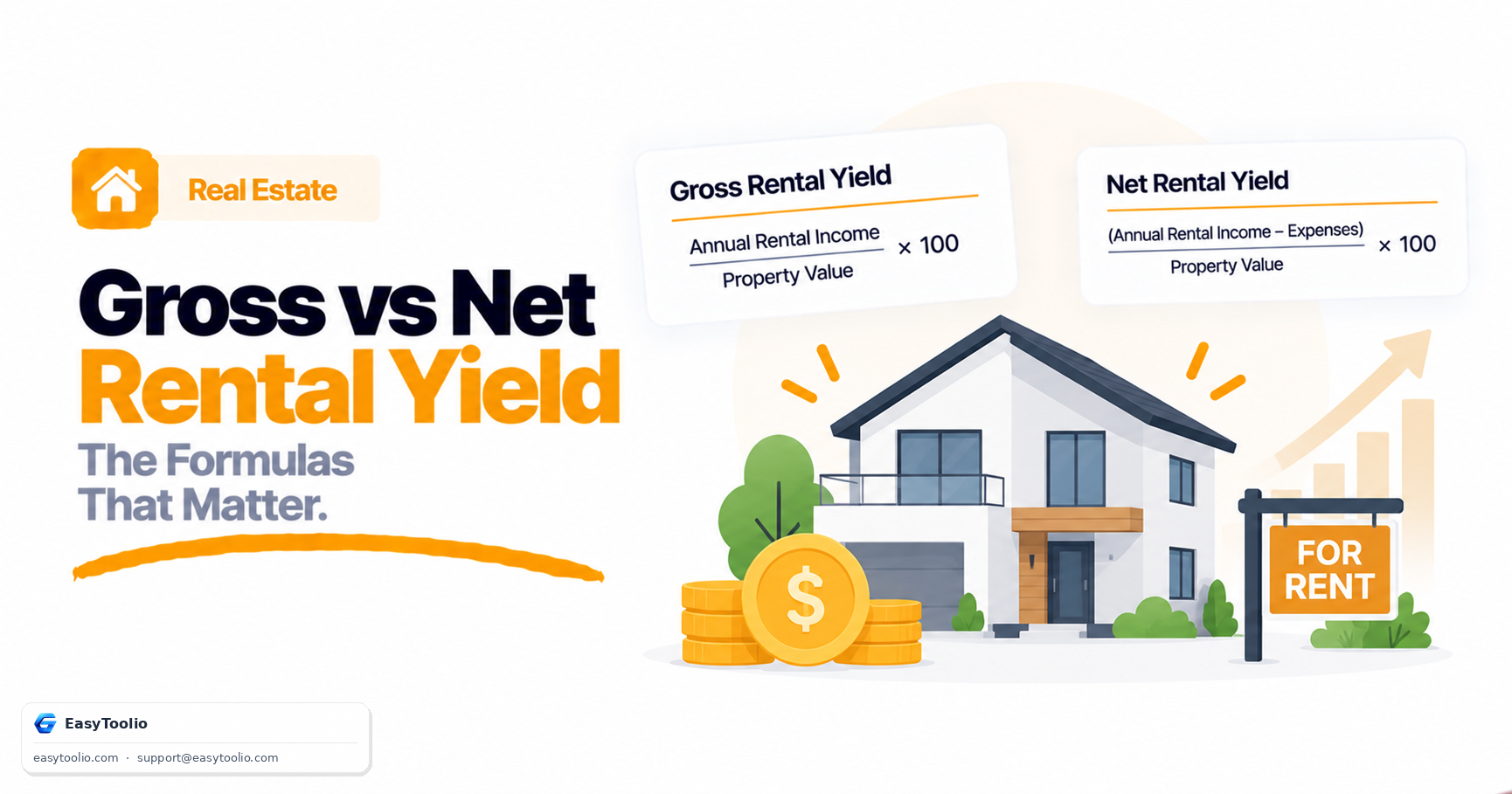
Ask ten landlords what "a good rental yield" is and you will get ten different numbers — because rental yield is meaningful only in comparison, not as an absolute figure. What every landlord and property investor should agree on, however, is the formula itself, and the critical difference between the gross figure often quoted in listings and the net figure that actually determines profitability.
Direct Answer: Gross Rental Yield is calculated as (Annual Rent ÷ Property Price) × 100, and reflects rental income before any expenses are deducted. Net Rental Yield starts from the same annual rent figure but subtracts operating expenses (property tax, insurance, maintenance, management fees, and a vacancy allowance) before dividing by the property price, giving a far more realistic picture of actual return. Because "a good yield" depends entirely on the local market and the investor's alternative options, it should be judged by comparing it against comparable local listings and against the return available from alternative investments — not against a fixed universal number.
1. The Two Formulas
Gross Rental Yield = Annual Rental Income ÷ Property Purchase Price × 100
Net Rental Yield = (Annual Rental Income - Annual Operating Expenses - Vacancy Allowance) ÷ Property Purchase Price × 100
| Yield Type | What It Includes | What It Ignores | Best Used For |
|---|---|---|---|
| Gross Yield | Rent only | Tax, insurance, maintenance, vacancy, management fees | Quick first-pass screening of listings |
| Net Yield | Rent minus all operating costs and vacancy | Financing costs (mortgage interest), capital appreciation | Realistic comparison of actual cash return |
Note that neither figure includes mortgage financing costs or capital appreciation — those belong in a separate return-on-investment calculation, not in the yield formula itself.
2. What Belongs in "Operating Expenses"
Net yield is only as accurate as the expense list behind it. A realistic net-yield calculation typically subtracts:
- Property tax (annual assessment)
- Landlord/building insurance
- Routine maintenance and repairs
- Property management fees, if a manager is used (commonly a percentage of collected rent)
- A vacancy allowance — an estimate for the weeks or months per year the unit may sit unrented between tenants
- Service charges or HOA/society fees, where applicable
Omitting the vacancy allowance is the single most common way landlords overstate their real yield, because a property that is rented 11 months out of 12 does not earn 12 months of rent.
3. Worked Numeric Example
Consider a property purchased for $300,000, rented at $2,000/month ($24,000/year):
Gross Yield: $24,000 ÷ $300,000 × 100 = 8.0%
Now apply realistic operating costs — say $3,000/year property tax, $1,200/year insurance, $1,800/year maintenance, $1,440/year management fee (6% of rent), and a one-month vacancy allowance ($2,000):
Total Deductions = $3,000 + $1,200 + $1,800 + $1,440 + $2,000 = $9,440
Net Yield = ($24,000 - $9,440) ÷ $300,000 × 100 = $14,560 ÷ $300,000 × 100 ≈ 4.85%
The gap between the 8.0% gross figure often quoted in a listing and the ~4.85% net figure is nearly half — which is exactly why relying on gross yield alone can make a mediocre investment look excellent.
4. How to Judge Whether a Yield Is "Good"
There is no single universal benchmark yield that applies across all cities, property types, and markets — a yield considered strong in one metro area may be mediocre in another with different price-to-rent dynamics. Instead of anchoring to a fixed percentage, compare your calculated net yield against two references:
- Comparable local listings: What net yield do similar properties (same neighborhood, property type, and condition) generate? This tells you whether this specific property is priced attractively relative to its rental income potential.
- Alternative-investment hurdle rates: What return could the same capital earn elsewhere (index funds, bonds, other real estate markets), adjusted for the relative risk and liquidity of each option? A rental property's net yield should be evaluated against what you are giving up by not deploying that capital elsewhere — not in isolation.
A yield calculation is a starting filter, not a final verdict — it should be paired with an ROI calculation that also accounts for financing costs and capital appreciation before a final investment decision is made.
Calculate both gross and net figures instantly using rental-yield-calculator, estimate full investment return including appreciation with property-roi-calculator, and total your acquisition costs with property-cost-calculator.
5. Frequently Asked Questions (FAQs)
Why do property listings usually advertise gross yield instead of net yield?
Gross yield is simpler to calculate and produces a higher, more attractive-looking number, since it excludes the operating costs that reduce real profitability. Always recalculate net yield yourself before relying on an advertised figure.
Does rental yield tell me my total return on a property?
No. Rental yield measures income return relative to purchase price; it does not include capital appreciation, mortgage interest costs, or the tax treatment of rental income and expenses — those factors belong in a separate ROI calculation.
Should I use current market value or original purchase price in the yield formula?
Both are used depending on the question being answered: yield on original purchase price tells you the return relative to what you actually paid, while yield on current market value tells you whether the property remains a good use of capital if you were buying it again today at today's price.
References: Standard gross/net rental yield methodology as used in property investment analysis; RICS (Royal Institution of Chartered Surveyors) property valuation guidance on operating expense treatment.