
Notification
Go to Home All Tools Compare Glossary Blog Contact

Stamp Duty Calculator

Calculate stamp duty and registration charges for property purchases across Indian states, with gender and location-based concessions.

Property & State Parameters

₹50,00,000

Legal & Government Fee Breakdown

Property Value ₹50,00,000
Stamp Duty Charges Rate: 5.00%
₹2,50,000
Registration Fees Rate: 1.00% (Capped at ₹30,000)
₹30,000
Legal Outlay Estimate
Total Gov Fees: 5.60%
Total Property Acquisition Cost ₹52,80,000

Property Outlay Share

Price vs Legal Costs
AI Legal Advisor

AI Property & Stamp Duty Advisor

Ask AI
Education

How State-Wise Stamp Duty Is Calculated

01

Stamp Duty and Registration Fee Formula

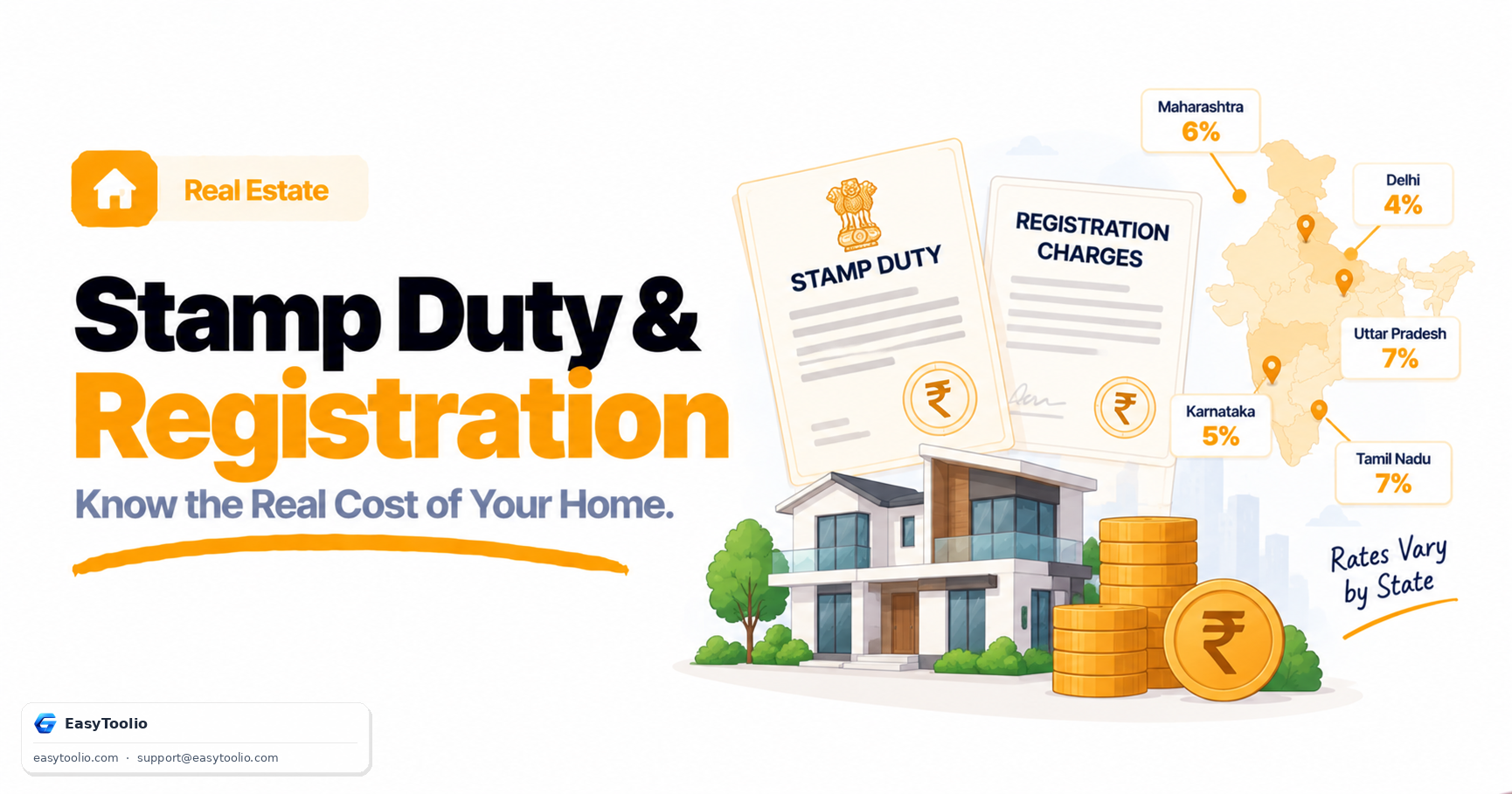
Both stamp duty and registration fee are calculated as a percentage of the property value, using rates that vary by the state selected. Maharashtra charges 5% stamp duty plus 1% registration (capped at Rs.30,000 once the property value exceeds Rs.30 lakh), while Tamil Nadu applies a flat 7% stamp duty plus a 4% registration fee.

02

Gender-Based and Urban/Rural Rate Variations

Several states adjust rates by buyer gender and location: Delhi charges 4% for women, 5% for joint male-and-female buyers, and 6% for men, all with 1% registration; Gujarat gives women a discounted 3.9% stamp duty with registration fully waived; and Karnataka and West Bengal both charge higher stamp duty in urban areas than in rural areas, with West Bengal rates increasing again once the property value crosses Rs.40 lakh.

03

Stamp Duty Calculation Example

On a Rs.50 lakh property in Delhi registered solely in the name of a woman buyer, stamp duty is 4% (Rs.2,00,000) plus 1% registration (Rs.50,000), for total government charges of Rs.2,50,000 and a total acquisition cost of Rs.52,50,000. The same property registered solely in the name of a man would carry Rs.3,00,000 in stamp duty instead.

04

When to Use Related Real Estate Tools

Use the Property Cost Calculator to see stamp duty alongside the full purchase cost, or the Home Loan EMI Calculator to plan financing that accounts for this added government outlay.

Good to know

Questions, answered

Quick answers about how this tool works.

Stamp duty is a direct tax levied by state governments on legal documents, primarily during property sales, transactions, or transfers. Paying stamp duty registers the property transaction in government records, establishing legal ownership.

Stamp duty is calculated as a percentage of the property agreement value or circle rate (whichever is higher). Registration fees are typically 1% of the property value, though some states cap it at a flat fee (e.g. ₹30,000 in Maharashtra).

Yes! Many Indian states offer lower stamp duty rates for women (e.g. 4% in Delhi compared to 6% for men, and 1% concession in UP and Punjab) to encourage property ownership among women.

Yes. Properties located within urban municipal corporation limits generally attract a higher stamp duty rate (which often includes municipal surcharges) than properties in rural gram panchayat areas.

Yes, under Section 80C of the Income Tax Act, home buyers can claim a tax deduction of up to ₹1.5 lakh on stamp duty and registration fees paid during the financial year the property was purchased.

Some states allow stamp duty refunds (usually minus a minimal cancellation charge) if the sale agreement is canceled and registered deed cancellation is filed within a specific window (typically 6 months).

Popular Tools on EasyToolio

Swipe

What do you need to work out next?

Search 190+ free tools by name, or pick a category below. Every one runs instantly in your browser — no signup, nothing to install.

More Real Estate tools