
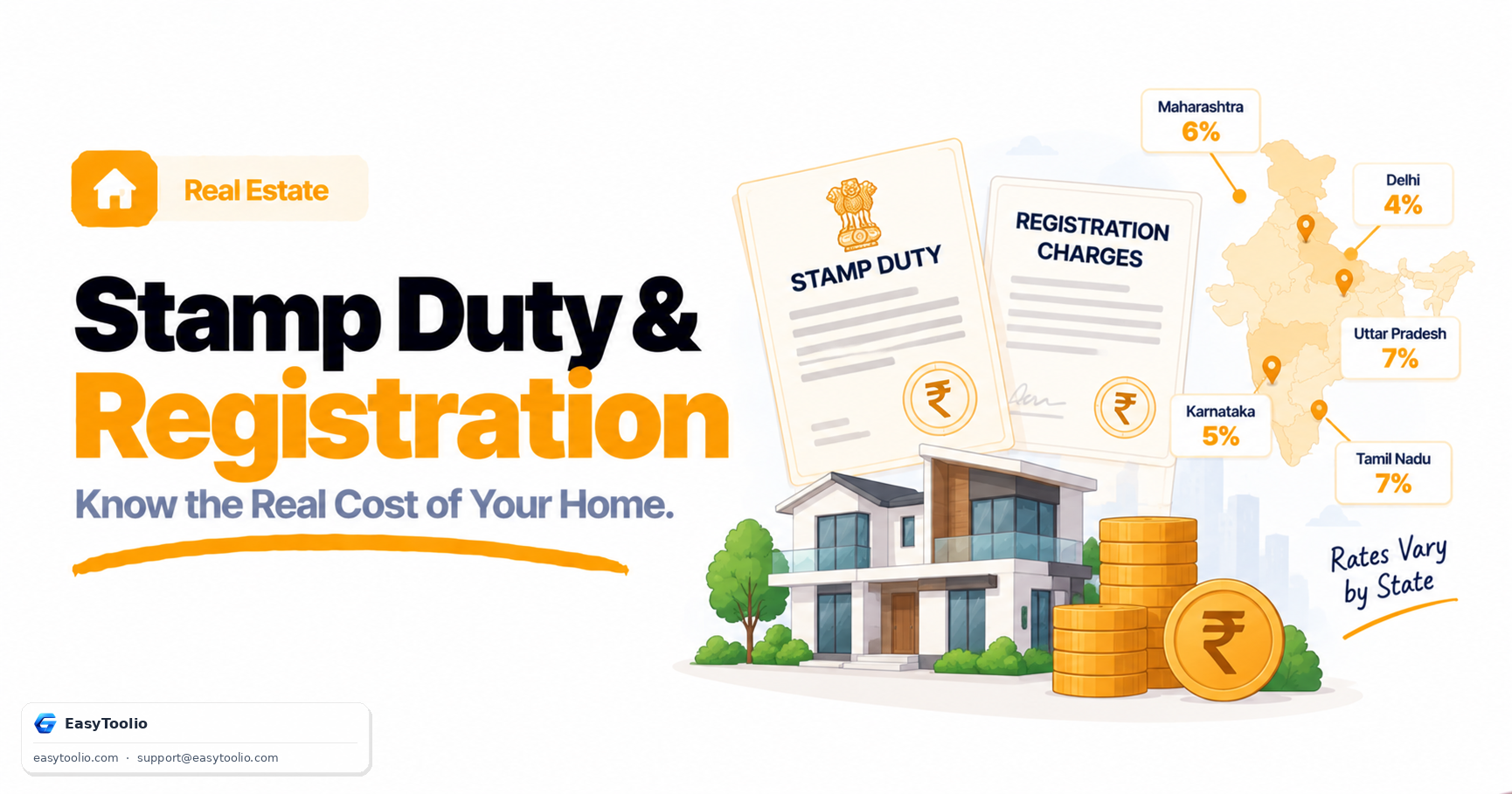
Buyers budgeting for a home purchase often focus entirely on the property price and forget that stamp duty and registration charges can add a substantial amount on top — sometimes 5-8% more than the quoted sale price. Understanding how these charges work, and why they differ so much from state to state, helps you budget accurately instead of being caught off guard at the registrar's office.
What Stamp Duty and Registration Charges Actually Are
Stamp duty is a tax levied by state governments on the legal recognition of a property transaction — essentially, the fee for making your sale deed a valid, enforceable legal document. Registration charges are a separate fee paid to record that transaction in the government's official land records. Both are state-government levies, distinct from GST, which is a central tax that applies only to under-construction properties bought directly from a builder (completed/resale properties do not attract GST).
You can estimate both charges together for your specific property and state using the Stamp Duty Calculator.
Why Rates Vary So Much by State
Because stamp duty is a state subject under India's constitution, each state government sets its own rate, and these rates change periodically through state budget announcements. As a general pattern, stamp duty across most states falls somewhere in the 3-7% range of property value, while registration charges are typically around 1%, though a few states also cap the registration fee at a flat amount for high-value properties. Cities like Mumbai, Delhi, and Bengaluru have each adjusted their applicable rates at different points in recent years, sometimes as part of temporary concessions during slow property markets. Because these numbers move, always verify the current rate applicable to your state and property type directly with the local sub-registrar office or state revenue department website before finalizing a budget — the ranges in this article are illustrative, not a substitute for the current official rate.
Common Stamp Duty Concessions
Several states offer a reduced stamp duty rate — commonly a 1-2 percentage point discount — when the property is registered solely or jointly in a woman's name, as an incentive to encourage female property ownership. Joint ownership between spouses can sometimes unlock a blended or reduced rate as well, depending on the state's specific rules. Some states also periodically announce temporary rate cuts during specific policy windows to boost registrations. Because concession rules and eligibility conditions differ by state and can change, buyers should confirm the exact applicable concession with their sub-registrar office or a property lawyer rather than assuming a rebate automatically applies.
How Stamp Duty Is Actually Calculated
A common misunderstanding is that stamp duty is calculated only on the price you agreed to pay the seller. In reality, stamp duty is charged on whichever is higher: the property's declared transaction value, or the government-notified circle rate (also called ready reckoner rate or guidance value, depending on the state) for that locality. This rule exists to prevent under-reporting of sale prices to reduce tax liability. If you buy a property below the circle rate, you'll still pay stamp duty calculated on the (higher) circle rate value, not your actual purchase price.
Worked Example: ₹80 Lakh Property
Assume a property is purchased for ₹80,00,000, the circle rate value for that property works out to the same ₹80,00,000 (i.e., the transaction value is at or above the circle rate), and the applicable rates in this illustrative example are 5% stamp duty and 1% registration charge.
| Component | Rate | Amount |
|---|---|---|
| Property value | — | ₹80,00,000 |
| Stamp duty | 5% | ₹4,00,000 |
| Registration charge | 1% | ₹80,000 |
| Total additional cost | 6% | ₹4,80,000 |
| Total outlay (property + charges) | — | ₹84,80,000 |
If this same buyer qualified for a 1-percentage-point women's concession on stamp duty (bringing it down to 4%), the stamp duty would instead be ₹3,20,000 — a savings of ₹80,000, which is a meaningful amount to factor into loan planning. Run your own numbers through the Property Cost Calculator to see the full all-in cost of a specific property, including these charges alongside brokerage and other fees.
Budgeting Tips for Buyers
Always ask your builder or seller for the circle rate applicable to the property's exact locality, since it can differ block-to-block within the same city. Factor stamp duty and registration into your total funds-required calculation separately from your down payment — banks generally do not finance these charges as part of the home loan, so you need this amount available in cash. Finally, keep in mind that stamp duty rates and concessions are revised periodically in state budgets, so a number you read a year ago may no longer be current by the time you register your property.
Frequently Asked Questions
Q: Is stamp duty the same as GST on property? A: No. Stamp duty and registration charges are state levies applicable to all property transactions, while GST is a separate central tax that applies only to under-construction properties purchased from a builder, not to resale or completed properties.
Q: Do I pay stamp duty on my agreed price or the government's circle rate? A: Whichever is higher. If your purchase price is below the area's circle rate, stamp duty is calculated on the circle rate, not your lower negotiated price.
Q: Can women buyers get a stamp duty discount in every state? A: Several states offer a reduced stamp duty rate for property registered in a woman's name, but the discount percentage, eligibility conditions, and availability vary by state and can change, so confirm current rules with your local sub-registrar.