
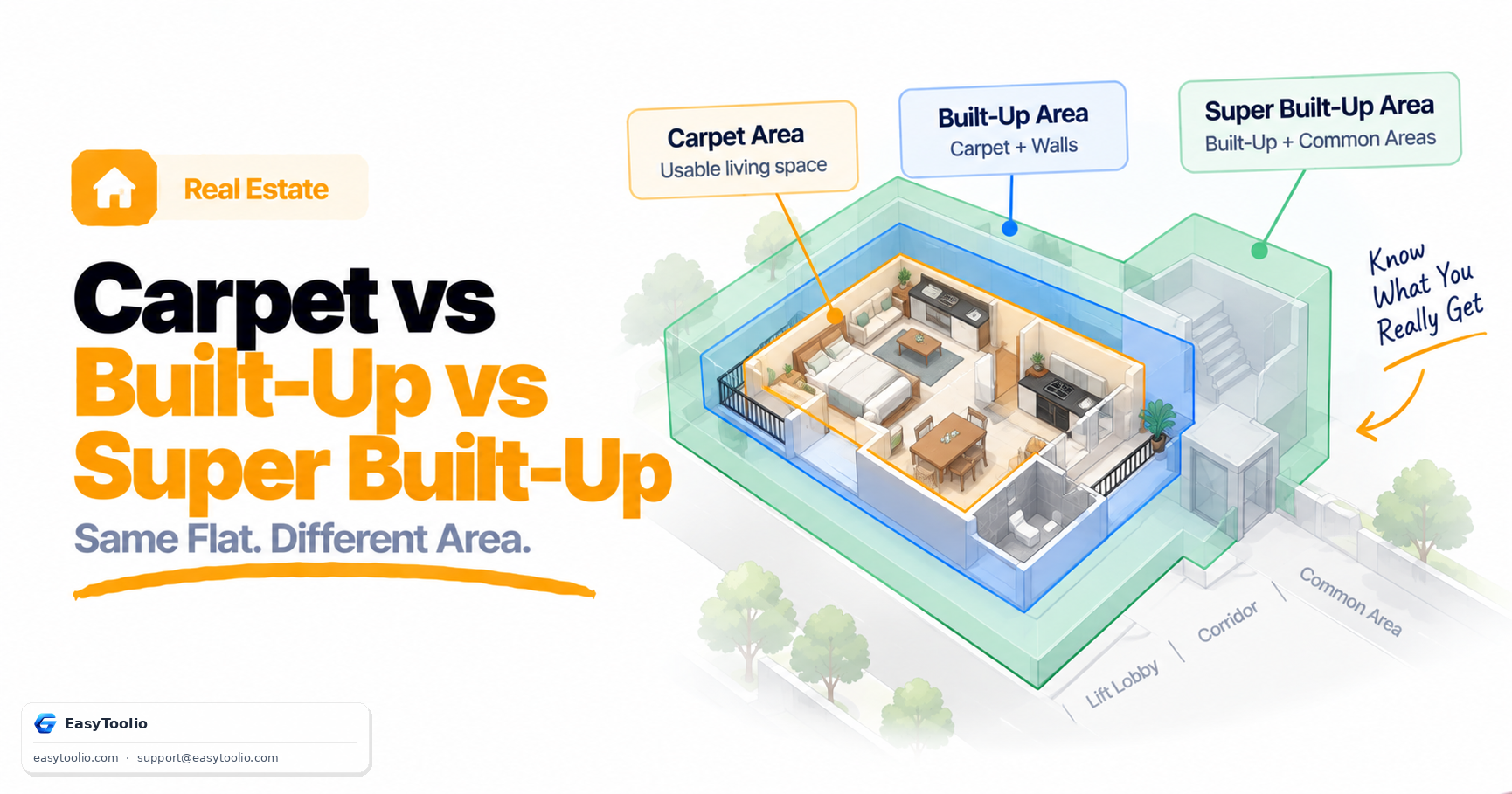
If you have ever booked a flat listed at 1,200 sq ft and then measured the actual room space with a tape and found it far smaller, you have run into the biggest source of confusion in Indian real estate: builders, brokers, and buyers often use "area" to mean three different things. Knowing exactly what carpet area, built-up area, and super built-up area mean — and how to convert between them — can save you from overpaying per usable square foot.
What Each Term Actually Means
Carpet area is the actual usable floor space inside your flat, measured wall to wall, excluding the thickness of the walls themselves. It is the area you could literally cover with carpet — your bedrooms, living room, kitchen, balconies, and internal passages, but nothing outside your unit.
Built-up area is the carpet area plus the area occupied by the walls of your flat (both internal and external walls belonging to your unit), and sometimes the balcony/utility area. It is typically 10-20% more than the carpet area, depending on the number and thickness of walls.
Super built-up area (also called "saleable area") is the built-up area plus a proportional share of the common areas of the building — the lobby, staircases, lifts, corridors, clubhouse, and sometimes the terrace. This is typically 15-25% more than the built-up area, and it is almost always the number used to quote the per-square-foot sale price, which is why flats look bigger on paper than they feel in person.
The Formulas
- Built-up Area = Carpet Area + Wall Area (≈ Carpet Area × 1.10 to 1.20)
- Super Built-up Area = Built-up Area + Proportional Common Area (≈ Built-up Area × 1.15 to 1.25)
- Carpet Area (from super built-up) = Super Built-up Area ÷ Loading Factor
The "loading factor" is the ratio between super built-up area and carpet area, and it usually ranges from 1.25 to 1.45 in Indian apartment projects. A lower loading factor means you are getting more usable space for the price you pay.
Worked Example
Suppose a builder quotes a flat at 1,000 sq ft super built-up area for ₹75,00,000, with a loading factor of 1.35.
- Carpet Area = 1,000 ÷ 1.35 ≈ 740 sq ft
- If built-up area is roughly 15% more than carpet area: Built-up Area = 740 × 1.15 ≈ 851 sq ft
- Effective price per carpet sq ft = ₹75,00,000 ÷ 740 ≈ ₹10,135 per sq ft
Notice the quoted price of ₹7,500 per sq ft (based on super built-up area) jumps to over ₹10,000 per sq ft once you calculate it on the carpet area you can actually use. This is the number that matters when comparing two projects.
Under RERA (Real Estate Regulatory Authority) rules, developers in India are now legally required to quote prices based on carpet area rather than super built-up area, though many still advertise the larger super built-up figure to make units look bigger. Always ask for the RERA carpet area certificate before signing.
Comparison Table
| Area Type | What It Includes | Typical Multiplier vs Carpet Area | Used For |
|---|---|---|---|
| Carpet Area | Usable internal floor space only | 1.0x (baseline) | RERA-mandated pricing, actual livability |
| Built-up Area | Carpet area + wall thickness + balcony | 1.10x – 1.20x | Property tax calculation, older listings |
| Super Built-up Area | Built-up area + share of common areas | 1.25x – 1.45x | Sale price quoting by builders |
How to Use This When Buying
Always ask the builder for all three figures in writing, not just the super built-up area. Use our Carpet Area Calculator to convert a quoted super built-up figure into real usable space, our Built-Up Area Calculator to check wall-area loading, and our Super Built-Up Area Calculator to reverse-engineer the loading factor a builder is applying. Comparing two flats fairly means comparing their price per carpet square foot, not their advertised super built-up size.
Frequently Asked Questions
Q: Which area does RERA require builders to use for pricing? A: RERA mandates that the sale price be quoted based on carpet area, defined precisely as the net usable floor area of an apartment excluding the area covered by external walls, service shafts, and common areas shared with other units.
Q: Is a lower loading factor always better? A: Generally yes — a lower loading factor (closer to 1.25) means you pay for less unusable common space and get more actual living area per rupee, though projects with more amenities (larger lobbies, clubhouses) tend to have higher loading factors.
Q: Does built-up area include the balcony? A: Yes, typically the balcony and utility/service area are counted within the built-up area, though some developers count balconies at 50% weightage — always confirm this in the sale agreement.