Notification
Go to Home All Tools Compare Glossary Blog Contact

Home Loan vs Renting Comparison

Compare buying a home with a loan against renting and investing the difference. Analyze net worth, EMI outgo, and property appreciation over time.

Buy vs Rent Variables

Min: ₹5 Lakh Max: ₹5 Cr
Min: ₹50,000 Max: ₹2 Cr

Ideally should not exceed the Home Price above — the loan amount is automatically floored at ₹0.

%
Min: 6% Max: 15%
Yrs
Min: 5 Yrs Max: 30 Yrs
%
Min: 0% Max: 15%
%
Min: 0% Max: 5%
Min: ₹1,000 Max: ₹5 Lakh
%
Min: 0% Max: 15%
%
Min: 1% Max: 20%
Scenarios:
Buy (Net Worth) ₹0
Property Value: ₹0
Less: Maintenance & Tax: -₹0
Monthly EMI: ₹0
Rent + Invest (Net Worth) ₹0
Down Payment Invested: ₹0
Growth from Surplus Invested: ₹0
Starting Monthly Rent: ₹0
Net Worth Difference

Buying builds ₹0 more net worth

Comparing property value against an invested rent-savings corpus.

Net Worth Growth Projections
Buy Rent + Invest

Quick Comparison Cards

Buying

Ownership
  • Upfront Capital: Large Down Payment
  • Monthly Cost: Fixed EMI
  • Liquidity: Low (Illiquid Asset)
  • Best For: Long-Term Stability

Renting + Investing

Flexible
  • Upfront Capital: ₹0 (Invested Instead)
  • Monthly Cost: Rent (Escalates Yearly)
  • Liquidity: High (Liquid Investments)
  • Best For: Flexibility & Mobility

What Buying a Home Really Involves

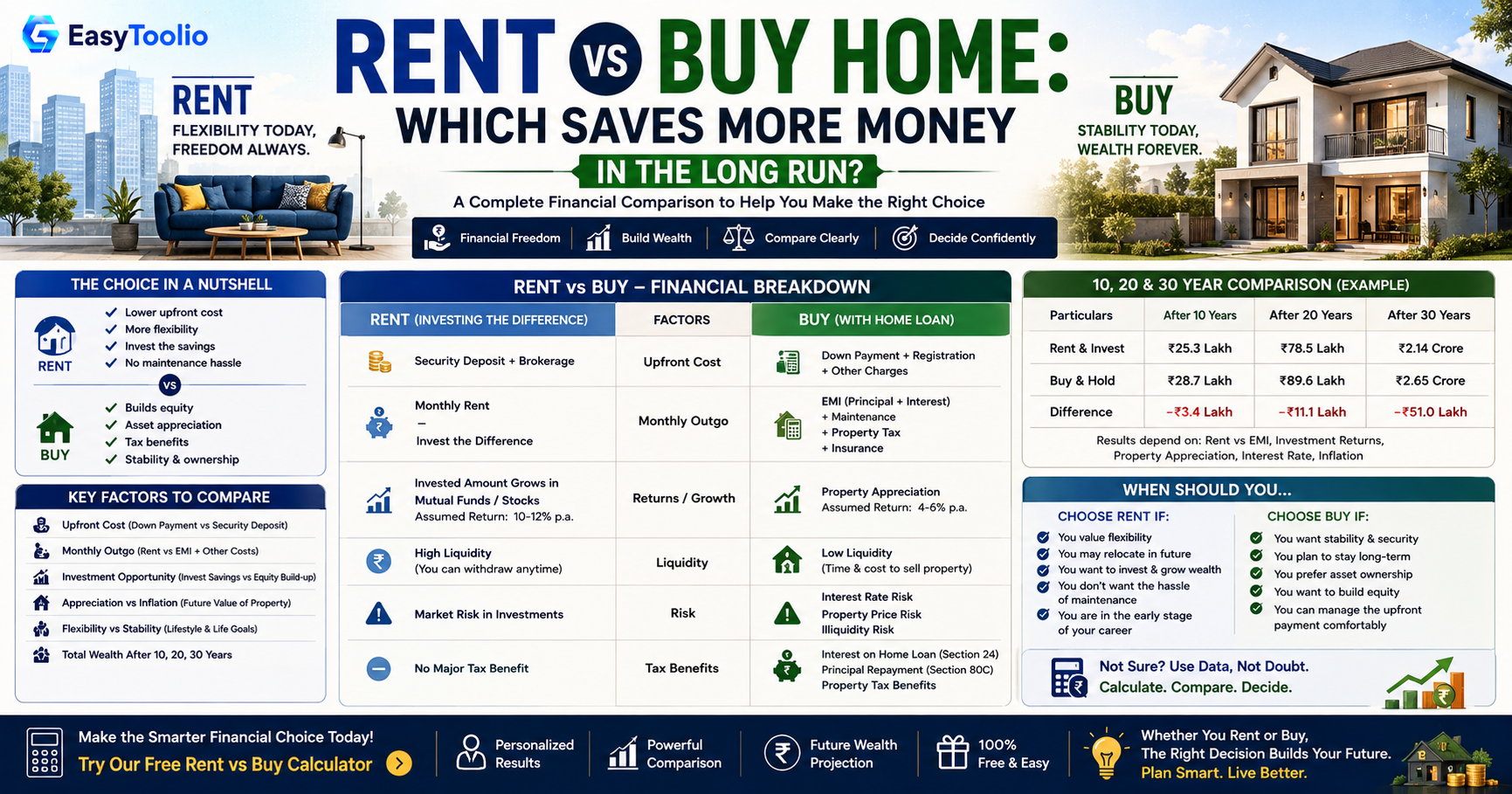
Buying a home means paying a large upfront down payment and taking on a home loan for the remainder, repaid through fixed monthly EMIs over the loan tenure. In exchange, you own a physical, appreciating asset that you can live in, customize, rent out, or pass on to your family.

Ownership also comes with recurring costs — property tax, society maintenance, repairs, and insurance — and ties up a significant chunk of your capital in an illiquid asset whose value depends heavily on location and market cycles.

What Renting + Investing the Difference Really Involves

Renting means paying a landlord a monthly rent that typically starts lower than an equivalent EMI, but escalates every year. Instead of locking up a down payment in a home, that capital — along with the monthly gap between what an EMI would cost and what rent actually costs — is invested in a diversified portfolio.

Over time, this invested corpus compounds, and the strategy only works if the surplus is genuinely invested every year rather than spent. It trades the emotional security of ownership for liquidity, flexibility, and market-linked growth potential.

Side-by-Side Parameter Matrix

Feature Buy Rent + Invest
Monthly Cost Fixed EMI for the entire loan tenure Starting monthly rent, escalating annually
Upfront Capital Required Large down payment paid at purchase ₹0 — the down payment stays invested instead
Total Maintenance Cost over Horizon Property tax & upkeep, accumulates over the horizon
Liquidity Low — property is illiquid and slow to sell High — investments can typically be redeemed anytime
Property Value / Investment Corpus at Horizon Home value grows at the assumed appreciation rate Down payment + invested monthly surplus, compounded
Net Worth at Horizon Property value minus maintenance costs Full investment corpus value

The Breakeven Point: How Long You Stay Matters Most

Buying only overtakes renting once you have owned the property long enough to absorb the one-time transaction costs and let appreciation compound meaningfully. In the early years, a large chunk of your EMI goes toward interest, and stamp duty plus registration costs are effectively sunk the moment you buy.

The longer your comparison horizon, the more time property appreciation and equity paydown have to work in your favor — but if you are likely to move within 3-5 years, renting and investing the difference is usually the financially safer choice. Use the "Comparison Horizon" slider above to test different holding periods.

Hidden Costs Buyers Often Forget

This calculator models the down payment, EMI, appreciation, and ongoing maintenance — but real home purchases carry several other costs that quietly erode returns. Stamp duty and registration charges alone can run 5-8% of the property value in many Indian states, paid entirely upfront.

On top of that, expect brokerage fees (often 1-2% of the property value), society or association charges, interior fit-out costs, and periodic repairs that are not captured by a flat maintenance percentage. Factor these into your own decision even though they are not part of the live calculation above.

Why Property Appreciation Isn't Guaranteed

Unlike the diversified investment portfolio assumed on the renting side, a single property is a concentrated, location-dependent bet. Appreciation varies wildly between micro-markets — a flat in a well-connected suburb may compound steadily, while one in an oversupplied locality may stagnate or even fall in real terms.

Real estate is also illiquid and carries no diversification: your entire net worth can end up concentrated in one asset, one city, and one micro-market cycle. A diversified investment portfolio, by contrast, spreads risk across many companies, sectors, and asset classes.

Emotional and Lifestyle Factors This Calculator Can't Capture

Owning a home offers a sense of stability, permanence, and freedom to customize your living space — factors that matter a great deal to growing families and long-term residents, but that carry no dollar value in a spreadsheet.

Renting, on the other hand, offers the freedom to relocate for a new job, a growing family's changing space needs, or simply a change of scenery — without the friction of selling a property. Weigh these lifestyle factors alongside the numbers, not instead of them.

Home Loan vs Renting: Which is Better?

The right choice depends on how long you plan to stay, how disciplined an investor you are, and how much you value stability versus flexibility.

When to Choose Buying

  • You plan to stay in the same city or home for 10+ years.
  • You value stability, customization, and owning an asset outright.
  • You can comfortably afford the down payment without straining your finances.
  • You expect strong, sustained property appreciation in your specific location.
  • You want to build long-term, inheritable real estate wealth.

When to Choose Renting + Investing

  • Your job or lifestyle may require relocating within the next few years.
  • You would rather deploy your capital into diversified, liquid investments.
  • You are disciplined enough to actually invest the monthly surplus, not spend it.
  • You want maximum flexibility and easy access to your money.
  • You are early in your career and unsure of your long-term city or location plans.

Buy Pros & Cons

Pros:

  • Builds home equity you fully own over time
  • Shields you from rent inflation for good
  • Emotional security and stability of ownership
  • Potential rental income if you relocate later

Cons:

  • Large upfront down payment locks up capital
  • Illiquid — hard to access money in emergencies
  • Ongoing maintenance, tax & repair costs
  • Appreciation is not guaranteed and is location-dependent

Rent + Invest Pros & Cons

Pros:

  • No large upfront capital lock-in
  • Full flexibility to relocate for work or lifestyle
  • Capital can grow in a diversified, liquid portfolio
  • No maintenance, repair, or property tax burden

Cons:

  • Rent has no ownership payoff and keeps rising
  • Requires discipline to actually invest the surplus monthly
  • Landlord can raise rent or ask you to vacate
  • No emotional security of owning a home

Real-World Scenarios

Illustrative examples only — actual results depend on the inputs you set above and are not guaranteed.

Scenario 1: The Metro Professional Buys

Rahul wants to buy a ₹80,00,000 apartment in a metro city with a ₹16,00,000 down payment, taking an 8.5% home loan for the remaining ₹64,00,000 over a 20-year comparison horizon. The equivalent rented home costs ₹30,000/month, escalating 5% a year.
Illustrative Analysis: With 5% annual property appreciation, his home could be worth roughly ₹2.1 crore in 20 years, against maintenance costs of around ₹16,00,000. If he instead invested the ₹16,00,000 down payment and the EMI-minus-rent surplus at 11% per year, the corpus could grow to a comparable or higher figure — the calculator above shows the exact numbers for his precise inputs.

Scenario 2: The Tier-2 City Saver Rents & Invests

Simran works in a tier-2 city where an equivalent home costs ₹40,00,000, with an ₹8,00,000 down payment and an 8.5% home loan over 15 years. She currently rents a similar home for ₹15,000/month and can invest at 12% per year.
Illustrative Analysis: Because her EMI is significantly higher than her starting rent, she has a large monthly surplus to invest early on. Over 15 years, that compounding surplus — plus her invested down payment — could build a sizeable corpus, potentially rivalling the appreciated property value, especially if she expects to relocate for career growth before the horizon ends.

Frequently Asked Questions

Get answers to the most common questions about buying a home versus renting and investing.

No. Buying builds equity in an appreciating asset but ties up your down payment and locks you into EMIs, maintenance, and property tax. Renting keeps you flexible and lets you invest the money you would have spent on a down payment. Which is better depends on how long you plan to stay, local property appreciation, and the return you could earn by investing instead.

The breakeven point is roughly how many years it takes for a home's built-up equity and appreciation to outweigh what a renter could have accumulated by investing the down payment and any EMI-rent difference. Shorter stays usually favor renting since upfront costs like registration and brokerage take years to recover.

Higher expected appreciation makes buying more attractive since your home's value compounds over the holding period, similar to an investment. However, property appreciation varies a lot by city and locality and is far less predictable than a diversified investment portfolio's long-term average return.

Stamp duty and registration charges (typically several percent of property value), brokerage, home loan processing fees, society maintenance, property tax, and repair costs are frequently left out of a simple "EMI vs rent" comparison, but they meaningfully affect the true cost of owning.

Yes, it is mathematically possible, especially when the EMI on an equivalent home loan is significantly higher than rent, and the investor consistently invests that surplus at a reasonable long-term return. This is exactly what this calculator projects for the "Rent + Invest" side.

This calculator focuses on the core cash-flow comparison — EMI, rent, appreciation, and investment growth — to keep the numbers easy to follow. Home loan interest and principal tax deductions can improve the buy scenario further depending on your tax slab, so treat this as a starting estimate, not a complete tax analysis.

As a general rule of thumb, buying tends to make more financial sense the longer you plan to stay in one place, commonly cited as 5-7+ years, since it gives more time to recover upfront transaction costs and benefit from property appreciation.

It means keeping the down payment invested instead of putting it into a property, and whenever your rent is lower than what an equivalent home loan EMI would be, investing that monthly surplus into a diversified fund instead of spending it, so the two strategies can be compared on equal footing.

What do you need to work out next?

Search 190+ free tools by name, or pick a category below. Every one runs instantly in your browser — no signup, nothing to install.

More Finance tools