
Notification
Go to Home All Tools Compare Glossary Blog Contact

Fraction Calculator

Add, subtract, multiply, or divide fractions and mixed numbers with this fraction calculator, complete with step-by-step solutions.

Select Operation
Mode: Mixed Number
Fraction 1
Fraction 2
Try Presets:

Types of Fractions

Proper Fraction Numerator < Denominator (e.g. 3/4, 5/8)
Improper Fraction Numerator ≥ Denominator (e.g. 7/4, 11/3)
Mixed Number Whole number + Proper fraction (e.g. 2 1/3)
Equivalent Fractions Equal numeric value (e.g. 2/4 = 1/2 = 50%)
Simplified Answer
Mixed Number 0
Improper Fraction 0
Decimal Value 0
Percentage 0%

Step-by-Step Solution

Common Fraction Conversions

1/2 0.50 (50%)
1/3 0.333 (33.3%)
1/4 0.25 (25%)
3/4 0.75 (75%)
1/5 0.20 (20%)
1/8 0.125 (12.5%)
Comprehensive Educational Guide

Mastering Fraction Arithmetic & Conversions

Learn how to perform fraction operations, convert between mixed numbers and improper fractions, and simplify results to lowest terms step-by-step.

1

Finding the LCD

To add or subtract fractions with different denominators, find the Least Common Denominator (LCD) by calculating the LCM of denominators.

2

Simplifying with GCD

A fraction is in simplest form when its numerator and denominator share no common factors other than 1 (divide both terms by GCD).

3

Mixed to Improper

To convert a mixed number w (n/d) to an improper fraction: multiply whole number by denominator, add numerator: (w·d + n) / d.

Step-by-Step Practical Calculations

Example 1: Adding 1/2 + 3/4

Goal: Add two fractions with unlike denominators.

  1. Find LCD of 2 and 4: LCD = 4
  2. Convert 1/2 to equivalent fraction with denominator 4: (1×2)/(2×2) = 2/4
  3. Add numerators: 2/4 + 3/4 = 5/4
  4. Convert improper fraction to mixed number: 1 1/4 (or 1.25)
Example 2: Dividing 3/4 ÷ 2/3

Goal: Divide two fractions using reciprocal rule.

  1. Keep first fraction: 3/4
  2. Change division (÷) to multiplication (×)
  3. Flip second fraction (reciprocal of 2/3): 3/2
  4. Multiply numerators & denominators: (3×3)/(4×2) = 9/8 = 1 1/8

Real-World Practical Applications

🎂

Culinary & Baking

Adjust measuring cup quantities when scaling recipes up or down (e.g. 1/2 cup to 3/4 cup flour).

🛠️

Carpentry & Hardware

Read imperial tape measure inch marks in eighths, sixteenths, and thirty-seconds (5/8", 3/16").

📊

Stock Shares & Equity

Calculate fractional stock share purchases, dividend yields, and corporate equity ownership splits.

🎵

Music Notation

Understand musical note beat values (whole note 1/1, half note 1/2, quarter note 1/4, eighth note 1/8).

Formula Reference

LCM & HCF (GCD) Formula

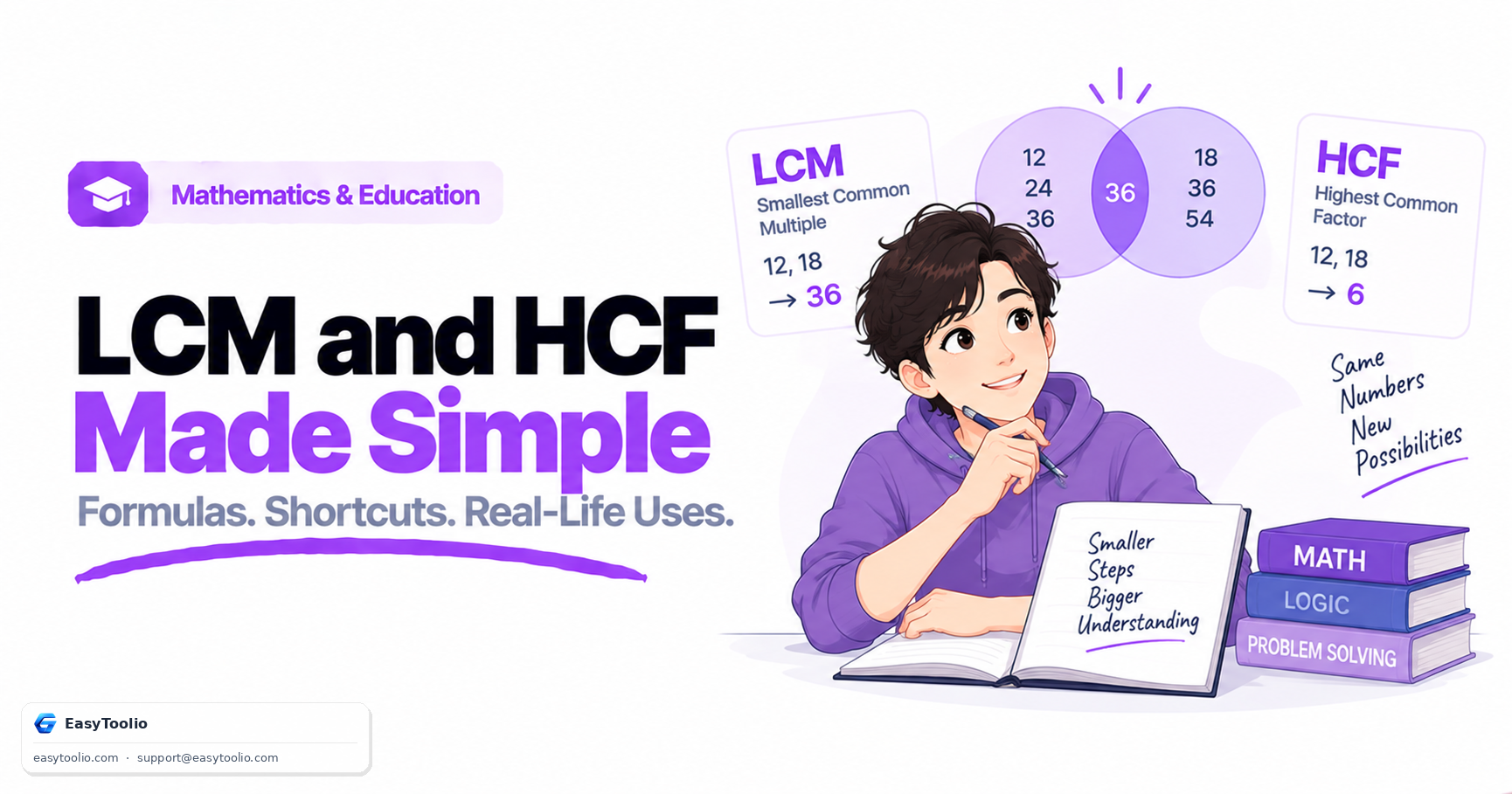
The Least Common Multiple (LCM) is the smallest positive integer divisible by all numbers in a set, while the Highest Common Factor (HCF or GCD) is the largest integer that divides...

$$\text{LCM}(a, b) \times \text{HCF}(a, b) = a \times b \quad \implies \quad \text{LCM}(a, b) = \frac{a \times b}{\text{HCF}(a, b)}$$
View Full Formula, Step-by-Step Guide & Worked Examples
Algebra & Math

AI Math Tutor

Ask AI
Education

How Fraction Arithmetic and Simplification Work

01

Fraction Arithmetic Formulas

Addition and subtraction require a common denominator, found using the Least Common Multiple (LCM) of the two denominators, before combining numerators: (a/b) ± (c/d) becomes equivalent fractions over the LCD. Multiplication multiplies numerators and denominators directly: (a/b) × (c/d) = (a×c)/(b×d), while division multiplies by the reciprocal of the second fraction: (a/b) ÷ (c/d) = (a/b) × (d/c).

02

Simplifying with the GCD

After computing a result, the calculator divides both the numerator and denominator by their Greatest Common Divisor (GCD), found using the Euclidean algorithm, to reduce the fraction to lowest terms. A common mistake is leaving a fraction unsimplified or forgetting to convert an improper fraction back into a mixed number for a final answer.

03

Worked Fraction Example

Adding 1/2 + 3/4: the LCD of 2 and 4 is 4, so 1/2 becomes 2/4, and 2/4 + 3/4 = 5/4. Since 5/4 is improper, it converts to the mixed number 1 1/4, which equals 1.25 in decimal form.

04

Practical Uses and Related Tools

Fraction skills are used in recipe scaling, carpentry tape measurements in eighths and sixteenths of an inch, and reading musical note durations. Use the LCM & HCF Calculator to find common denominators for more complex fractions, or the Average Calculator when working with sets of fractional values.

Good to know

Questions, answered

Quick answers about how this tool works.

Find the Least Common Denominator (LCD), convert each fraction to equivalent fractions with that LCD, add or subtract numerators, and simplify.

Multiply the top numbers (numerators) together and multiply the bottom numbers (denominators) together, then reduce the fraction to simplest form.

Flip the second fraction (find its reciprocal) and multiply it by the first fraction: (a/b) ÷ (c/d) = (a/b) × (d/c) = (a×d) / (b×c).

An improper fraction has a numerator larger than or equal to its denominator (e.g. 7/4). A mixed number combines a whole number and proper fraction (e.g. 1 3/4).

Dividing both the numerator and denominator by their Greatest Common Divisor (GCD) simplifies the fraction to its lowest terms.

Popular Tools on EasyToolio

Swipe

What do you need to work out next?

Search 190+ free tools by name, or pick a category below. Every one runs instantly in your browser — no signup, nothing to install.