
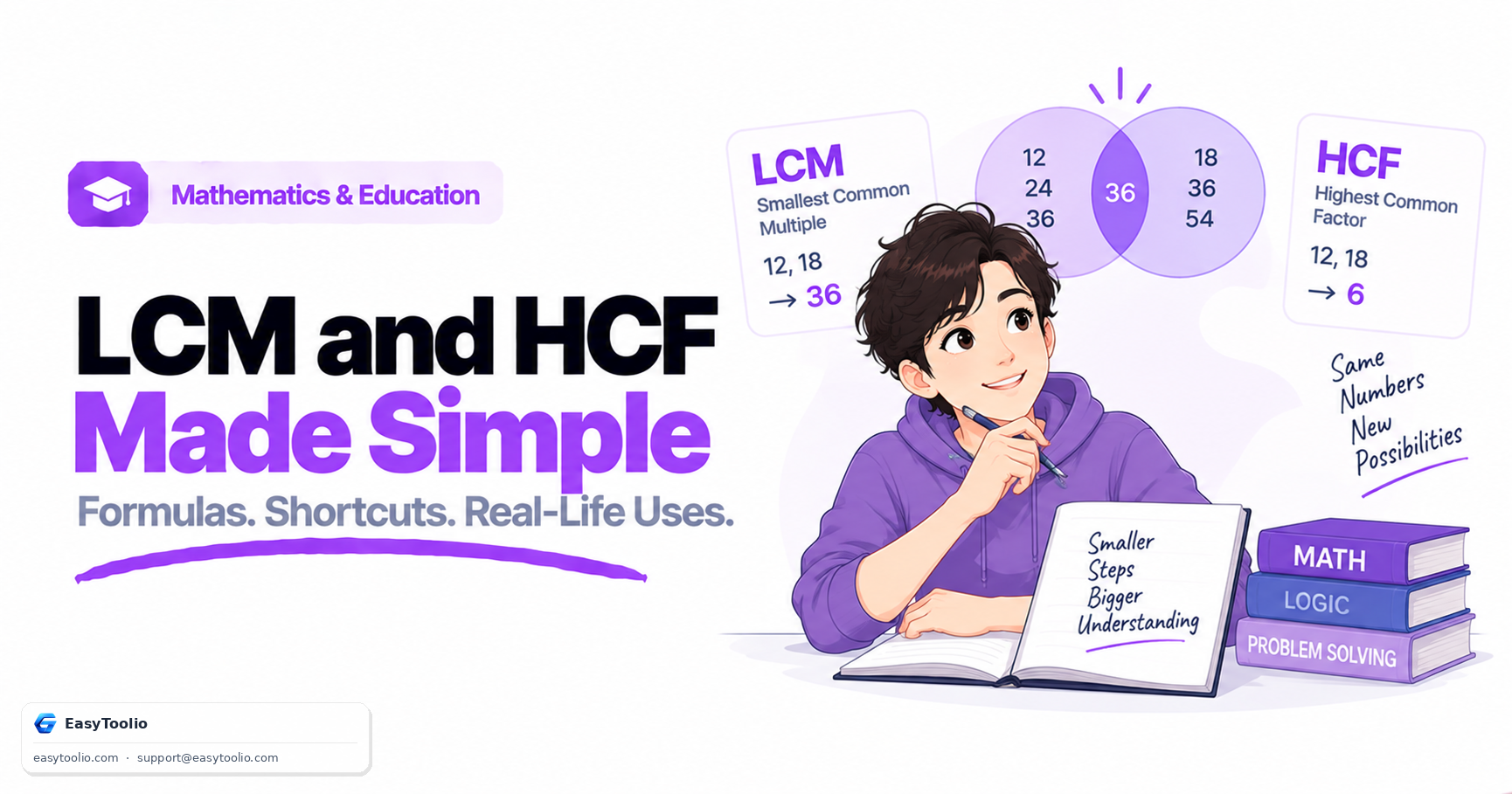
LCM and HCF show up everywhere in school maths — from fraction addition to those classic "when will two bells ring together again" word problems. Once you know two methods and one shortcut formula, both become fast, almost mechanical calculations. Here is everything you need, with worked examples.
What LCM and HCF Actually Mean
LCM (Least Common Multiple) of two or more numbers is the smallest number that all of them divide into exactly. It is the smallest number that appears in every number's multiplication table.
HCF (Highest Common Factor), also called GCD (Greatest Common Divisor), is the largest number that divides all the given numbers exactly, with no remainder.
Think of it this way: HCF finds what the numbers share; LCM finds the smallest number that contains them all.
Try both instantly with the LCM and HCF Calculator — enter any set of numbers and see the full working, not just the answer.
Method 1: Prime Factorization
This is the most reliable method and the one every textbook teaches first.
Worked example — find the LCM and HCF of 24 and 36:
Step 1: Break each number into prime factors.
- 24 = 2 × 2 × 2 × 3 = 2³ × 3¹
- 36 = 2 × 2 × 3 × 3 = 2² × 3²
Step 2: For HCF, take the lowest power of every prime that appears in both numbers.
- Common primes: 2 and 3
- Lowest power of 2: 2² (from 36)
- Lowest power of 3: 3¹ (from 24)
- HCF = 2² × 3¹ = 4 × 3 = 12
Step 3: For LCM, take the highest power of every prime that appears in either number.
- Highest power of 2: 2³ (from 24)
- Highest power of 3: 3² (from 36)
- LCM = 2³ × 3² = 8 × 9 = 72
So the HCF of 24 and 36 is 12, and the LCM is 72.
Method 2: The Division (Euclidean) Shortcut for HCF
Prime factorization gets slow with large numbers. For HCF specifically, the division method (Euclidean algorithm) is much faster:
- Divide the larger number by the smaller number and note the remainder.
- Divide the previous divisor by that remainder.
- Repeat until the remainder is 0. The last non-zero divisor is the HCF.
Worked example — HCF of 84 and 32:
| Step | Divide | Quotient | Remainder |
|---|---|---|---|
| 1 | 84 ÷ 32 | 2 | 20 |
| 2 | 32 ÷ 20 | 1 | 12 |
| 3 | 20 ÷ 12 | 1 | 8 |
| 4 | 12 ÷ 8 | 1 | 4 |
| 5 | 8 ÷ 4 | 2 | 0 |
The remainder became 0 at divisor 4, so HCF = 4. This method takes seconds even for large numbers where factorization would be tedious.
The Shortcut Formula: LCM x HCF = Product of the Numbers
For any two numbers, there is a fixed relationship:
LCM × HCF = First number × Second number
This is extremely useful as both a shortcut and a self-check. If you already know one of LCM or HCF, you can find the other instantly by division instead of repeating the whole method.
Check using our earlier example (24 and 36): LCM × HCF = 72 × 12 = 864 24 × 36 = 864 ✓
They match, confirming the answer is correct. Note this shortcut formula only works for two numbers, not three or more.
Where LCM and HCF Actually Get Used
These are not just exam concepts — both show up in everyday and technical problems:
- Adding or comparing fractions: To add 1/24 + 5/36, you need a common denominator — that denominator is the LCM of 24 and 36, i.e. 72. This is exactly why the Fraction Calculator computes the LCM internally before adding unlike fractions.
- Scheduling and timing problems: "Two traffic lights change every 24 seconds and 36 seconds. If they change together now, when will they next change together?" The answer is the LCM — 72 seconds.
- Dividing into equal groups: "You have 84 pens and 32 pencils and want to make identical gift packs with no items left over." The largest number of packs you can make is the HCF — 4 packs.
- Simplifying ratios and fractions: Dividing both terms of a ratio by their HCF reduces it to the simplest form.
- Music and repeating patterns: LCM determines when two repeating cycles — such as musical beats or rotating gears — will align again.
Common Mistakes Students Make
- Confusing which one is bigger. LCM is always greater than or equal to the largest number given; HCF is always less than or equal to the smallest number given. If your HCF comes out bigger than one of the input numbers, you made an error.
- Forgetting to take the lowest/highest power correctly in the prime factorization method — always double-check which prime factors are common to all numbers, not just some.
- Applying the LCM × HCF = product shortcut to three or more numbers. It only holds for exactly two numbers.
- Stopping the division method too early. The HCF is the last non-zero remainder's divisor, not the first small number you see.
Frequently Asked Questions
Q: What is the difference between HCF and GCD? A: They are the same thing — HCF (Highest Common Factor) and GCD (Greatest Common Divisor) are two names for the identical concept, just used more commonly in different regions and textbooks.
Q: Does the LCM x HCF = product shortcut work for three numbers? A: No, this shortcut only applies to exactly two numbers. For three or more numbers, you must use the prime factorization method directly to find LCM and HCF separately.
Q: Which method is faster for large numbers? A: The division (Euclidean) method is much faster for HCF with large numbers, since it avoids fully factorizing each number. For LCM, prime factorization remains the most reliable approach, or you can compute it from HCF using LCM = (a x b) / HCF for two numbers.