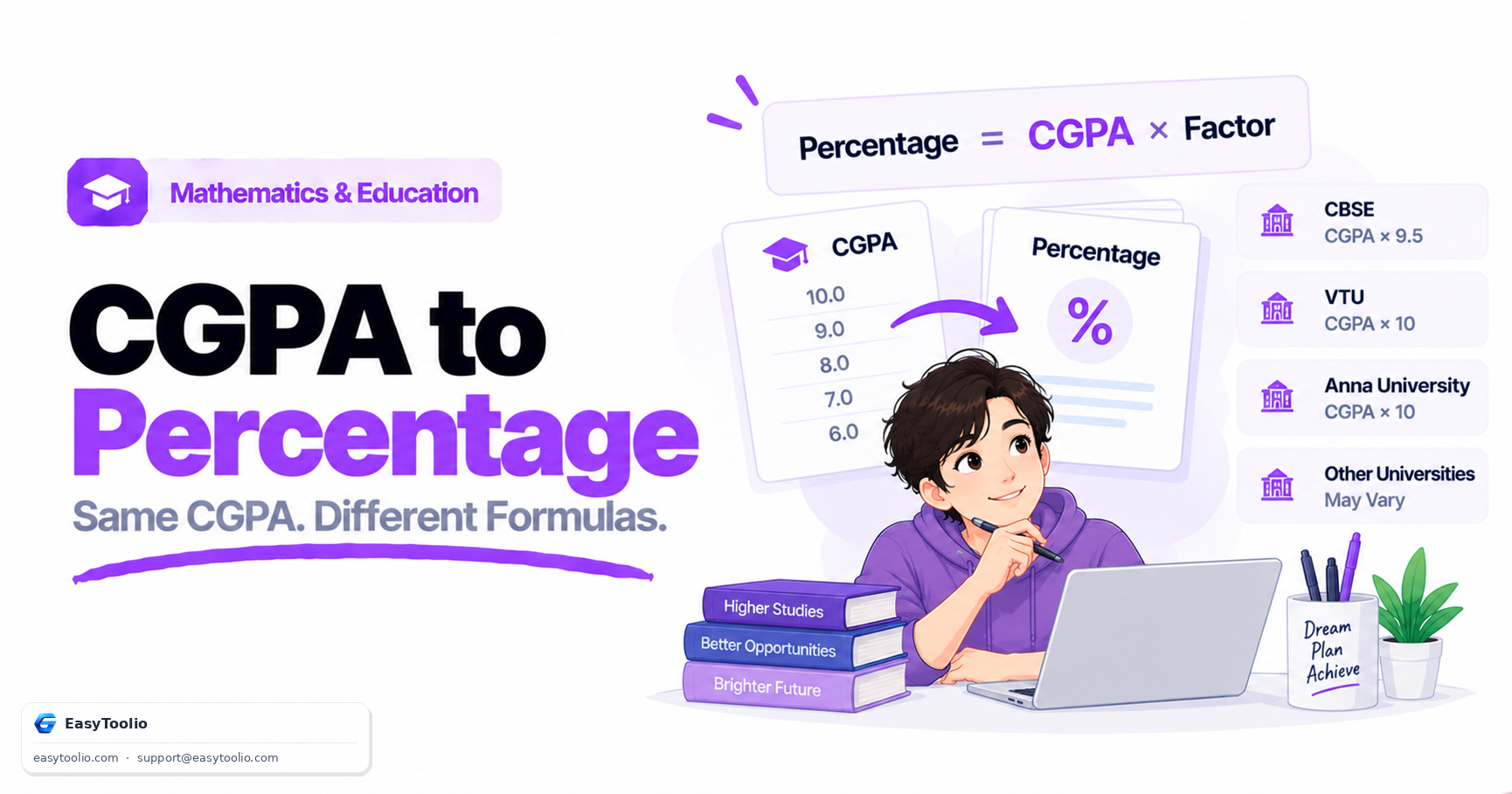
"What is my CGPA in percentage?" is one of the most searched academic questions in India — and one of the most inconsistently answered, because there is no single national formula. CBSE, state universities, and technical universities each apply their own conversion factor. Here is exactly what each one uses.
Why There Is No Universal CGPA-to-Percentage Formula
CGPA (Cumulative Grade Point Average) is reported on a 10-point scale, while percentage is reported out of 100. Converting between the two requires a multiplication factor, but that factor was set independently by different education boards and universities — there was never a single national standard. This is why the same CGPA can translate to a different percentage depending on which institution issued it. You can check your own conversion instantly using the CGPA to Percentage Calculator, or go the other way with the Percentage to CGPA Calculator.
Common CGPA-to-Percentage Formulas in India
| Institution / Board | Formula | Example (CGPA 8.4) |
|---|---|---|
| CBSE (Class 10 & 12) | Percentage = CGPA × 9.5 | 8.4 × 9.5 = 79.8% |
| VTU (Visvesvaraya Technological University) | Percentage = (CGPA − 0.75) × 10 | (8.4 − 0.75) × 10 = 76.5% |
| Anna University | Percentage = CGPA × 10 (approx., varies by regulation year) | 8.4 × 10 = 84% |
| Generic 10-point scale (many universities) | Percentage = CGPA × 10 | 8.4 × 10 = 84% |
Worked Examples
CBSE student with CGPA 9.2: Percentage = 9.2 × 9.5 = 87.4%
VTU engineering student with CGPA 7.8: Percentage = (7.8 − 0.75) × 10 = 7.05 × 10 = 70.5%
Generic 10-point university, CGPA 6.5: Percentage = 6.5 × 10 = 65%
Notice that the exact same CGPA of 8.4 produces results ranging from 76.5% to 84% depending purely on which formula applies — an almost 8-point swing. This is precisely why blindly using CGPA × 9.5 (the CBSE formula) for an engineering degree, or CGPA × 10 for a CBSE mark sheet, produces an incorrect percentage.
Why the "Official" Conversion Sometimes Differs From What Employers Expect
Some employers and foreign university admissions offices apply their own blanket conversion (often a flat CGPA × 9.5, since it is the most widely known formula from CBSE) regardless of which institution actually issued the CGPA. This can work against students from universities that use a more generous formula like CGPA × 10, since the employer's assumed conversion understates their actual percentage. If a specific cutoff matters — for a job application or an admission requirement — it is worth requesting an official conversion certificate directly from your university's examination department rather than relying on a generic formula.
How to Find Your Institution's Official Formula
- Check your marksheet or grade card — many universities print the conversion formula directly on the document, often in small print near the CGPA field.
- Visit your university's examination/controller of examinations webpage — most publish an official circular or regulation document specifying the exact formula for your batch and course.
- Contact the examination cell directly — if the formula is not published, a formal request usually gets a written response you can use for job or visa applications.
- Check your regulation year — some universities (including Anna University) have changed their CGPA formula across different curriculum revisions, so a formula that applied to a 2015-batch student may not apply to a 2021-batch student.
Why the Formula You Use Actually Matters
This isn't just an academic curiosity — the formula choice has real consequences. Scholarship cutoffs, admission eligibility criteria, and some recruiter shortlisting filters are often stated as a minimum percentage (for example, "60% and above"). A student whose university uses CGPA × 10 clears a 60% cutoff at a CGPA of exactly 6.0, while a CBSE-formula equivalent would need only a CGPA of about 6.32 (60 ÷ 9.5) to clear the same bar. Using the wrong formula to self-check eligibility before applying can lead a student to wrongly assume they don't qualify — or wrongly assume they do — for a cutoff that a correct, institution-specific conversion would have placed on the other side of the line.
Reversing the Formula: Percentage to CGPA
Some situations run the other direction — an admissions form or scholarship portal asks for CGPA, but your marksheet only shows a percentage. Rearranging each formula above gives the reverse conversion:
| Institution / Board | Forward Formula | Reverse Formula | Example (75%) |
|---|---|---|---|
| CBSE (Class 10 & 12) | Percentage = CGPA × 9.5 | CGPA = Percentage ÷ 9.5 | 75 ÷ 9.5 ≈ 7.89 |
| VTU | Percentage = (CGPA − 0.75) × 10 | CGPA = (Percentage ÷ 10) + 0.75 | (75 ÷ 10) + 0.75 = 8.25 |
| Generic 10-point scale | Percentage = CGPA × 10 | CGPA = Percentage ÷ 10 | 75 ÷ 10 = 7.50 |
As with the forward conversion, the same 75% produces three different CGPA estimates depending on the formula — anywhere from 7.50 to 8.25 — so the reverse conversion is subject to exactly the same institution-specific caveat as the forward one. Our Percentage to CGPA Calculator applies these reverse formulas directly.
Common Mistakes When Converting CGPA to Percentage
- Applying the CBSE ×9.5 factor to a university CGPA. This is by far the most common error, since CGPA × 9.5 is the formula most students encounter first (from school) and mistakenly assume is universal.
- Forgetting VTU's −0.75 deduction before multiplying. Calculating VTU percentage as CGPA × 10 instead of (CGPA − 0.75) × 10 overstates the percentage by 7.5 points.
- Assuming the conversion factor is fixed across all batches. Universities occasionally revise their CGPA formula between curriculum/regulation years, so a factor that was correct for an older batch may not apply to a newer one.
- Using a rounded CGPA for high-stakes conversions. If your marksheet lists CGPA to two decimal places (e.g., 8.43, not 8.4), use the full precision — rounding before converting can shift the resulting percentage by a fraction of a point, which occasionally matters for cutoff-based eligibility.
Frequently Asked Questions
Q: Is CGPA × 9.5 correct for all Indian universities? A: No — that formula is specific to CBSE Class 10 and 12 results. Many engineering and state universities use CGPA × 10 or other institution-specific formulas, so applying CBSE's factor elsewhere can misstate your percentage.
Q: Why does my university's conversion differ from a generic online calculator? A: Generic calculators typically default to CGPA × 9.5 or CGPA × 10, but your specific university may use a different formula, especially if it applies a deduction (like VTU's −0.75) before multiplying.
Q: Can I get an official percentage certificate instead of calculating it myself? A: Yes — most universities issue an official percentage/CGPA equivalence certificate on request from the examination department, which is the safest option when a precise percentage is required for a job or visa application.
Q: How do I convert a percentage back to CGPA? A: Reverse the applicable formula — for example, under the generic ×10 scale, divide the percentage by 10 (75% ÷ 10 = 7.50 CGPA), and under CBSE's formula, divide by 9.5 instead. The correct reverse formula depends on the same institution-specific factor as the forward conversion.
Q: Does the CGPA-to-percentage factor ever change for the same university? A: It can, across different regulation or curriculum years. If your batch's conversion certificate or marksheet doesn't state the formula explicitly, confirm the exact factor with your examination department rather than assuming it matches an earlier batch's formula.