
If you are an Indian student applying to a US or Canadian university, you will eventually run into a wall: your CGPA or percentage means nothing to an admissions officer trained on the 4.0 GPA scale. Here is how the American system works and how your Indian marks actually translate.
How the US 4.0 GPA Scale Works
In the standard US system, each letter grade corresponds to a fixed grade point:
| Letter Grade | Grade Point (4.0 scale) |
|---|---|
| A | 4.0 |
| A− | 3.7 |
| B+ | 3.3 |
| B | 3.0 |
| B− | 2.7 |
| C+ | 2.3 |
| C | 2.0 |
| D | 1.0 |
| F | 0.0 |
Your unweighted GPA is simply the credit-weighted average of these grade points across all your courses, calculated the same way you would compute an Indian CGPA — using the GPA Calculator, or check individual course grades with the Grade Calculator.
Weighted GPA: Why Some US Students Report Above 4.0
US high schools also use a weighted GPA, which adds extra points for Advanced Placement (AP), Honors, or International Baccalaureate (IB) courses to reflect their higher difficulty — typically an extra 0.5 to 1.0 point on top of the standard scale. This is why a strong US high schooler might report a weighted GPA of 4.3 or even 4.6, despite the "maximum" unweighted GPA being 4.0. When comparing your Indian CGPA to a US applicant's GPA, always check whether their number is weighted or unweighted, since a weighted 4.3 is not directly comparable to your unweighted CGPA.
Why Indian CGPA Does Not Map Linearly to the 4.0 Scale
Indian CGPA runs on a 10-point scale, and Indian percentage runs out of 100 — neither was designed with the American 4.0 system in mind, so there is no exact mathematical conversion between them. Credential evaluation agencies used by US universities, most notably WES (World Education Services) and ECE (Educational Credential Evaluators), apply their own institution-specific conversion tables rather than a single universal formula, and different evaluators can produce slightly different results for the identical Indian marksheet.
Approximate Conversion Reference Table
The table below reflects commonly used approximate bands from study-abroad consultants and credential evaluators — always confirm with the specific evaluator your target university requires, since exact cutoffs vary.
| Indian CGPA (10-point) | Approx. Percentage | Approx. US GPA (4.0 scale) |
|---|---|---|
| 9.0 – 10.0 | 85% – 95%+ | 3.7 – 4.0 |
| 8.0 – 8.9 | 76% – 84% | 3.3 – 3.6 |
| 7.0 – 7.9 | 66% – 75% | 3.0 – 3.2 |
| 6.0 – 6.9 | 57% – 65% | 2.5 – 2.9 |
| 5.0 – 5.9 | 48% – 56% | 2.0 – 2.4 |
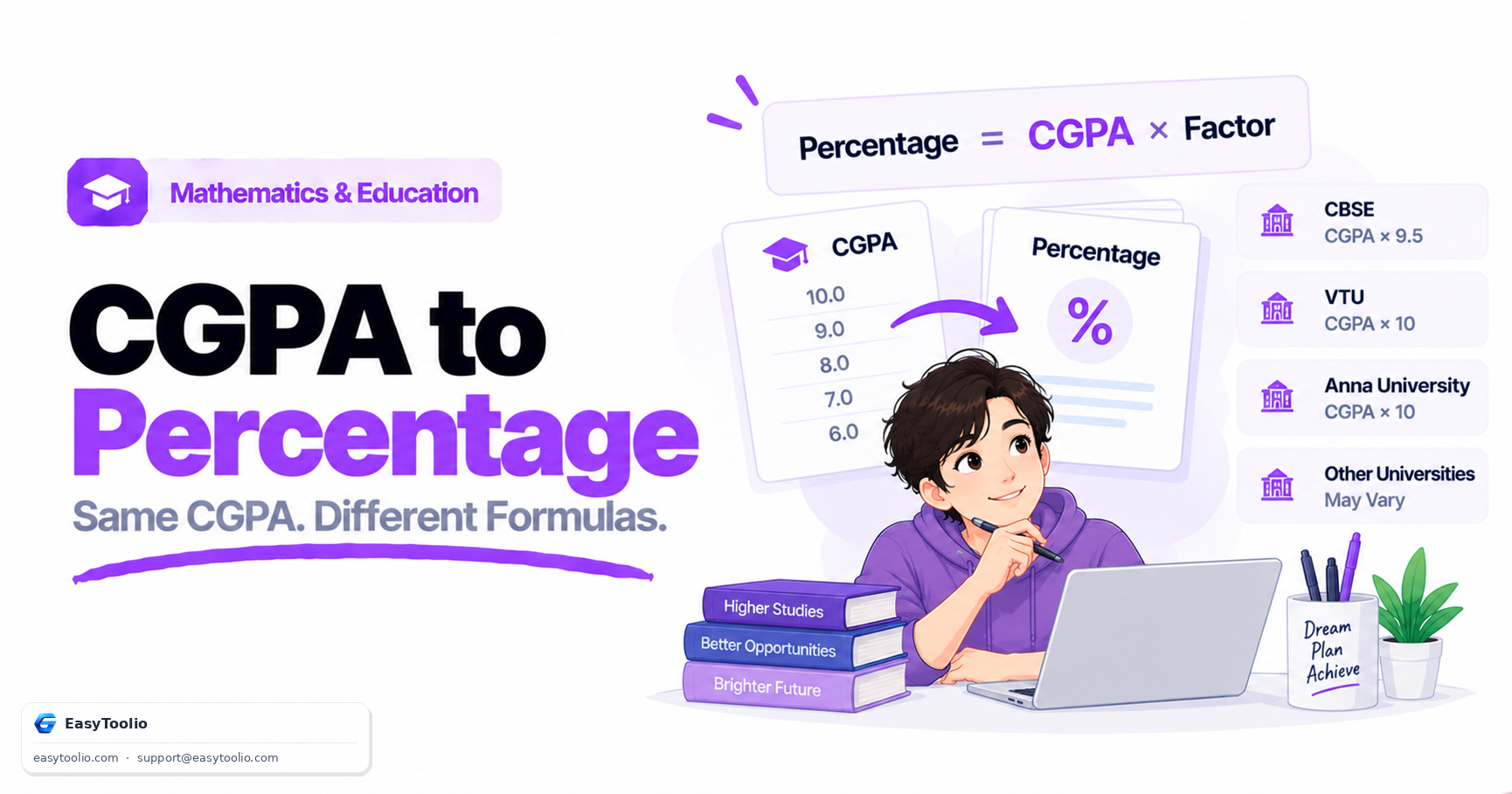
Example: A student with a CGPA of 8.6 (roughly 82% under a CGPA × 9.5-style formula) would typically be positioned in the 3.3–3.6 approximate US GPA band — comparable to a strong "B+ to A−" average student, though the exact figure an evaluator assigns can differ.
Why This Conversion Matters for Study-Abroad Applications
Most US and Canadian universities require either a self-reported GPA conversion or a formal evaluation from an agency like WES or ECE as part of the application. Getting this wrong in either direction is costly: understating your GPA can make you look like a weaker applicant than you are, while overstating it can create a mismatch when the university's own evaluator produces a lower number, potentially raising questions during verification.
Practical Tips for Presenting Indian Grades to US Institutions
- Always state your CGPA on its original 10-point scale first, then provide the approximate US GPA as a secondary reference — never present only a converted number without the original.
- Check which credential evaluation service your target university accepts (WES, ECE, or the university's own international office) before paying for an evaluation, since not all universities accept every agency.
- Include your official percentage alongside CGPA if your marksheet reports both, since some evaluators weight the percentage figure more heavily than CGPA for older transcripts.
- Do not average multiple approximate conversions — pick the specific evaluator's methodology your target school requires and follow that one number, rather than blending several online rules of thumb.
Frequently Asked Questions
Q: Is there an official formula to convert Indian CGPA to US GPA? A: No single official formula exists — agencies like WES and ECE use their own approximate conversion tables, so the same CGPA can map to slightly different GPA figures depending on the evaluator.
Q: What is the difference between weighted and unweighted GPA? A: Unweighted GPA caps at 4.0 and treats all courses equally; weighted GPA adds extra points for AP, Honors, or IB courses, which is why some US students report GPAs above 4.0.
Q: Should I get my Indian CGPA formally evaluated before applying abroad? A: If your target university requires a credential evaluation (common for US institutions), yes — a formal WES or ECE evaluation carries more weight than a self-reported approximate conversion.