
Every semester, students get an SGPA. At the end of the course, they get a CGPA. The two numbers look similar and are calculated using the same underlying idea, but they measure completely different things — and mixing them up leads to real confusion about academic standing, scholarship eligibility, and job applications.
SGPA vs CGPA: The Core Difference
SGPA (Semester Grade Point Average) measures your performance in a single semester only — it resets and starts fresh every term.
CGPA (Cumulative Grade Point Average) measures your performance across all semesters completed so far — it is a running, weighted average that gets recalculated every time a new semester's results are added.
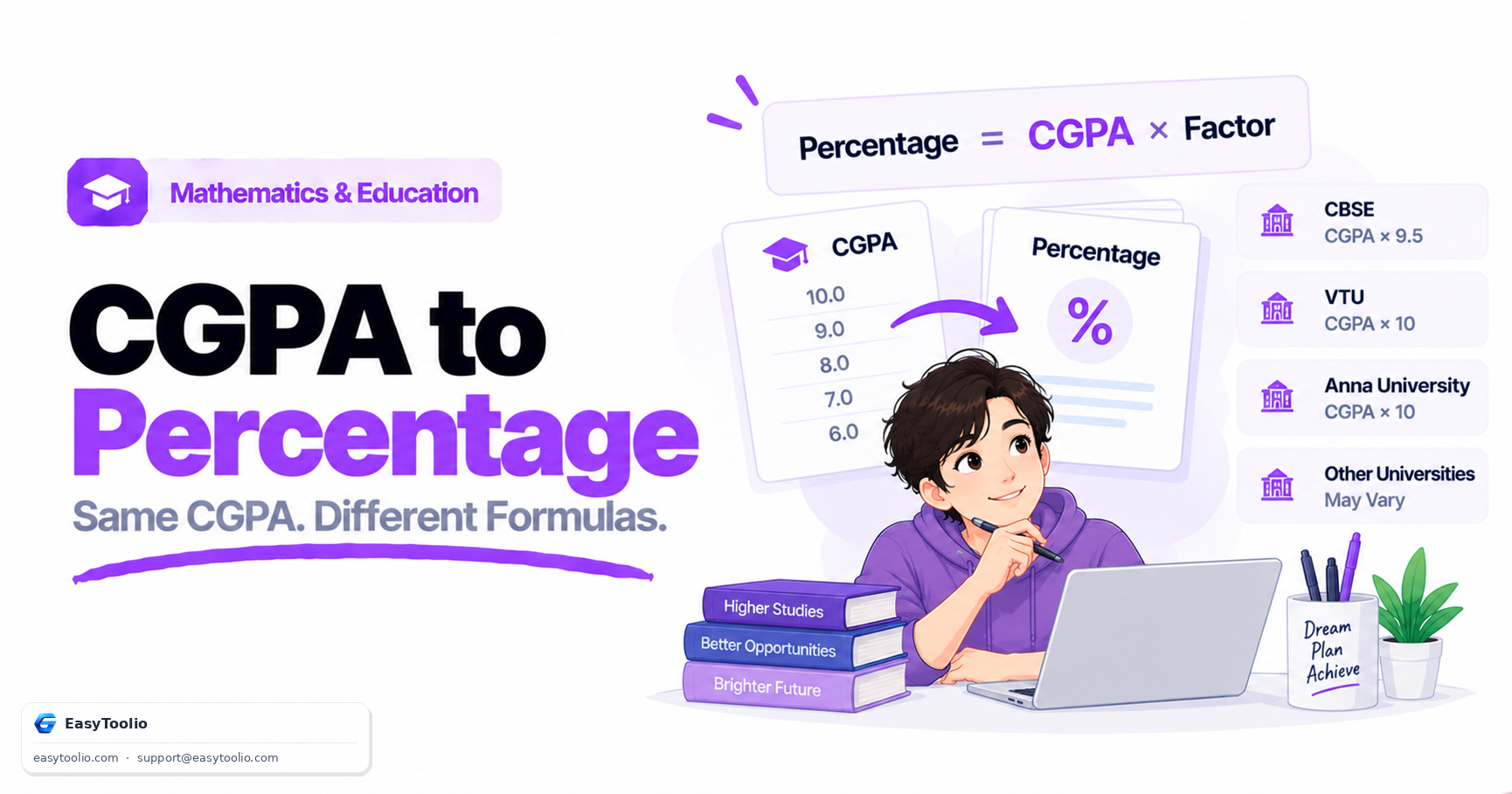
You can calculate your semester result with the SGPA Calculator and convert your overall CGPA to a percentage with the CGPA to Percentage Calculator.
The Exact Formula for Each
Both SGPA and CGPA use the same underlying credit-weighted formula — they just differ in scope.
SGPA formula (one semester):
SGPA = Σ (Credit of subject × Grade Point earned) ÷ Σ (Credits of subject)
CGPA formula (all completed semesters):
CGPA = Σ (Credit of subject × Grade Point earned, across ALL semesters) ÷ Σ (Credits of subject, across ALL semesters)
Critically, CGPA is not a simple average of your SGPAs — it is a credit-weighted average across every subject you have ever taken, which only equals a simple SGPA average if every semester carried the exact same total credits.
Worked Multi-Semester Example
Suppose a student has completed three semesters with the following results:
| Semester | Total Credits | SGPA | Grade Points Earned (Credits × SGPA) |
|---|---|---|---|
| Semester 1 | 20 | 8.0 | 160 |
| Semester 2 | 22 | 7.0 | 154 |
| Semester 3 | 24 | 9.0 | 216 |
CGPA after Semester 1: 160 ÷ 20 = 8.00
CGPA after Semester 2: (160 + 154) ÷ (20 + 22) = 314 ÷ 42 = 7.48
CGPA after Semester 3: (160 + 154 + 216) ÷ (20 + 22 + 24) = 530 ÷ 66 = 8.03
Notice that a simple average of the three SGPAs (8.0 + 7.0 + 9.0) ÷ 3 = 8.00 gives a different answer than the correctly credit-weighted CGPA of 8.03. The discrepancy arises because Semester 3 carried more credits (24) than Semester 1 (20), so its stronger 9.0 SGPA counts for more in the true CGPA.
Why One Bad Semester Hurts CGPA Less Than It Hurts That Semester's Own SGPA
If Semester 2's SGPA of 7.0 had instead been a poor 5.0, that semester's own SGPA would show the full drop — from a strong performer to a weak one, a 2-point fall reflected entirely in that term's record. But the CGPA impact is diluted, because Semester 2's 22 credits are only one part of the cumulative total. A single weak semester pulls the overall CGPA down by a fraction of what it does to that semester's SGPA, and later strong semesters (as in Semester 3 above) can pull the CGPA back up. This is exactly why one bad semester is rarely catastrophic for long-term academic standing — the cumulative nature of CGPA absorbs the shock.
Common Student Misconceptions
- "CGPA is just the average of all my SGPAs" — Only true if every semester has identical total credits. The moment credit loads differ (which is common, since elective loads, labs, and project credits vary by term), a simple average will not match the true CGPA.
- "A 9.0 SGPA this semester will bring my CGPA up by a full point" — In reality, since CGPA weights by cumulative credits from all semesters, a single strong semester has a diminishing effect on CGPA the more semesters you have already completed.
- "SGPA and CGPA use different scales" — They use the exact same 10-point grade point scale; the only difference is the scope of data (one semester vs cumulative).
Which Number Matters More — SGPA or CGPA?
Different situations look at different numbers, so it helps to know which one is actually being evaluated:
- Semester scholarships and merit lists are usually based on that term's SGPA, since they reward performance in the period just completed.
- Placements, higher-education applications, and final degree classification are almost always based on CGPA, since it reflects overall academic performance across the whole program rather than a single term.
- Backlog/supplementary exam eligibility is typically evaluated per semester using SGPA or individual subject grades, not the cumulative CGPA.
A student aiming for a competitive CGPA cutoff by graduation should track both: SGPA tells you how a specific semester went, while CGPA tells you whether your overall trajectory is on target for that cutoff.
Recovering CGPA After a Weak Semester
Because CGPA is a cumulative, credit-weighted figure, a low semester can be offset — though how much depends on how many credits remain. Using the earlier example, suppose after 3 semesters (66 total credits) at CGPA 8.03, the student wants to know how a strong Semester 4 (24 credits) affects things.
CGPA after Semester 4 with a 9.5 SGPA = (530 + 24 × 9.5) ÷ (66 + 24) = (530 + 228) ÷ 90 = 758 ÷ 90 = 8.42
That single strong semester lifted the CGPA from 8.03 to 8.42 — a meaningful jump, because the completed credit base (66) was still relatively small. The same 9.5 SGPA earned in, say, semester 7 of an 8-semester program would move the CGPA by much less, because it would only be one term added to a much larger cumulative credit base. This is the practical reason academic advisors often say "the early semesters matter most for your CGPA trajectory."
Frequently Asked Questions
Q: Can my CGPA be higher than every one of my individual SGPAs? A: No — CGPA is a credit-weighted average of your SGPAs, so it will always fall between your lowest and highest SGPA, never above the maximum.
Q: Does a low SGPA in one semester permanently damage my CGPA? A: It lowers the CGPA at that point, but since CGPA is cumulative and credit-weighted, subsequent strong semesters can recover much of that impact — the effect is diluted rather than permanent.
Q: Why is my calculated CGPA slightly different from a simple average of my SGPAs? A: Because CGPA is credit-weighted, not a plain average — if your semesters carried different total credits, a simple average of SGPAs will not match the correctly weighted CGPA.
Q: Do scholarships look at SGPA or CGPA? A: It depends on the scheme — many semester-based merit scholarships evaluate that term's SGPA, while overall or final-year scholarships and placement eligibility more commonly use cumulative CGPA. Check the specific scholarship or company's stated criteria rather than assuming.
Q: Why does a strong semester improve CGPA more early in a degree than later? A: CGPA is weighted by cumulative credits across all completed semesters. Early on, the total credit base is small, so one strong semester is a larger fraction of the total and moves CGPA more. Later, the same strong semester is diluted by a much larger existing credit base.