Notification
Go to Home All Tools Compare Glossary Blog Contact

Old vs New Tax Regime Comparison

Compare income tax outgo under Old Tax Regime (with 80C, HRA, 24b deductions) vs New Tax Regime (lower tax slabs). Find which regime saves you more tax.

Your Income Profile

Age Group

Age only affects Old Regime slabs. New Regime slabs are the same for everyone.

Are you a Salaried Employee? Applies Standard Deduction (₹75,000 New / ₹50,000 Old)
Min: ₹3L Max: ₹5Cr
Old Regime Deductions Only

Capped at ₹1.5 Lakh (PPF, ELSS, EPF, Life Insurance, etc.)

Capped at ₹1 Lakh (self/family/parents premium)

Capped at ₹2 Lakh (self-occupied property)

No cap applied here — enter your combined HRA exemption, 80TTA/80TTB, 80G, etc.

Old Tax Regime Deductions Allowed
₹0
Net Taxable Income: ₹0
Cess (4%): ₹0
New Tax Regime Default
₹0
Net Taxable Income: ₹0
Cess (4%): ₹0
Verdict

New Regime saves you ₹0

Based on your inputs, this regime results in a lower tax liability.

This is a simplified comparison for incomes up to ~₹50 Lakh. For very high incomes with surcharge, or a full deduction breakdown including HRA, use our detailed Income Tax Calculator.

Line-by-Line Tax Breakdown

Old Regime New Regime
Gross Annual Income
₹0 ₹0
Standard Deduction
-₹0 -₹0
Total Other Deductions
-₹0
Net Taxable Income
₹0 ₹0
Tax After Rebate/Relief
₹0 ₹0
Health & Education Cess (4%)
₹0 ₹0
Final Tax Payable
₹0 ₹0
Net Take-Home After Tax
₹0 ₹0
Final Tax Liability Comparison
Old Regime New Regime

Quick Comparison Cards

Old Tax Regime

Optional
  • Standard Deduction: ₹50,000
  • 87A Rebate Threshold: ₹5,00,000 Net Income
  • HRA / 80C / 80D / 24b: Allowed
  • Best For: High-deduction taxpayers

New Tax Regime

Default
  • Standard Deduction: ₹75,000
  • 87A Rebate Threshold: ₹12,00,000 Net Income
  • HRA / 80C / 80D / 24b: Not Allowed
  • Best For: Few or no deductions
Deduction-Rich, Higher Slabs

What is the Old Tax Regime?

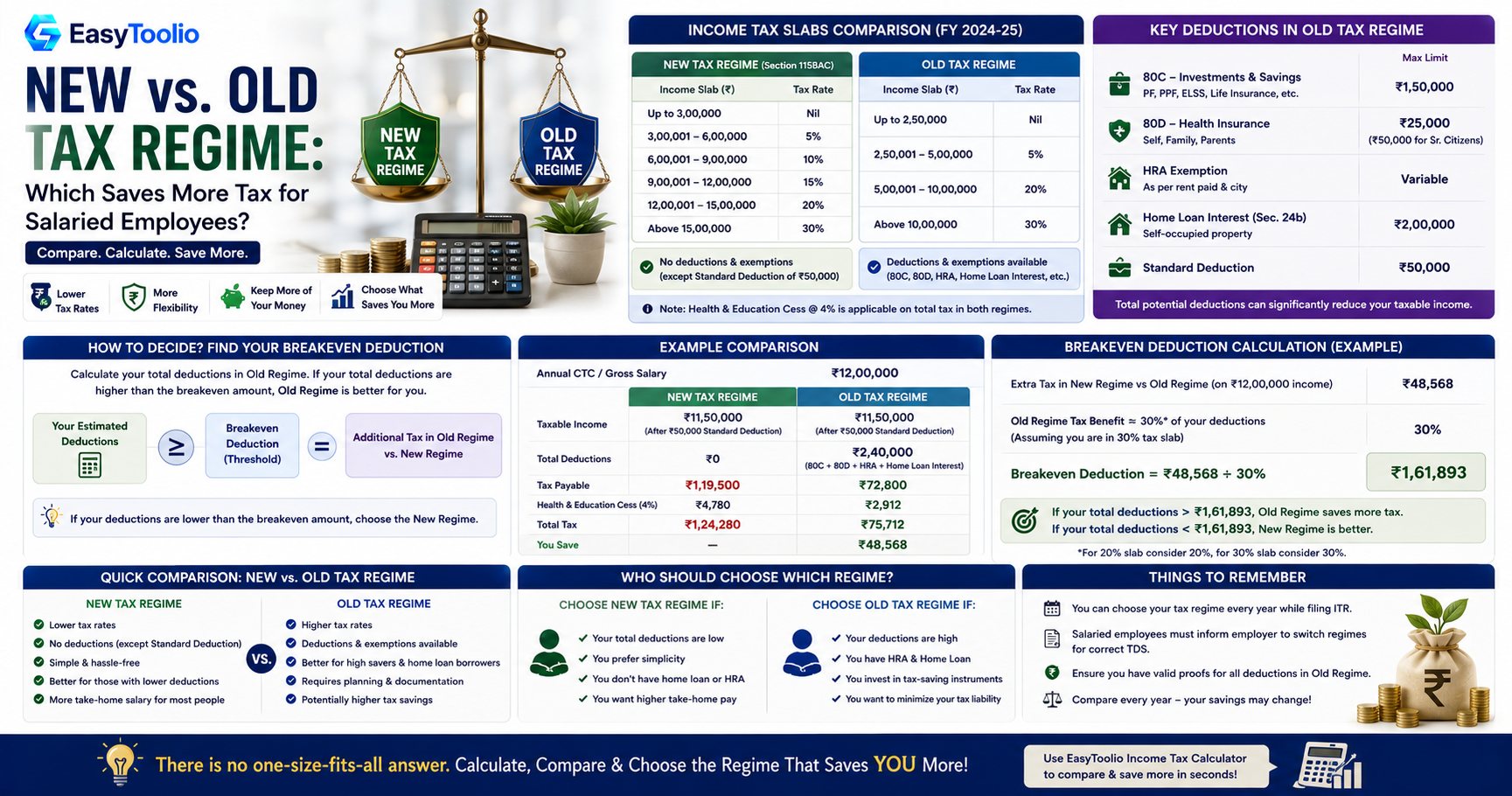
The Old Tax Regime is India's original income tax structure, retained as an optional choice alongside the New Regime. It uses wider tax slabs starting at a nil rate up to ₹2.5 Lakh (₹3 Lakh for senior citizens, ₹5 Lakh for super senior citizens), followed by 5%, 20%, and 30% bands.

Its main advantage is the wide range of deductions and exemptions it allows — Section 80C investments (up to ₹1.5 Lakh), Section 80D health insurance premiums, home loan interest under Section 24(b), House Rent Allowance (HRA) exemption, and more. Taxpayers with substantial eligible deductions often find the Old Regime works out cheaper despite its higher headline rates.

Simplified, Lower Slabs, Default

What is the New Tax Regime?

The New Tax Regime is the default regime for FY 2025-26 (AY 2026-27). It offers a nil rate up to ₹4 Lakh, then 5%, 10%, 15%, 20%, 25%, and 30% in ₹4 Lakh steps up to ₹24 Lakh and beyond — generally lower rates and wider bands than the Old Regime.

In exchange for the lower rates, it strips away most exemptions and deductions. It still allows the standard deduction for salaried employees (₹75,000) and the employer's NPS contribution under Section 80CCD(2), but not HRA, 80C, 80D, or home loan interest. A generous Section 87A rebate makes net taxable income up to ₹12 Lakh effectively tax-free, with marginal relief just above that threshold.

Feature Comparison

Feature / Rule Old Tax Regime New Tax Regime
Standard Deduction (Salaried) ₹50,000 ₹75,000
Section 87A Rebate Threshold Net income up to ₹5,00,000 Net income up to ₹12,00,000
Marginal Relief above Rebate Threshold Not available Available
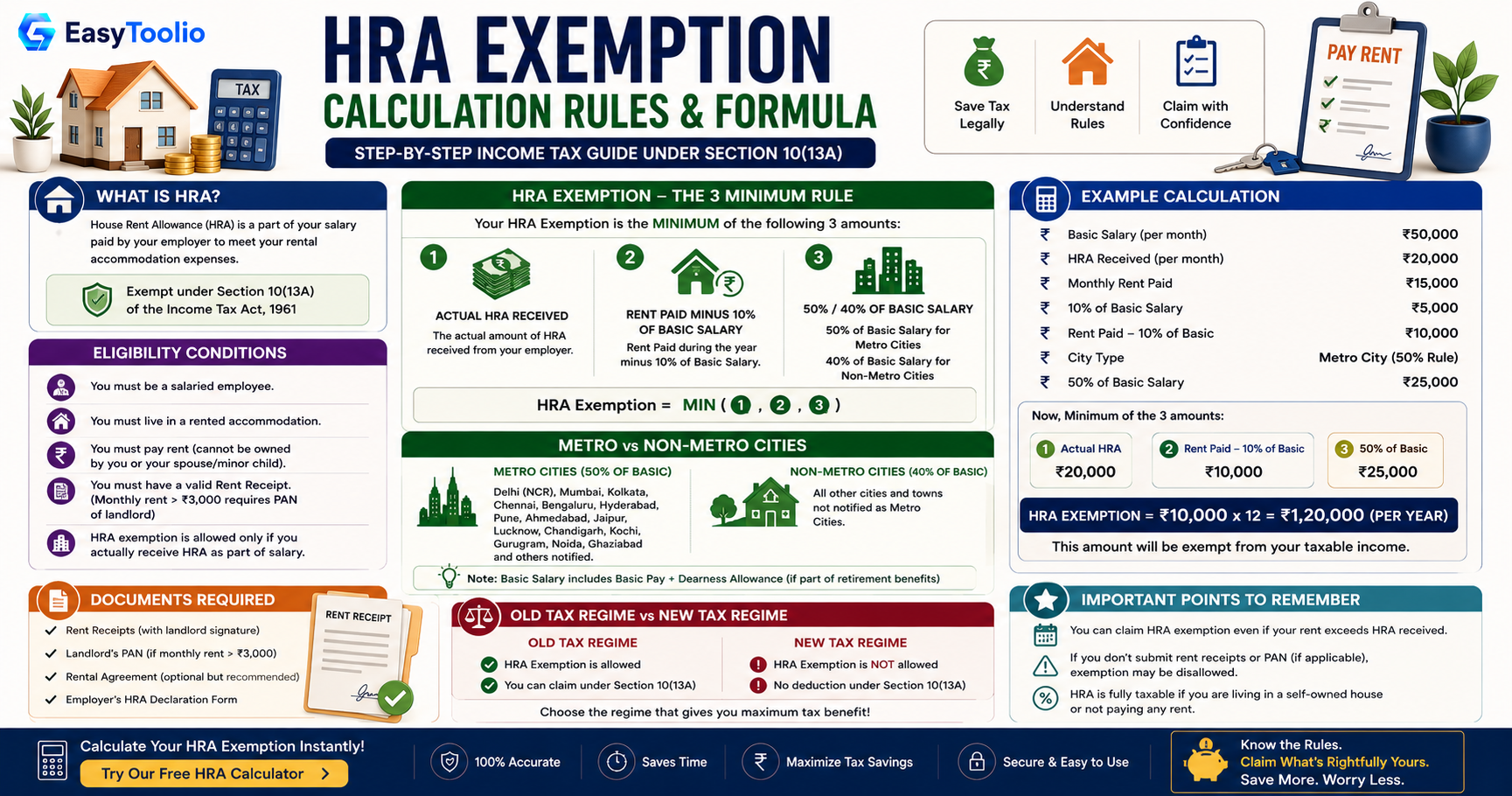
HRA Exemption Allowed Not allowed
Section 80C (up to ₹1.5L) Allowed Not allowed
Section 80D Health Insurance Allowed Not allowed
Home Loan Interest (Sec 24b) Allowed (self-occupied, up to ₹2L) Not allowed (self-occupied)
Employer NPS Contribution (80CCD(2)) Allowed Allowed
Compliance / Documentation Higher — must track and prove every deduction claimed Lower — no proofs needed for most taxpayers
Default Regime (if none chosen) Must be actively opted for Applied automatically
Slab Rates

Old Regime Slabs (Below 60 years)

Net Income Bracket Tax Rate
Up to ₹2,50,000Nil
₹2,50,001 – ₹5,00,0005%
₹5,00,001 – ₹10,00,00020%
Above ₹10,00,00030%

Senior citizens (60-80): Nil up to ₹3L. Super senior citizens (80+): Nil up to ₹5L. 5% and 20%/30% bands otherwise follow the same structure.

Slab Rates

New Regime Slabs (FY 2025-26)

Net Income Bracket Tax Rate
Up to ₹4,00,000Nil
₹4,00,001 – ₹8,00,0005%
₹8,00,001 – ₹12,00,00010%
₹12,00,001 – ₹16,00,00015%
₹16,00,001 – ₹20,00,00020%
₹20,00,001 – ₹24,00,00025%
Above ₹24,00,00030%

Same slabs apply to all age groups under the New Regime — age-based exemption only applies under the Old Regime.

Section 87A Rebate: ₹12 Lakh vs ₹5 Lakh Threshold

Both regimes offer a Section 87A rebate that can bring your tax bill to zero, but the thresholds are very different. Under the Old Regime, the rebate applies only when net taxable income is at or below ₹5,00,000 — cross that line by even ₹1, and you owe tax on the full slab-computed amount with no cushion. Under the New Regime, the threshold is much higher at ₹12,00,000, and it comes with marginal relief to smooth the transition just above that line.

Marginal relief works like this: if your net taxable income is, say, ₹12,05,000 (just ₹5,000 over the threshold), the ordinary slab calculation would produce a base tax of roughly ₹60,750 — an enormous jump for ₹5,000 of extra income. Marginal relief caps the tax so it never exceeds the amount of income over ₹12 Lakh, so the tax here is capped at ₹5,000 (plus 4% cess, ₹5,200 total) instead of the full ₹60,750 (plus cess). The Old Regime has no equivalent provision above its ₹5 Lakh threshold.

Which Deductions Survive Under the New Regime

The New Regime is built around fewer exemptions in exchange for lower rates, but it does not remove every benefit. Salaried employees still get the flat standard deduction (₹75,000), and an employer's contribution to your NPS account under Section 80CCD(2) remains deductible in both regimes — since it is treated as a business expense for the employer rather than a personal tax-saving deduction.

Most other common deductions and exemptions do not carry over: Section 80C investments (PPF, ELSS, life insurance, EPF, home loan principal), Section 80D health insurance premiums, HRA exemption, and home loan interest under Section 24(b) on a self-occupied property are all unavailable under the New Regime. This is why taxpayers who rely heavily on these deductions need to run the numbers before assuming the New Regime's lower rates automatically mean lower tax.

When the Old Regime Still Wins

The Old Regime tends to come out ahead once your total eligible deductions become large relative to your income. Common situations include: a substantial HRA claim from paying high rent in a metro city, significant home loan interest on a self-occupied property (up to the ₹2 Lakh cap under Section 24b), and maxed-out Section 80C (₹1.5 Lakh) plus Section 80D (up to ₹1 Lakh) investments and premiums.

When several of these apply simultaneously, total deductions can easily cross ₹4-5 Lakh a year, which is often enough to offset the New Regime's lower slab rates and higher rebate threshold. See the "Real-World Examples" section below for a worked calculation showing exactly this scenario.

Can You Switch Regimes Every Year?

Salaried individuals with no business or professional income generally have the flexibility to choose between the Old and New Regime each financial year when filing their return — you are not locked into whichever regime you picked previously, and can re-evaluate annually as your income, investments, HRA, or home loan situation changes.

Taxpayers with business or professional income face more restricted switching rules and should confirm the current provisions with a tax advisor or the Income Tax Department before assuming they can switch as freely as salaried taxpayers.

Old vs New Tax Regime: Which is Better?

There is no single answer — it depends entirely on how much you can legitimately claim in deductions relative to your income. Use the calculator above to check your own numbers.

When to Choose New Regime

  • You have little or no HRA claim, home loan, or 80C/80D investments.
  • Your net taxable income is at or below ₹12 Lakh, where the rebate zeroes out your tax entirely.
  • You want a simpler filing process without tracking receipts and proofs.
  • You are a freelancer or first jobber who hasn't built up deduction-eligible investments yet.
  • You prefer flexibility to invest savings however you choose, rather than being pushed into 80C instruments.

When to Choose Old Regime

  • You pay significant rent and can claim a large HRA exemption.
  • You have a home loan on a self-occupied property with substantial interest under Section 24(b).
  • You already max out Section 80C (₹1.5 Lakh) and Section 80D (health insurance) every year.
  • Your combined deductions comfortably exceed the extra ₹25,000 standard deduction gap of the New Regime.
  • You have other exemptions (80G donations, 80TTA/80TTB savings interest) that add up meaningfully.

Old Tax Regime: Pros & Cons

Pros
  • Wide range of deductions: 80C, 80D, HRA, 24(b), 80TTA/80TTB, and more.
  • Can significantly lower tax for high-deduction taxpayers.
  • Encourages disciplined long-term savings via 80C-eligible instruments.
Cons
  • Higher slab rates and a lower ₹5 Lakh rebate threshold.
  • No marginal relief just above the rebate threshold.
  • Requires paperwork, proofs, and active planning to benefit fully.
  • Must be actively opted for — not the default.

New Tax Regime: Pros & Cons

Pros
  • Lower slab rates across most income bands.
  • Higher ₹12 Lakh rebate threshold with marginal relief above it.
  • Simpler filing — no proofs needed for most taxpayers.
  • Applied automatically by default, so no action needed.
Cons
  • No HRA, 80C, 80D, or home loan interest deductions.
  • Can work out more expensive for taxpayers with large existing deduction claims.
  • Removes the tax-linked incentive to invest in 80C instruments.

Real-World Comparison Scenarios

Scenario 1: Salaried Employee Earning ₹12 Lakh with Standard Investments

Priya is a salaried employee earning a gross annual salary of ₹12,00,000. She invests ₹1,50,000 under Section 80C and pays ₹25,000 in health insurance premiums (Section 80D), with no home loan.
New Regime: ₹12,00,000 − ₹75,000 standard deduction = ₹11,25,000 net income. This is below the ₹12 Lakh rebate threshold, so the entire base tax is rebated under Section 87A. Final tax = ₹0.
Old Regime: ₹12,00,000 − ₹50,000 standard deduction − ₹1,50,000 (80C) − ₹25,000 (80D) = ₹9,75,000 net income. Tax works out to ₹12,500 (5% slab) + ₹95,000 (20% slab) = ₹1,07,500, plus 4% cess (₹4,300) = ₹1,11,800.
Result: Priya saves ₹1,11,800 by choosing the New Regime, purely because her net income falls under the ₹12 Lakh rebate threshold.

Scenario 2: High-Deduction Homeowner Earning ₹16 Lakh

Arjun earns a gross salary of ₹16,00,000. He pays rent and a home loan, claiming ₹1,50,000 (80C), ₹50,000 (80D), ₹2,00,000 home loan interest (Section 24b), and a further ₹3,00,000 in combined HRA exemption and other deductions.
New Regime: ₹16,00,000 − ₹75,000 standard deduction = ₹15,25,000 net income. Tax is ₹20,000 (5%) + ₹40,000 (10%) + ₹48,750 (15% on the remaining ₹3,25,000) = ₹1,08,750, plus 4% cess (₹4,350) = ₹1,13,100.
Old Regime: ₹16,00,000 − ₹50,000 standard deduction − ₹1,50,000 − ₹50,000 − ₹2,00,000 − ₹3,00,000 = ₹8,50,000 net income. Tax is ₹12,500 (5%) + ₹70,000 (20% on ₹3,50,000) = ₹82,500, plus 4% cess (₹3,300) = ₹85,800.
Result: Arjun saves ₹27,300 by choosing the Old Regime, because his large HRA, home loan interest, and maxed-out 80C/80D deductions outweigh the New Regime's lower slab rates.

Frequently Asked Questions

Common questions about choosing between the Old and New Income Tax Regime.

The Old Tax Regime has higher slab rates but allows numerous deductions and exemptions (like Section 80C, 80D, HRA, and home loan interest). The New Tax Regime has lower slab rates and a higher basic exemption, but removes most deductions in exchange for the simpler, lower rates.

The New Tax Regime is currently the default regime. If you do not explicitly opt for the Old Regime while filing your return (where eligible), your tax will be computed under the New Regime automatically.

Taxpayers with significant deductions — a large HRA claim, home loan interest under Section 24(b), substantial Section 80C investments (PPF, ELSS, life insurance), and health insurance premiums under 80D — often end up paying less tax under the Old Regime despite its higher slab rates.

Taxpayers with few or no deductions — for example, those without a home loan, minimal 80C investments, and no HRA claim — usually pay less tax under the New Regime because of its lower slab rates and higher rebate threshold, even without claiming any exemptions.

Salaried individuals without business income can choose between the Old and New Regime each financial year when filing their return. Those with business or professional income have more restricted switching rules, so it is worth checking current rules if that applies to you.

Under the New Regime, tax is effectively reduced to zero for net taxable income up to ₹12,00,000, with marginal relief tapering the benefit just above that threshold. Under the Old Regime, the rebate only brings tax to zero for net taxable income up to ₹5,00,000, with no marginal relief above it.

The New Regime still allows a few benefits, including the standard deduction for salaried employees and employer contributions to NPS under Section 80CCD(2), but it excludes most other common deductions like Section 80C, 80D, HRA exemption, and home loan interest under Section 24(b).

For salaried taxpayers, the standard deduction is a flat amount subtracted from gross salary before tax is calculated, and it differs between the two regimes — the New Regime's standard deduction is higher than the Old Regime's, which partly offsets the loss of other deductions.

What do you need to work out next?

Search 190+ free tools by name, or pick a category below. Every one runs instantly in your browser — no signup, nothing to install.

More Finance tools