All Tools Compare Glossary Formulas Blog Contact
Be the first to rate
Back to Glossary
Financial Term Dictionary

What is GST?

Published on July 05, 2026 • Last updated July 05, 2026

Formula Included

Definition

Goods and Services Tax (GST) is a comprehensive indirect tax levied on the supply of goods and services.

Detailed Explanation

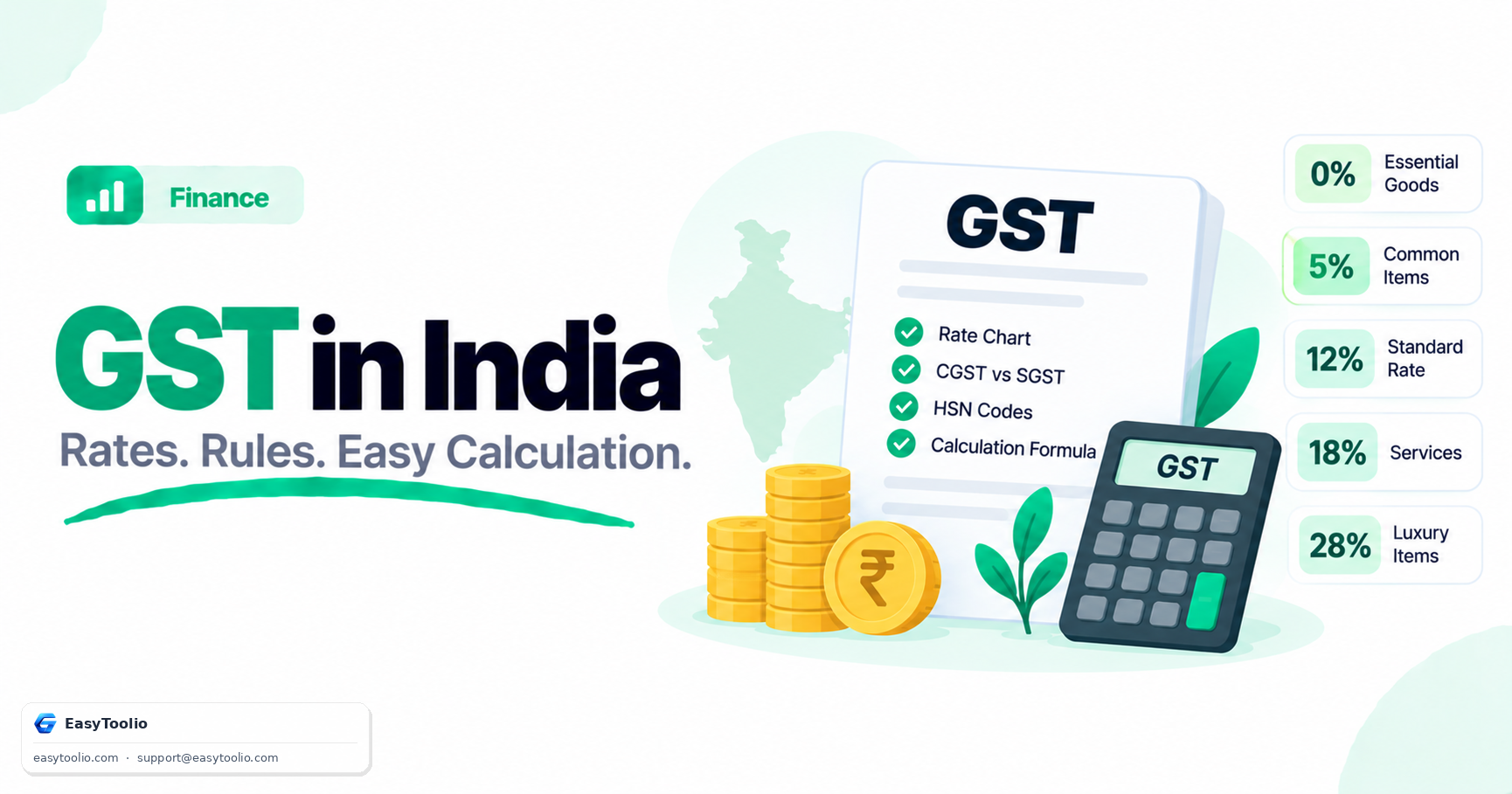
GST is a single, destination-based tax that replaced multiple indirect taxes such as excise duty, VAT, octroi, and service tax. By taxable event on value addition at each stage, it eliminates the cascading tax effect (tax-on-tax), simplifying compliance and making logistics smoother.

Mathematical Formula

To Add GST: $$GST\ Amount = Original\ Cost \times \frac{GST\%}{100}$$ $$Total\ Price = Original\ Cost + GST\ Amount$$ To Remove GST: $$Original\ Cost = Total\ Price \div \left(1 + \frac{GST\%}{100}\right)$$ $$GST\ Amount = Total\ Price - Original\ Cost$$

Calculation Examples

Adding 18% GST to a service worth $1,000: - Original Cost = $1,000 - GST Rate = 18% - GST Amount = $1,000 * 0.18 = $180 - Total price paid by customer = $1,180 Removing 18% GST from a retail price of $1,180: - Original Cost = $1,180 / 1.18 = $1,000 - GST Amount = $1,180 - $1,000 = $180

Frequently Asked Questions

CGST (Central GST) and SGST (State GST) are levied on intra-state transactions (within the same state) and split equally. IGST (Integrated GST) is levied on inter-state transactions and collected by the central government.

Input Tax Credit allows a business to reduce the GST paid on purchases from the GST liability it collects on sales, effectively taxing only the value added at that stage.

Businesses with aggregate turnover exceeding specified thresholds (e.g. ₹40 Lakhs for goods and ₹20 Lakhs for services in India) must register and file GST returns.

Free Forever • No Limits

Your everyday toolkit,
always within reach

Bookmark EasyToolio and access 125 tools whenever you need them. Calculate, decide, generate — all for free.

Try Decision Wheel