Notification
Go to Home All Tools Compare Glossary Blog Contact
Be the first to rate
Text Utilities

Word Counter

Count words, characters, sentences, paragraphs, reading time, speaking time, and keyword density instantly.

Load Sample:

SEO Content Optimization

Readability Level -

Provide text to check readability level.

Content Length Empty

Write or paste some text to begin SEO analysis.

Readability Score 0

Higher is easier to read.

Passive Voice 0

Heuristic warning count.

Long Sentences 0

Sentences over 25 words.

Content Optimization Suggestions
  • Provide content to receive suggestions.

Text Statistics

Word Count Results 0
Unique Words 0
Lexical Diversity 0%

Character Count

0
Without Spaces 0
Sentences 0
Paragraphs 0

Reading Time Calculator

0 sec

Speaking Time Calculator

0 sec
Avg. Word Length 0
Avg. Sentence 0
Most Used Word -
Longest Word -

Social Media Limits

Twitter/X Post 0 / 280
Instagram Caption 0 / 2200
LinkedIn Post 0 / 3000
Facebook Display 0 / 5000
YouTube Description 0 / 5000
SEO Meta Description 0 / 160

Keyword Density

Type some text to see keyword density
Practical Application

When to Use the Word Counter

Explore the most common real-world scenarios and use cases where this tool delivers maximum efficiency and precision.

SEO Content Optimization

Analyze word counts and keyword density to match search engine guidelines for blogs, reviews, and landing pages.

Social Media Planning

Track strict character constraints for Twitter/X posts, Instagram captions, or LinkedIn status updates.

Academic Writing Constraints

Validate length guidelines for essays, dissertations, research abstracts, and journal submissions.

Speech & Presentation Preparation

Estimate reading and speaking times to ensure scripts fit within designated event time limits.

Examples & Scenarios

  • Checking that an SEO blog post falls within the recommended 1,500 to 2,500 word limit.
  • Optimizing an Instagram caption to stay safely below the 2,200 character ceiling.
  • Calculating whether a public speech will take roughly 5 minutes at standard conversational speed.

Pro Tip

Use the Exclude Stopwords checkbox in the Keyword Density tool to ignore common filler words (like "the", "and", "is") and highlight your actual content themes.

Guide

How Word Count Works

Use this guide to understand word counting, readability, SEO content length, and platform character limits before publishing.

What is a Word Counter?

A word counter is a writing utility that measures words, characters, sentences, paragraphs, reading time, speaking time, and keyword density from pasted or typed text. It helps writers, students, editors, marketers, and SEO teams check content length before publishing.
How Word Count is Calculated

This tool counts text tokens made of letters or numbers while keeping common contractions and hyphenated words together. Punctuation does not count as a separate word, and empty spaces are ignored.

Characters With Spaces vs Without Spaces

Character count with spaces includes visible spacing between words. Character count without spaces removes all whitespace. Social platforms usually count spaces, while some forms and academic rules may ask for characters without spaces.

Reading and Speaking Time Formulas

Reading time is estimated at about 275 words per minute. Speaking time is estimated at about 150 words per minute. A 500-word text is roughly 2 minutes to read and 3 to 4 minutes to speak.

Keyword Density Analysis

Keyword density is calculated as keyword uses divided by total words, multiplied by 100. A natural SEO range is usually around 0.5% to 2%. Higher repetition can look forced, especially on short pages.

Academic Writing Word Count Standards

Short essays often range from 500 to 800 words, standard essays from 1000 to 1500 words, and research papers from 2500 words upward. Always follow your institution's assigned range first.

SEO Content Optimization

Content Type Recommended Length
Blog Post 1500-2500 words
Landing Page 500-1500 words
Product Page 300-800 words
Category Page 500-1200 words

Reading Time Examples

500words ≈ 2 minutes reading time
1500words ≈ 6 minutes reading time
3000words ≈ 12 minutes reading time

Social Media Character Limits

Character limits change by platform, but common planning targets include 280 characters for X posts, 2200 for Instagram captions, 3000 for LinkedIn posts, and about 150 to 160 characters for SEO meta descriptions.

FAQs

Frequently Asked Questions

A Word Counter scans the text you type or paste, detects word-like tokens, and calculates totals for words, characters, sentences, paragraphs, reading time, speaking time, and keyword density in your browser.

Words are counted as groups of letters or numbers. Common contractions and hyphenated terms are kept together, while standalone punctuation marks are not counted as words.

Reading time is calculated using an average reading speed of 275 words per minute (WPM) for adults. Total words are divided by 275 to estimate the time in minutes.

Speaking time is calculated using an average verbal speed of 150 words per minute (WPM), typical for professional presentations and speeches.

Keyword density is the percentage of times a word appears compared with the total word count. It is calculated as keyword uses divided by total words, multiplied by 100.

A natural keyword density is usually around 0.5% to 2%. There is no perfect number, but repeated keywords above 2.5% can start to look over-optimized in short content.

Many SEO blog posts perform well between 1500 and 2500 words when the topic needs depth. Short updates may be 600 to 1000 words, while pillar guides can be 3000 words or more.

Short essays are often 500 to 800 words, standard essays are often 1000 to 1500 words, and research papers can be 2500 words or more. Always follow the assigned word count first.

A standard X/Twitter post supports up to 280 characters for many accounts. Spaces, punctuation, emojis, and letters all count toward that limit.

Most speakers deliver about 130 to 160 words per minute. This tool uses 150 words per minute as a practical speaking-time estimate.

Punctuation usually does not count as a separate word. It can affect sentence count when punctuation marks such as periods, exclamation marks, and question marks indicate sentence endings.

Yes. Numbers are counted as words when they appear as standalone tokens, which matches many common writing and editing workflows.

Lexical diversity compares unique words with total words. A higher score means your text uses a wider vocabulary, while a lower score may indicate repetition.

Use shorter sentences, simple words, active voice, clear headings, bullet lists, and transitions. The readability and long-sentence warnings help identify areas to simplify.

It is accurate for standard web writing, essays, blog posts, and SEO drafts. Different platforms may use slightly different rules for hyphenated words, emojis, or special symbols.

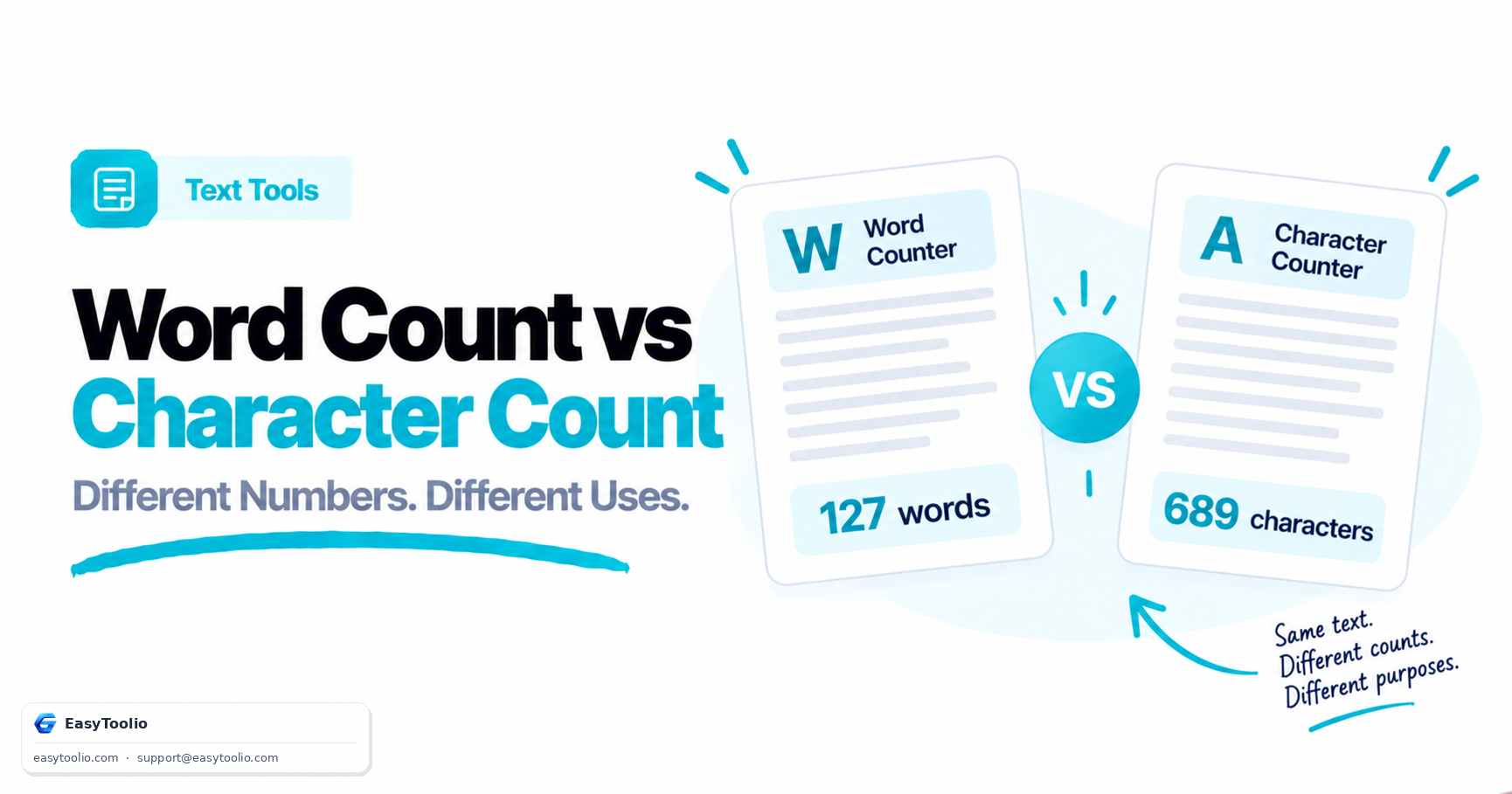
Word count measures how many words are in your text. Character count measures letters, numbers, punctuation, symbols, and usually spaces, depending on the selected metric.

Yes. You can copy the text, copy statistics, copy an SEO report, export TXT, create a DOCX-compatible file, or use the PDF print workflow.

No. Text analysis runs locally in your browser. Your pasted text and uploaded TXT files are not sent to the server for counting.

Platform Spotlight

Popular Tools on EasyToolio

Explore More Tools Like Word Counter

Loved the Word Counter? Explore our suite of related utilities to boost your productivity even further.