Whether you're reading a gym scale in kilograms but track your weight loss in pounds, or you're filling out a shipping form that suddenly wants a US-style weight, the kg-to-pounds conversion is one of the most frequently needed unit switches. The good news is the formula is fixed and simple once you know the exact factor.
The Exact Conversion Factor
The kilogram is the base SI unit of mass, while the pound is a unit used mainly in the United States and, informally, in the UK. The internationally agreed relationship is:
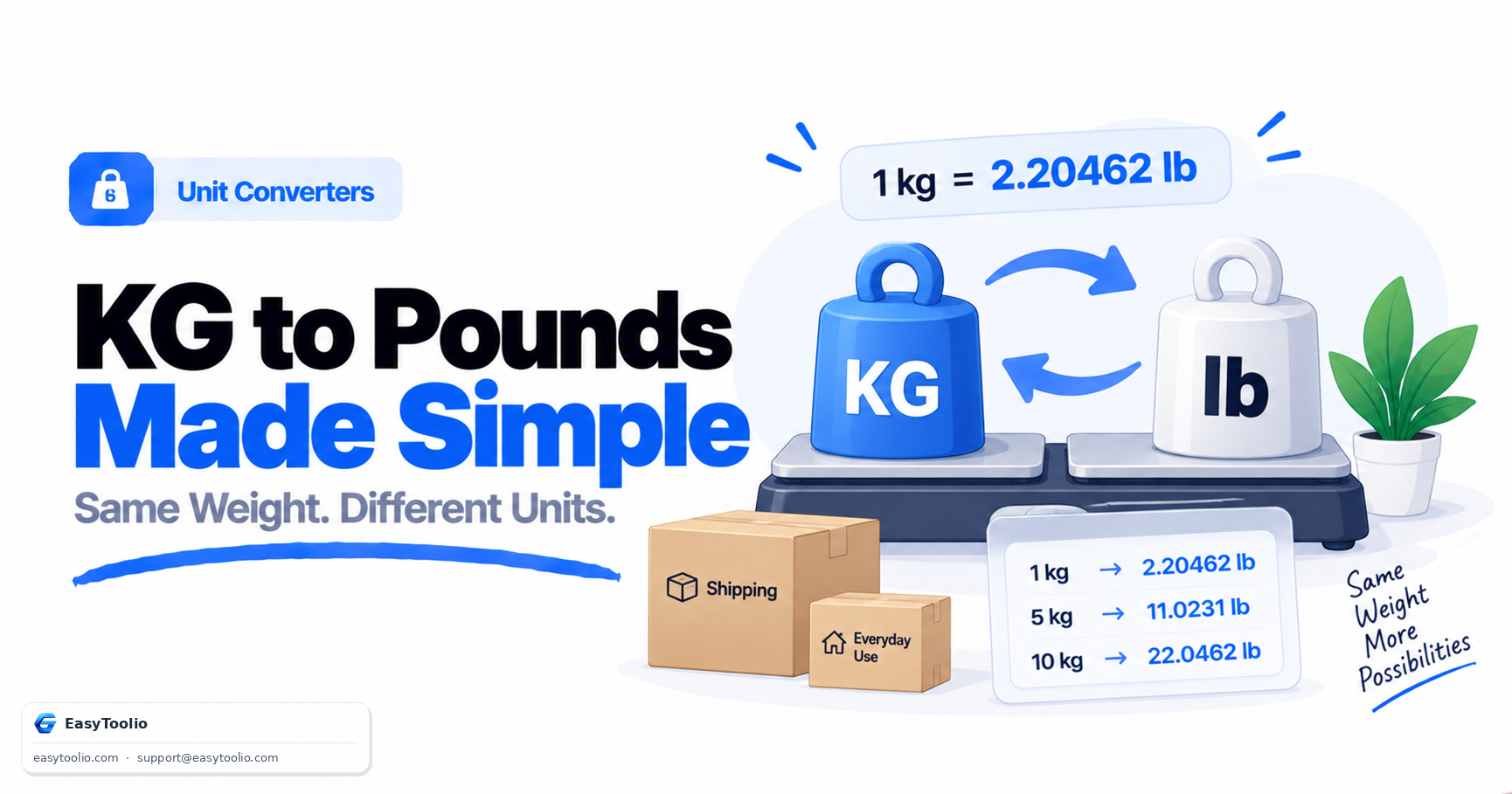
- 1 kilogram = 2.20462 pounds
- 1 pound = 0.453592 kilograms
These values are defined to high precision under the international pound agreement of 1959, so they are considered exact for all practical purposes (typically rounded to 5-6 decimal places).
How to Convert
To convert kilograms to pounds, multiply by 2.20462. To convert pounds to kilograms, multiply by 0.453592 (or divide by 2.20462).
kg → lb: pounds = kilograms × 2.20462 lb → kg: kilograms = pounds × 0.453592
Worked Example
Suppose your bathroom scale reads 72 kg and you want the figure in pounds:
72 × 2.20462 = 158.73 pounds
Now suppose a US shipping label lists a package weight of 50 lb and you need the kilogram value for an Indian courier form:
50 × 0.453592 = 22.68 kg
For quick, error-free results without manual multiplication, use the KG to Pound Converter or the Pound to KG Converter.
Body Weight Reference Chart
| Kilograms | Pounds |
|---|---|
| 50 | 110.23 |
| 60 | 132.28 |
| 70 | 154.32 |
| 80 | 176.37 |
| 90 | 198.42 |
| 100 | 220.46 |
Where This Conversion Comes Up Most
Fitness and health tracking is the biggest use case, since many international apps, protein supplement dosages, and gym equipment display weight in pounds while most of the world weighs itself in kilograms. Cooking is another common one — American recipes often list ingredient weights in pounds, while metric kitchens work in kilograms and grams. International shipping and cargo also rely on accurate weight conversion, since freight charges are often calculated per pound or per kilogram depending on the carrier's origin country, and even a small rounding error can shift a shipment into a higher pricing bracket.
Common Mistakes to Avoid
A frequent error is confusing pounds (lb) with the British "stone" unit, where 1 stone equals 14 pounds — these are not interchangeable. Another mistake is rounding the conversion factor too aggressively (using 2.2 instead of 2.20462), which is fine for a rough estimate but can introduce noticeable errors on heavier weights like cargo or livestock. Always use the full 2.20462 factor when the result needs to be precise, such as for medical dosing or customs declarations.
Frequently Asked Questions
Q: How many pounds is 1 kg exactly? A: 1 kilogram equals 2.20462 pounds.
Q: Is it accurate enough to just multiply by 2.2? A: For quick mental estimates, yes, but for precise figures like medical or shipping weights, use the full 2.20462 factor to avoid cumulative rounding errors.
Q: How do I convert my body weight from pounds to kg? A: Multiply the pound figure by 0.453592. For example, 150 lb × 0.453592 = 68.04 kg.