
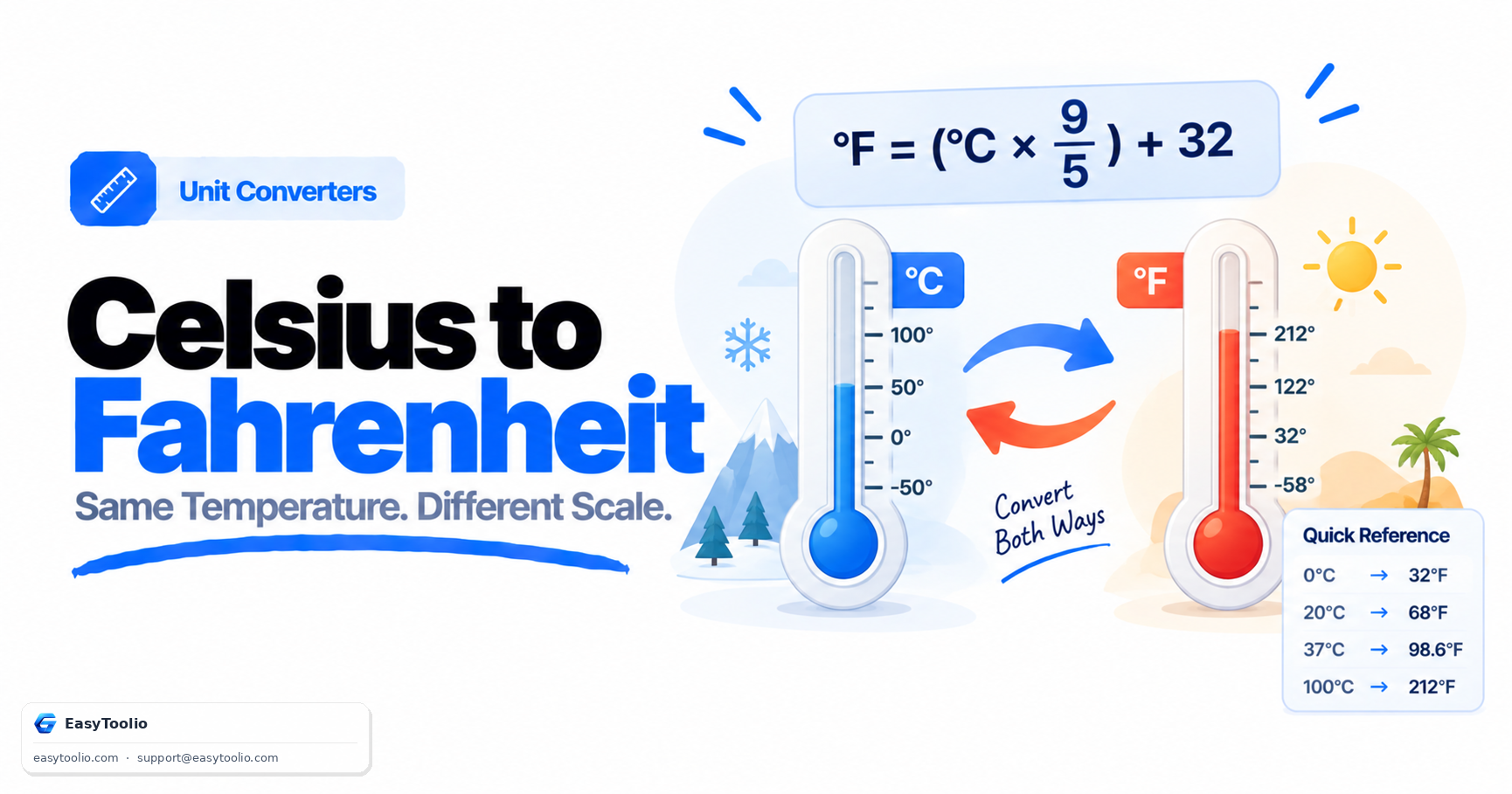
Whether you're checking a fever, following a recipe from a US cookbook, or just trying to understand what "95°F" feels like, converting between Celsius and Fahrenheit is one of the most common small calculations people run into. The formula is fixed and simple — the trick is remembering it correctly under pressure.
The Exact Formula
The official conversion between the two scales is:
°F = (°C × 9/5) + 32
And in reverse:
°C = (°F − 32) × 5/9
These formulas are exact, not approximations, because both scales are precisely defined relative to the same physical reference points (water's freezing and boiling points at standard atmospheric pressure). For instant, error-free results, use the Celsius to Fahrenheit Converter or the Fahrenheit to Celsius Converter rather than doing the arithmetic by hand.
A Quick Mental-Math Shortcut
For a fast, rough estimate without a calculator, double the Celsius value and add 30 (instead of the exact ×9/5 + 32):
Quick estimate: °F ≈ (°C × 2) + 30
For example, 20°C roughly converts to (20 × 2) + 30 = 70°F, which is very close to the exact value of 68°F. This shortcut is accurate enough for everyday judgment calls like deciding what to wear, but it drifts further from the true value at extreme temperatures, so use the exact formula (or the converter tool) whenever precision actually matters, like a medical reading.
Full Reference Table
| Celsius (°C) | Fahrenheit (°F) | Context |
|---|---|---|
| -40 | -40 | Point where both scales are equal |
| 0 | 32 | Water freezes |
| 10 | 50 | Cold winter day |
| 20 | 68 | Comfortable room temperature |
| 25 | 77 | Warm room temperature |
| 30 | 86 | Hot day |
| 37 | 98.6 | Normal human body temperature |
| 38 | 100.4 | Common fever threshold |
| 40 | 104 | High fever / hot summer day |
| 100 | 212 | Water boils |
| 180 | 356 | Common baking temperature |
| 220 | 428 | High-heat baking/roasting |
Why the US Still Uses Fahrenheit
The Fahrenheit scale was created in the early 18th century by physicist Daniel Gabriel Fahrenheit, who originally calibrated it using a mixture of ice, water, and salt (brine) as a stable low reference point, with the upper reference roughly aligned to human body temperature. The Celsius scale, developed later, took a simpler and more scientifically convenient approach by defining exactly 0°C as water's freezing point and 100°C as its boiling point at sea-level atmospheric pressure — a cleaner 100-degree span that made it easier to adopt internationally alongside the metric system. Most countries transitioned to Celsius as part of broader metrication efforts in the 20th century, but the United States (along with a small number of other countries) retained Fahrenheit for everyday and weather use, partly due to the cost and disruption of converting existing infrastructure, instruments, and public familiarity.
Everyday Situations Where This Conversion Matters
Travelers moving between the US and most of the rest of the world constantly need to translate weather forecasts — "75°F" means very little intuitively if you grew up thinking in Celsius, and vice versa. Cooking is another frequent case: many recipes and oven dials from American sources are listed in Fahrenheit, while ingredients and cookware elsewhere often assume Celsius settings, making an accurate conversion essential to avoid an undercooked or burnt dish. Checking a fever is a particularly high-stakes example, since a small conversion error (say, misreading 38°C as a safe temperature when it is actually a mild fever) can lead to the wrong health decision. Even everyday small talk about the weather benefits from a quick, reliable conversion when talking to someone using the other scale.
Worked Examples: Both Directions
Working through a few full examples end-to-end makes the formula easier to apply from memory.
Convert 25°C to Fahrenheit:
°F = (25 × 9/5) + 32 = (25 × 1.8) + 32 = 45 + 32 = 77°F
Convert 100°F to Celsius:
°C = (100 − 32) × 5/9 = 68 × 5/9 = 37.78 = ≈37.8°C
Convert -10°C to Fahrenheit (a cold-weather example):
°F = (-10 × 9/5) + 32 = -18 + 32 = 14°F
Notice that the ×9/5 step is identical to multiplying by 1.8 — both are mathematically the same operation, and either can be used depending on which is faster for you to compute mentally.
Why the Formula Uses 9/5 (or 1.8) and 32 Specifically
The two constants in the formula aren't arbitrary — they come directly from how the two scales were each anchored to water's freezing and boiling points:
- Celsius defines 0° as water's freezing point and 100° as its boiling point — a 100-degree span.
- Fahrenheit defines water's freezing point as 32° and its boiling point as 212° — a 180-degree span.
Because 180 ÷ 100 simplifies to 9/5 (or 1.8), that ratio scales a Celsius degree into the correct number of Fahrenheit degrees. The +32 is simply an offset correction, since the two scales don't share a common zero point — Fahrenheit's "zero" sits 32 degrees below where water freezes, while Celsius's zero sits exactly at the freezing point. Understanding this is what makes the formula easy to reconstruct from scratch if you ever forget it: figure out the 180/100 = 9/5 scaling ratio, then add the 32-degree offset to align the two zero points.
Common Conversion Mistakes to Avoid
- Adding 32 before multiplying by 9/5, instead of after. The order matters: °F = (°C × 9/5) + 32, not (°C + 32) × 9/5 — reversing the order produces a completely different, incorrect number.
- Using 5/9 when converting Celsius to Fahrenheit (or 9/5 when going the other way). The two directions use reciprocal fractions, and swapping them silently produces a wrong answer that can still look plausible at a glance.
- Relying on the "double and add 30" shortcut for anything precise, such as a body-temperature reading or a scientific measurement, where the small drift between the shortcut and the exact formula can matter.
- Rounding too early in a multi-step conversion. For calculations that chain several conversions together, round only the final displayed result, not intermediate values, to avoid compounding small errors.
Frequently Asked Questions
Q: What temperature is the same in both Celsius and Fahrenheit? A: -40 degrees. At exactly -40°C the value is also -40°F — this is the one point where the two scales intersect.
Q: Is normal body temperature 37°C or 98.6°F? A: Both — they represent the same temperature. 37°C converts exactly to 98.6°F using the standard formula (37 × 9/5) + 32.
Q: Is the "double and add 30" shortcut accurate enough to use regularly? A: It's a handy approximation for quick, casual estimates like weather or room temperature, but it becomes less accurate at extreme temperatures, so use the exact formula or a converter for anything precise, like a fever reading or a recipe.
Q: Why is the Celsius-to-Fahrenheit formula (°C × 9/5) + 32 and not something simpler? A: Because the two scales don't share the same zero point or the same size of one degree. The 9/5 factor scales the 100-degree Celsius span to Fahrenheit's 180-degree span between freezing and boiling, and the +32 offset aligns Fahrenheit's freezing point (32°F) with Celsius's (0°C).
Q: What's the fastest way to convert Fahrenheit to Celsius in my head? A: Subtract 32 first, then either divide by 1.8 or multiply by 5/9 — both give the exact result. For a rough mental estimate only, subtracting 32 and halving the result gets you in the right neighborhood, but like any shortcut it's an approximation rather than the exact formula, so it's best reserved for casual, non-critical estimates.