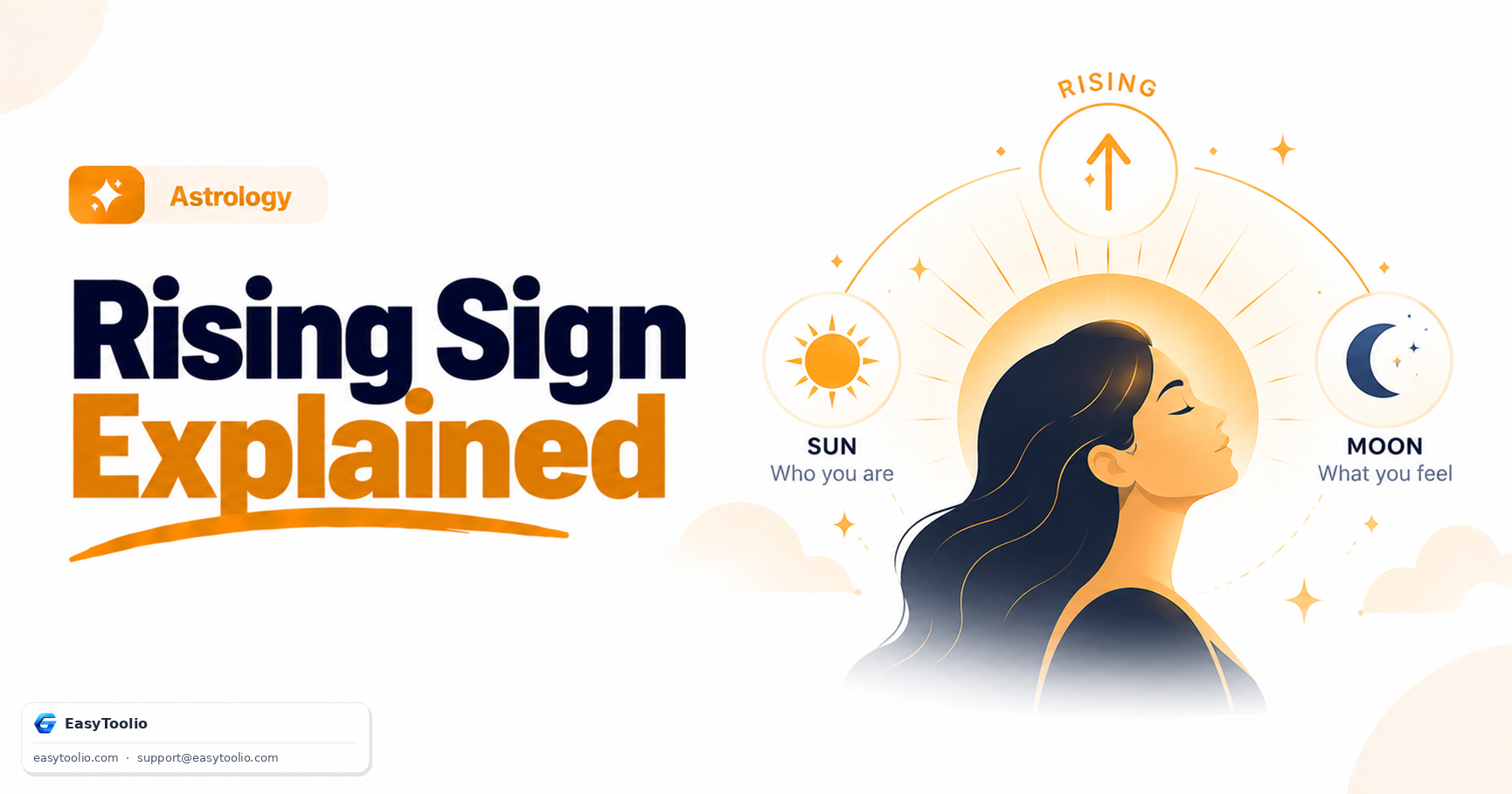
Most people can name their Sun sign without thinking. Many now know their Moon sign too, thanks to Vedic astrology's growing popularity online. But ask someone their Rising sign — also called the Ascendant or Lagna — and you'll often get a blank stare. That's a gap, because in both Western and Vedic astrology, the Ascendant is arguably the single most structurally important point in your entire birth chart.
What Is the Ascendant (Rising Sign)?
Your Ascendant is the zodiac sign that was rising on the eastern horizon at the exact moment and place of your birth. As the Earth rotates on its axis, a different zodiac sign appears to "rise" over the horizon roughly every two hours, cycling through all 12 signs over a full day.
You can find yours instantly with our Rising Sign Ascendant Calculator — you'll just need your accurate birth time and location.
Why the Ascendant Needs Exact Birth Time (Unlike Sun or Moon Sign)
Here's the critical distinction that trips most people up:
- Your Sun sign changes roughly once a month — it depends only on your birth date.
- Your Moon sign changes roughly every 2–3 days — it depends on your birth date and, near a transition day, your birth time.
- Your Ascendant changes roughly every 2 hours — it depends almost entirely on your exact birth time and location, far more sensitively than either of the other two.
This means two siblings born on the same day, even a few hours apart, will very likely have different Ascendants — while sharing the same Sun sign and possibly the same Moon sign. It also means that if you don't know your birth time precisely (many older birth certificates in India only record the date, or round the time to the nearest hour), your calculated Ascendant may be wrong, sometimes by a full sign.
Common mistake: People who don't know their exact birth time often assume their Sun sign is their "main" sign for chart purposes. In Vedic astrology specifically, the Ascendant — not the Sun sign — is what the entire chart structure is built around, so an unclear birth time undermines far more of the reading than most people realize.
If you genuinely don't know your birth time, the best options are: check the hospital birth record, ask family members who were present, or work with an astrologer who can "rectify" the chart using major life events as calibration points — a specialized and imperfect technique, but better than guessing.
Ascendant vs Moon Sign: Outward Self vs Inner Self
A simple way traditional astrology frames the difference:
| Represents | Changes | Best known for | |
|---|---|---|---|
| Sun sign | Core identity, ego | ~Monthly | Public persona, "which sign are you" |
| Moon sign (Rashi) | Emotional nature, instincts, inner reactions | Every 2–3 days | Vedic astrology's primary personality sign |
| Ascendant (Rising) | First impression, physical demeanor, how you approach the world | ~Every 2 hours | The starting point of the entire birth chart |
The Moon sign is often described as governing your inner emotional world — how you process feelings, react under stress, and what makes you feel secure. The Ascendant, by contrast, is described as shaping your outward presentation — physical bearing, mannerisms, and the immediate impression you make on people who don't know you well yet. Many astrology practitioners describe the Ascendant as the "mask" you wear when meeting the world, layered over the Moon's more private inner nature.
Why Vedic Astrology Builds the Whole Chart Around the Ascendant
In Vedic astrology (Jyotish), the birth chart (Kundli) is a 12-house wheel, and the Ascendant sign is placed in House 1 by definition — every other house is counted outward from there. This means your Ascendant doesn't just describe your outward personality; it determines which zodiac sign rules each of the 12 life areas (career, marriage, wealth, health, and so on) for you specifically.
For example, if your Ascendant is Leo, Leo becomes House 1, Virgo becomes House 2, Libra House 3, and so on around the wheel — an entirely different house arrangement than someone whose Ascendant is Scorpio. This is why two people can have identical Sun and Moon signs yet receive very different chart readings: their Ascendants set up a completely different house framework.
This is also why professional Vedic astrologers almost always ask for your birth time before doing a full reading — without it, they can determine your Rashi (Moon sign) but not your Ascendant, and therefore not the house placements that a complete chart analysis depends on.
What Determines Your Ascendant, Practically
Three inputs are required for an accurate Ascendant calculation:
- Exact birth time — to the minute, ideally
- Exact birth location — latitude and longitude (or city, which the calculator resolves)
- Birth date — to place the correct zodiacal degree on the eastern horizon at that specific moment and place
Because of how sensitive the Ascendant is to birth time, even manual chart calculation software requires all three fields precisely — there's no shortcut using birth date alone, unlike a Sun sign lookup.
Calculate Your Rising Sign
Our Rising Sign Ascendant Calculator takes your birth date, time, and place and returns your Ascendant sign along with a short description of its traditional significance. If you're also curious about your Moon sign, our Moon Sign Calculator uses the same birth details to compute your Rashi — giving you two of the "Big Three" placements from a single set of inputs.
Frequently Asked Questions
Q: Why does my Ascendant change so much more often than my Sun or Moon sign? A: The Ascendant is tied to the Earth's rotation on its axis, cycling through all 12 zodiac signs roughly every 24 hours — about one sign every 2 hours — whereas the Sun sign depends on the Earth's yearly orbit (changing monthly) and the Moon sign on the Moon's own faster orbit (changing every 2–3 days).
Q: What happens if I don't know my exact birth time? A: Your calculated Ascendant may be inaccurate, potentially off by an entire sign, since the Ascendant shifts roughly every two hours — check hospital records or ask family first, and if truly unavailable, a specialized astrologer can attempt "chart rectification" using known life events, though this is an imperfect technique.
Q: Is the Ascendant more important than the Moon sign in Vedic astrology? A: They serve different purposes — the Moon sign (Rashi) is traditionally read as your inner emotional nature, while the Ascendant sets House 1 of your entire 12-house birth chart, determining the house placement of every other planet. Most Vedic astrologers consider both essential and read them together rather than ranking one above the other.