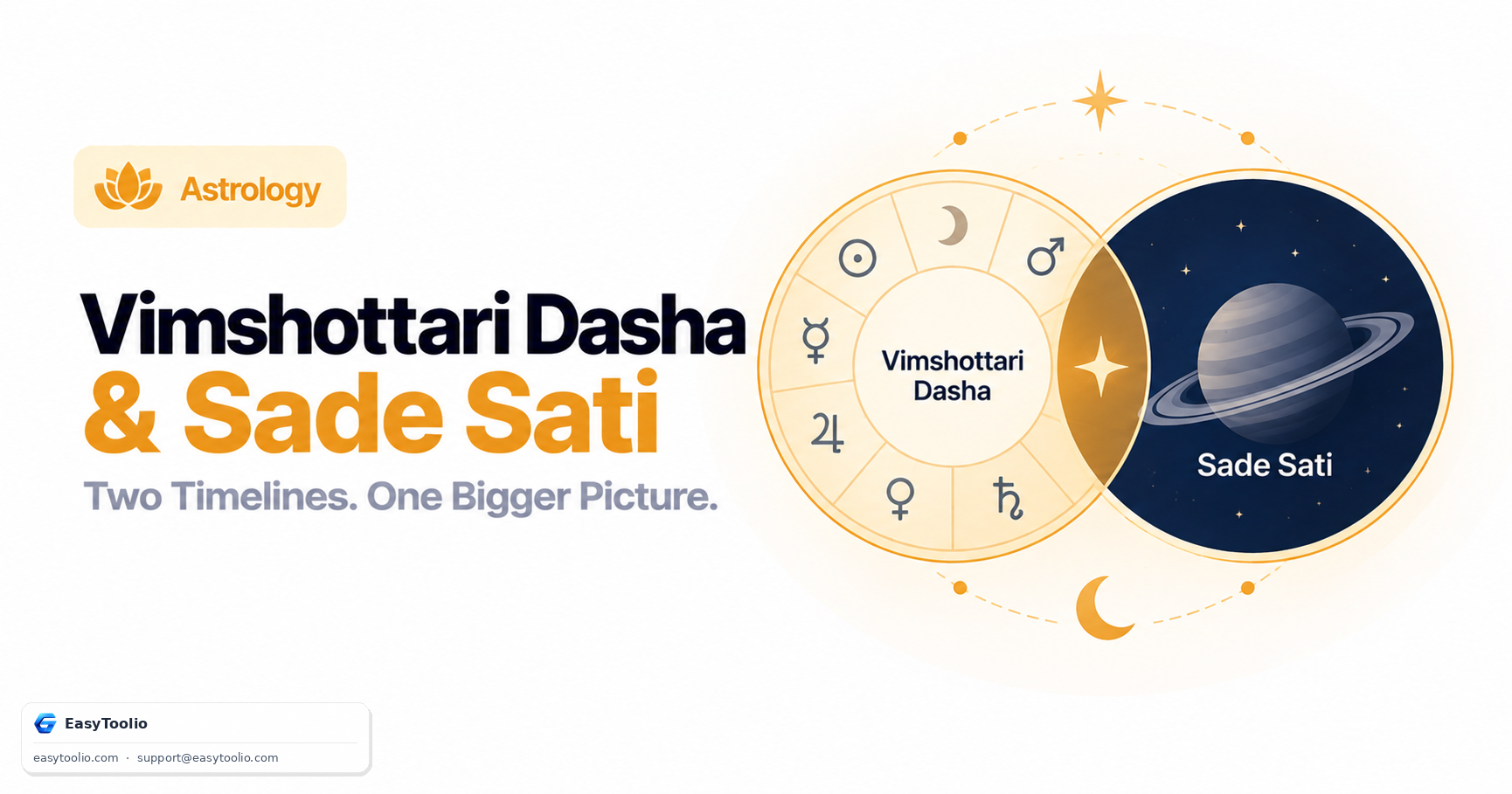
Ask a Vedic astrologer "when will I get married?" or "when will my career take off?" and the answer almost always traces back to one system: Vimshottari Dasha. It is the most widely used method in Vedic (Jyotish) astrology for timing life events, and it works on a surprisingly structured mathematical framework — a fixed 120-year cycle divided among nine planets.
What Is Vimshottari Dasha?
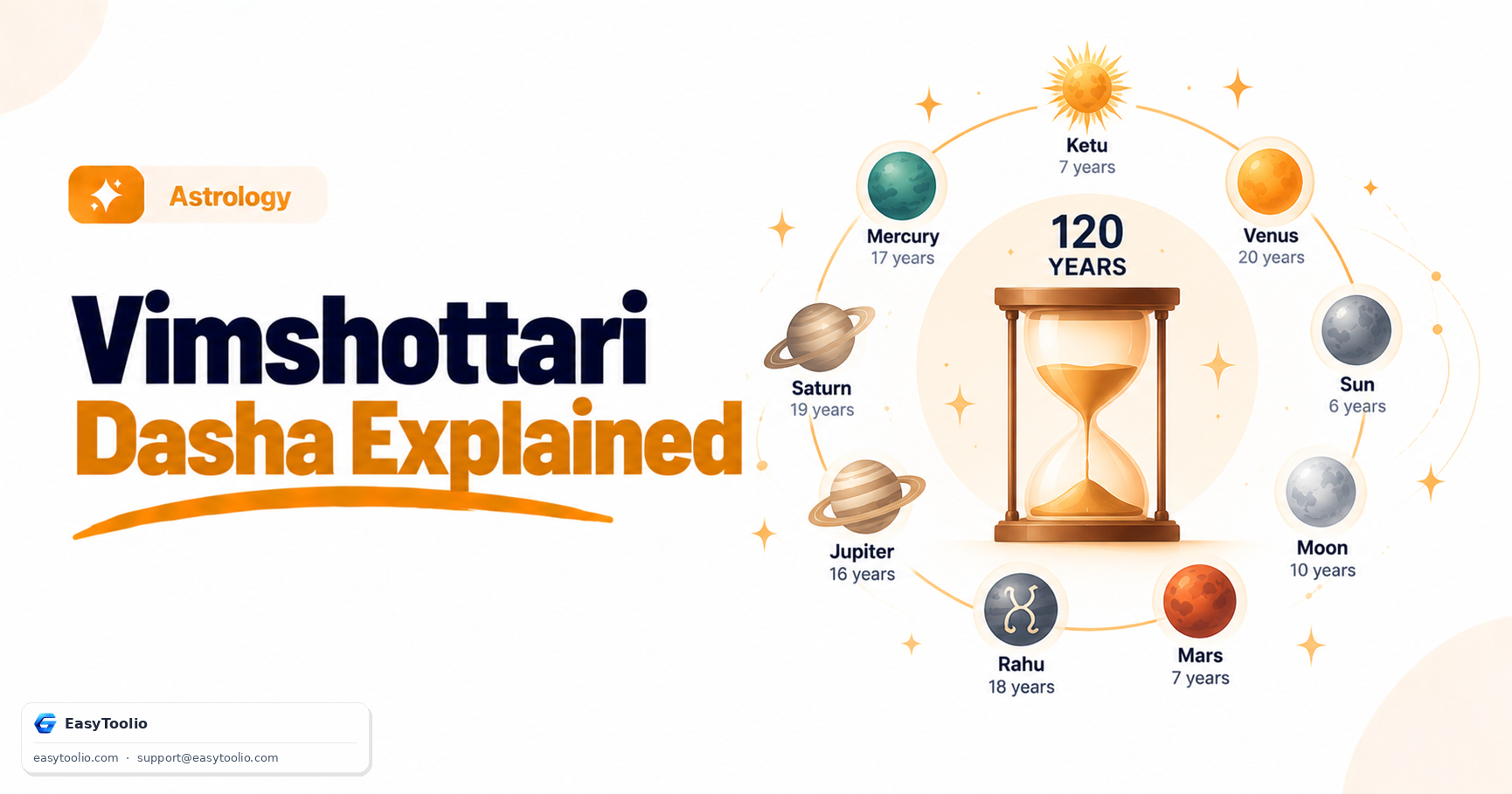
"Vimshottari" means 120 in Sanskrit (Vimshati = 20, Uttara = more, roughly "one hundred and twenty"), referring to the total length of the full planetary cycle: 120 years. This cycle is divided into nine unequal periods, one ruled by each of the nine Vedic planets (Navagraha) — the Sun, Moon, Mars, Mercury, Jupiter, Venus, Saturn, Rahu, and Ketu.
Each planet governs a Mahadasha (major period) of a fixed length that never changes, regardless of a person's chart:
| Planet | Mahadasha Length |
|---|---|
| Ketu | 7 years |
| Venus | 20 years |
| Sun | 6 years |
| Moon | 10 years |
| Mars | 7 years |
| Rahu | 18 years |
| Jupiter | 16 years |
| Saturn | 19 years |
| Mercury | 17 years |
| Total | 120 years |
These nine periods always occur in the same fixed sequence: Ketu → Venus → Sun → Moon → Mars → Rahu → Jupiter → Saturn → Mercury, and then the cycle repeats from Ketu again.
How Your Starting Dasha Is Determined
Here is the part that makes Vimshottari Dasha personal rather than a generic calendar: your first Mahadasha is determined by your birth Nakshatra, not your date of birth in isolation.
Each of the 27 Nakshatras is ruled by one of the nine planets (the same nine-planet sequence repeats three times across the 27 Nakshatras — see our Nakshatra guide for the full table). Whichever planet rules your birth Nakshatra becomes the ruling planet of your first Mahadasha.
But it's more precise than just "whichever planet rules your Nakshatra" — astrologers also calculate how far the Moon had already travelled through that Nakshatra at your birth. If you were born when the Moon was, say, 40% of the way through a Nakshatra, then 40% of that planet's Mahadasha length is considered "already elapsed" before birth, and your first Dasha period in life is the remaining 60% of that planet's years.
This is precisely why an accurate birth time matters so much — a Dasha calculation is only as accurate as the Moon's exact position at your birth moment.
Mahadasha vs Antardasha: The Two Layers
Vimshottari Dasha isn't just nine blocks of years — each Mahadasha is further subdivided into Antardashas (sub-periods), following the same nine-planet order and proportional to each planet's overall share of the 120-year cycle.
Example: Venus Mahadasha (20 years) broken into Antardashas
| Antardasha (within Venus Mahadasha) | Approx. Duration |
|---|---|
| Venus–Venus | 3 years 4 months |
| Venus–Sun | 1 year |
| Venus–Moon | 1 year 8 months |
| Venus–Mars | 1 year 2 months |
| Venus–Rahu | 3 years |
| Venus–Jupiter | 2 years 8 months |
| Venus–Saturn | 3 years 2 months |
| Venus–Mercury | 2 years 10 months |
| Venus–Ketu | 1 year 2 months |
Astrologers read these two layers together — the Mahadasha sets the broad theme of a life chapter (e.g., a Venus Mahadasha broadly relates to relationships, luxury, and creative pursuits), while the Antardasha refines when within that chapter specific events are more likely, based on the sub-period planet's own significations and its relationship to the Mahadasha lord.
Some astrologers go a level deeper still, into Pratyantardasha (sub-sub-periods), for very precise event timing — though Mahadasha and Antardasha are the two levels most commonly discussed.
Why Astrologers Use This System
Vimshottari Dasha is popular in Vedic astrology because it gives a structured timeline, not just a static personality reading. Traditional practice holds that a planet's Mahadasha "activates" the themes and house significations that planet governs in your individual birth chart. A well-placed Jupiter Mahadasha, for instance, is traditionally associated with growth, education, and good fortune, while a challenging Saturn Mahadasha is associated with discipline, delay, and hard-won achievement — the specific effects always depend on that planet's placement and strength in the individual's own chart, not a one-size-fits-all reading.
This is why Vimshottari Dasha is the go-to framework Vedic astrologers reach for when discussing the probable timing of:
- Career changes — new job, promotion, business launch
- Marriage and relationships — the traditional timing question asked most often
- Health cycles — periods considered more vulnerable or more robust
- Major relocations or life transitions
It's worth stressing that this is a traditional belief system, not a scientifically validated predictive method — treat Dasha timing as a lens for reflection alongside your own judgment and planning, not a guarantee.
Calculating Your Own Vimshottari Dasha Timeline
Working this out by hand requires knowing your exact birth Nakshatra, the precise degree the Moon had travelled within it, and then manually computing the proportional Mahadasha and Antardasha breakdown — tedious even for trained astrologers without software.
Our Vimshottari Dasha Calculator automates the entire process: enter your birth date, time, and place, and it instantly maps out your full 120-year Mahadasha sequence along with the Antardasha breakdown for your current period — showing you exactly which planetary period you are in right now and when it changes next.
Frequently Asked Questions
Q: How is my first Mahadasha decided? A: It's determined by the ruling planet of your birth Nakshatra, adjusted for exactly how far the Moon had already moved through that Nakshatra at your birth — the "elapsed" portion is subtracted from that planet's full Mahadasha length to set your first period's remaining duration.
Q: What is the difference between a Mahadasha and an Antardasha? A: A Mahadasha is a major planetary period (ranging from 6 to 20 years depending on the planet) that sets the broad theme of a life chapter, while an Antardasha is a shorter sub-period within it, following the same nine-planet sequence, used to refine the timing of specific events within that chapter.
Q: Do all nine planets get equal time in the 120-year cycle? A: No — the lengths are fixed and unequal: Ketu and Mars get 7 years each, the Sun gets only 6, while Venus gets 20 and Saturn gets 19. The full cycle across all nine planets always totals exactly 120 years, repeating from Ketu again once Mercury's period ends.