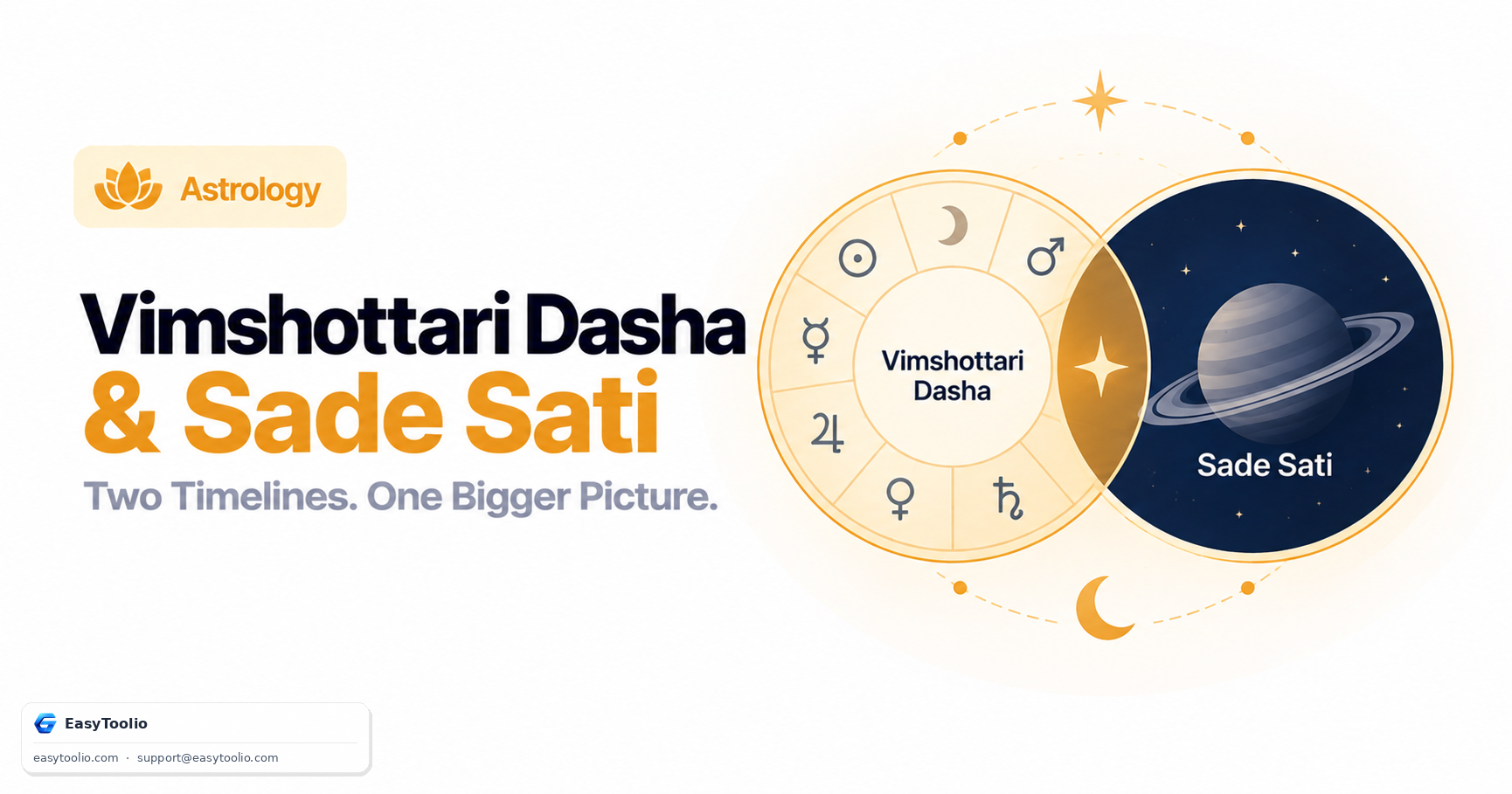
Someone checks two different astrology tools in the same week — one says they're in a Saturn Mahadasha, the other says they're in the middle of Sade Sati — and reasonably wonders whether these are two different names for the same thing, or two unrelated warnings stacking on top of each other. They're the second: related in theme (both track Saturn), but structurally distinct systems that happen to overlap sometimes.
Vedic astrology uses several independent timing frameworks to judge which period of a person's life is currently "active," and Vimshottari Dasha and Sade Sati are two of the most commonly checked. Understanding how they're calculated separately is the only way to understand why they sometimes align and sometimes don't.
Direct Answer: Vimshottari Dasha is a 120-year cyclical system that divides a person's life into sequential planetary periods (mahadashas), each ruled by one of the nine grahas for a fixed number of years (Saturn's mahadasha runs 19 years, for example), further subdivided into sub-periods (antardashas) — it's calculated from the Moon's Nakshatra position at birth and tracks which planet's general influence is "in charge" at any given time. Sade Sati is a specific, narrower transit condition: it refers to the roughly 7.5-year period when transiting Saturn moves through the 12th, 1st, and 2nd houses counted from a person's natal Moon sign — it happens roughly once every 30 years (matching Saturn's orbital period) regardless of anyone's Dasha sequence. Because the two systems are calculated independently — one from birth-time Nakshatra placement, the other from ongoing Saturn transit relative to natal Moon — a person can be in a Saturn-linked Dasha period and in Sade Sati at the same time, in one but not the other, or in neither.
1. Two Different Clocks, Both Involving Saturn
| Vimshottari Dasha | Sade Sati | |
|---|---|---|
| What it tracks | Sequential planetary "rulership" periods across a fixed 120-year cycle | Saturn's real-time transit relative to the natal Moon |
| Calculated from | Moon's Nakshatra at birth | Natal Moon sign + current Saturn transit position |
| Duration when Saturn is involved | 19-year Mahadasha, subdivided into shorter Antardashas | ~7.5 years total (roughly 2.5 years per house, across 3 houses) |
| Frequency in a lifetime | Saturn Mahadasha occurs once per 120-year cycle sequence | Recurs roughly every 30 years, tied to Saturn's orbital period |
| Independent of the other? | Yes — determined purely by birth Nakshatra sequencing | Yes — determined purely by current Saturn position vs. natal Moon |
The key structural point: Vimshottari Dasha is essentially a pre-set sequence calculated once from your birth Nakshatra and then read forward mechanically for your entire life, while Sade Sati is a recurring transit event that happens on Saturn's own real-time schedule, roughly every three decades, independent of whatever Dasha sequence you happen to be running through at that moment.
2. When the Two Overlap: The Compounding Scenario
Because both systems can independently point to Saturn at the same time, a person can find themselves in a Saturn Mahadasha or Antardasha from the Vimshottari sequence at the exact same calendar years as their Sade Sati transit. Astrologers generally treat this overlap as a compounding condition — both the long-run Dasha "storyline" and the real-time transit "trigger" are emphasizing Saturn's themes (discipline, restriction, delay, but also long-term structural reward) simultaneously, which is traditionally read as intensifying whatever Saturn-related lessons or challenges the chart is already indicating.
You can check where you currently stand in the 120-year sequence using our Vimshottari Dasha calculator, and check separately whether current transiting Saturn has entered your Sade Sati window using our Sade Sati calculator — most consultations run both checks rather than relying on either alone.
3. When They Don't Overlap: The Softening Scenario
The reverse combination is just as commonly discussed: a person going through Sade Sati (Saturn transit) while running a favorable, unrelated Dasha period — say, a well-placed Jupiter or Venus Mahadasha. In this case, many astrologers read the Dasha as providing a cushioning or softening context, suggesting the general life period is still supportive even while the specific Sade Sati transit brings its own narrower pressures (often centered on discipline, responsibility, or a particular life area tied to which of the three houses Saturn is currently transiting).
This is a frequently cited reason experienced astrologers push back against treating Sade Sati in isolation as an automatically difficult period — the concurrent Dasha context is considered essential to judging how sharply its effects will actually be felt.
4. Why Astrologers Check Both Rather Than Either Alone
Because Vimshottari Dasha describes the broad multi-year "chapter" a person's life is in, and Sade Sati describes a specific real-time Saturn transit trigger layered on top of whatever chapter is running, a reading that only checks one is considered incomplete by most traditional standards. The Dasha gives the general theme and duration; the transit (Sade Sati or otherwise) gives the specific timing of when a particular pressure point is activated within that broader theme. Treating them as two inputs to the same overall assessment — rather than two competing predictions — is how the two systems are meant to be used together.
Frequently Asked Questions
Is Sade Sati just another name for Saturn's Mahadasha?
No — they're calculated completely differently. Sade Sati is Saturn's real-time transit relative to your natal Moon (recurring roughly every 30 years), while a Saturn Mahadasha is a fixed 19-year period within the Vimshottari sequence calculated from your birth Nakshatra. They can occur at the same time, or independently of each other.
How often does Sade Sati happen in a person's life?
Typically about 2–3 times over an average lifespan, since it recurs roughly every 30 years in step with Saturn's orbital period around the zodiac.
If I'm not in a Saturn Dasha, can I still experience Sade Sati?
Yes — Sade Sati depends only on transiting Saturn's position relative to your natal Moon, not on which Dasha period you're currently running, so it can occur during any Mahadasha.
Does having both a Saturn Dasha and Sade Sati at once always mean a hard period?
Astrologers generally treat the overlap as intensifying whatever Saturn-related themes the chart already carries rather than guaranteeing difficulty outright — the rest of the chart (planetary strength, aspects, other concurrent periods) still factors into the actual reading.
Which of the two systems is considered more important?
Neither is treated as more authoritative on its own — Vimshottari Dasha provides the broader multi-year context, while Sade Sati provides a specific transit-based trigger, and traditional practice reads them together rather than substituting one for the other.
Can I check both from the same birth details?
Yes — both systems are derived from your birth chart (specifically your Moon's Nakshatra for Dasha, and your Moon sign for Sade Sati), so the same accurate birth date, time, and place feed both calculations.
References: Traditional Vimshottari Dasha sequencing as documented in Jyotisha reference texts (Parashari system); Sade Sati as the transit of Saturn through the 12th, 1st, and 2nd houses from the natal Moon in Vedic astrological practice.