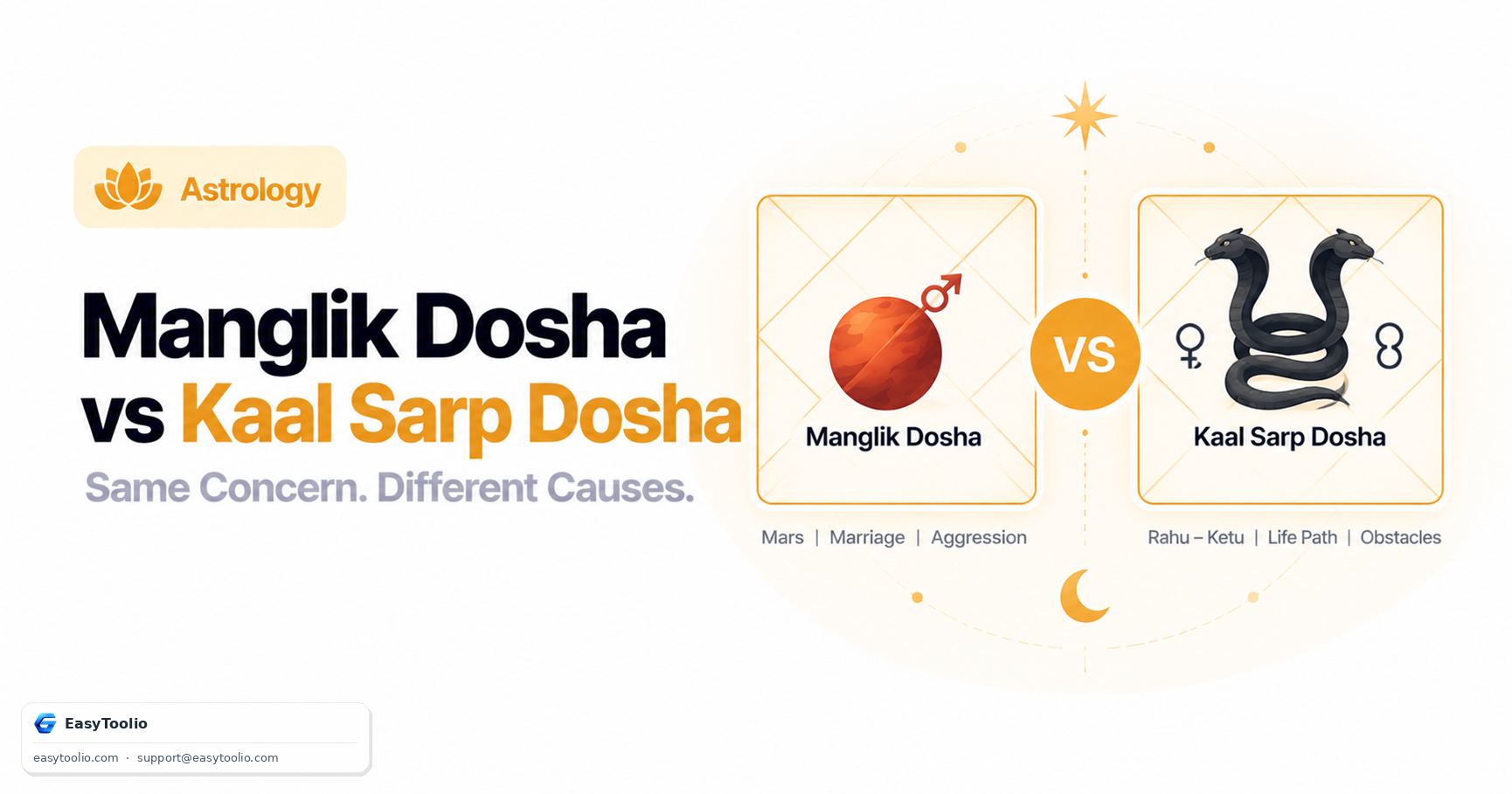
Two people compare notes after separate astrology consultations, both mention being told they have "a dosha," and both assume it's the same warning — until it turns out one was flagged for Manglik Dosha and the other for Kaal Sarp Dosha, two conditions that share almost nothing in common except the word "dosha" itself and a reputation for being taken seriously in marriage matching.
Both are considered significant afflictions in Vedic astrology, and both get raised in matchmaking and life-event consultations, but they are checked from entirely different chart mechanics and traditionally call for different remedies.
Direct Answer: Manglik Dosha (also called Kuja Dosha) is checked by looking at a single planet — Mars (Mangal) — and whether it occupies one of a specific set of houses (commonly the 1st, 2nd, 4th, 7th, 8th, or 12th, counted from either the Ascendant, the Moon, or Venus depending on the school) relative to the birth chart; it is specifically associated with marital harmony, temperament, and timing of marriage. Kaal Sarp Dosha is checked by looking at all seven classical planets together and whether every single one falls within one half of the chart, hemmed between the Rahu–Ketu axis; it is associated with broader, recurring life obstacles rather than marriage specifically, and its severity and theme depend on which house Rahu occupies. A chart can have Manglik Dosha, Kaal Sarp Dosha, both simultaneously, or neither — they are independent conditions checked by entirely separate criteria.
1. Side-by-Side: What Each Dosha Actually Checks
| Manglik Dosha (Kuja Dosha) | Kaal Sarp Dosha | |
|---|---|---|
| Planet(s) involved | Mars (Mangal) only | All seven classical planets, relative to Rahu-Ketu |
| Trigger condition | Mars placed in specific houses (commonly 1, 2, 4, 7, 8, 12) | All seven planets enclosed on one side of the Rahu-Ketu axis |
| Reference point | Counted from Ascendant, Moon, or Venus (school-dependent) | Counted from Rahu's house placement |
| Primary life area affected | Marriage, temperament, timing of union | General life obstacles; specific area depends on Rahu's house (12 named types) |
| Number of variations | Generally treated as present or absent, with degree of severity discussed | 12 distinct named types |
| Common context raised in | Marriage matching (kundli milan) specifically | Broader chart reading, career, health, and marriage consultations alike |
2. Manglik Dosha: A Single-Planet, Marriage-Focused Check
Manglik Dosha is checked almost exclusively in the context of marriage compatibility. Because Mars is associated with aggression, conflict, and impulsiveness in Vedic astrology, its placement in certain houses relative to the chart is traditionally read as a risk factor for friction, delay, or discord specifically within a marriage — hence why it's checked so heavily during kundli matching before a wedding is finalized. Our Manglik Dosha calculator evaluates Mars's house placement against the standard rule set to flag whether the condition is present, and to what degree, since some placements are considered a "partial" or weaker form of the dosha.
Critically, a chart can be Manglik without carrying any of the seven-planet Rahu-Ketu enclosure that defines Kaal Sarp Dosha — the two checks simply don't overlap in method.
3. Kaal Sarp Dosha: A Whole-Chart, Multi-Life-Area Check
Kaal Sarp Dosha, by contrast, is not about any single planet's house placement — it is a structural observation about the entire chart: do all seven classical planets sit within one 180-degree half relative to Rahu and Ketu, with none crossing to the other side? This is a much broader, whole-chart condition, and its named variation (there are 12, based on which house Rahu occupies) determines which specific life area — health, career, marriage, wealth, and so on — is most associated with the affliction. You can check a chart for this specific enclosure with our Kaal Sarp Dosha calculator.
Because Rahu and Ketu are involved rather than Mars, Kaal Sarp Dosha is conventionally discussed as a karmic, long-arc theme rather than a marriage-specific timing issue — closer in spirit to "recurring life obstacles" than to "friction within a specific relationship."
4. Can a Chart Have Both? Yes — and Astrologers Read Them as Compounding
Because the two conditions are checked independently, nothing prevents a chart from satisfying both criteria simultaneously: Mars sitting in a triggering house and all seven planets sitting enclosed between Rahu and Ketu. When a chart shows both, many practitioners read this as a compounding situation — the Manglik placement's marriage-specific friction sitting on top of the Kaal Sarp Dosha's broader life-obstacle theme — and remedies for both are typically recommended together rather than treating one as making the other redundant. Equally, a chart can have neither, or exactly one, since the two are structurally unrelated checks.
5. Remedies Differ Because the Underlying Planets Differ
Because Manglik Dosha centers on Mars while Kaal Sarp Dosha centers on the Rahu-Ketu axis, the traditionally prescribed remedies diverge accordingly:
| Dosha | Typical Remedial Focus |
|---|---|
| Manglik Dosha | Mangal Shanti puja, Kumbh Vivah (symbolic marriage ritual before the real one), fasting on Tuesdays, red coral gemstone (after consultation) |
| Kaal Sarp Dosha | Rahu-Ketu Shanti puja (notably at Trimbakeshwar), Maha Mrityunjaya or Rahu/Ketu mantra japa, Naga Panchami observance, Hessonite or Cat's Eye gemstones |
A remedy aimed at pacifying Mars does little for a Rahu-Ketu-based affliction and vice versa, which is exactly why an astrologer treats these as two separate diagnoses rather than interchangeable warnings, even though both get lumped together in casual conversation as "having a dosha."
Frequently Asked Questions
Can someone be both Manglik and have Kaal Sarp Dosha at the same time?
Yes — the two conditions are checked by entirely independent criteria (Mars's house placement versus all seven planets' position relative to Rahu-Ketu), so a chart can satisfy both, either, or neither.
Is Manglik Dosha only relevant for marriage?
It is almost exclusively discussed in the context of marriage compatibility and timing, since Mars's traditional association with conflict and impulsiveness is read as a specific risk factor within a marital relationship rather than a general life theme.
Does Kaal Sarp Dosha affect marriage too?
It can, depending on which of the 12 types is present — if Rahu falls in the 7th house specifically (Takshak Kaal Sarp), marriage and partnerships are the area traditionally cited, but the dosha's default association is broader life obstacles, not marriage specifically.
Which dosha is considered more serious?
Neither is universally ranked above the other — severity in both cases is traditionally judged by additional chart factors (planetary strength, aspects, house lordships), not by the dosha label alone, and many modern astrologers caution against overweighting either diagnosis in isolation.
Do both doshas require the same puja or remedy?
No — remedies are planet-specific. Manglik Dosha remedies center on pacifying Mars, while Kaal Sarp Dosha remedies center on pacifying Rahu and Ketu, so a single ritual does not typically address both.
Can a dosha be cancelled out by another chart factor?
Traditional Vedic astrology does recognize certain cancellation conditions (called "dosha bhanga") for some doshas including Manglik Dosha, where specific additional placements are said to neutralize or significantly weaken the affliction — this is why a full reading, not just the raw dosha flag, matters for interpretation.
References: Traditional Kuja Dosha (Manglik) house-placement rules as documented in Jyotisha reference texts; traditional Kaal Sarp Dosha classification by Rahu's house placement; Trimbakeshwar temple's Rahu-Ketu remedial puja tradition.