Notification
Go to Home All Tools Compare Glossary Blog Contact
Be the first to rate
Health & Wellness

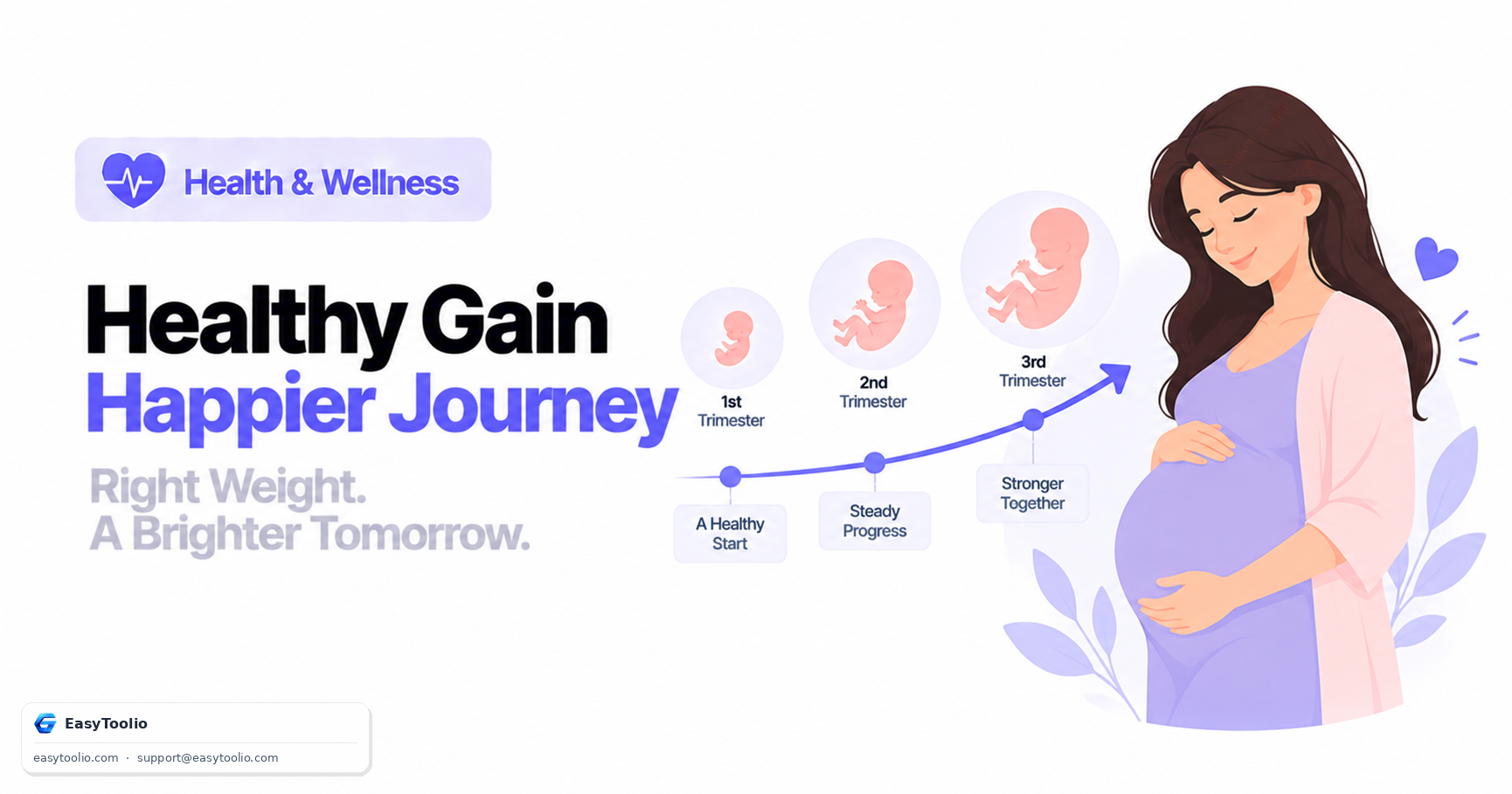
Pregnancy Weight Gain Calculator

Pregnancy Weight Gain Tracker & Calculator

Track healthy pregnancy weight gain based on your pre-pregnancy BMI, week, and single or twin status.

Important Clinical Notice & Disclaimer

Calculations run locally on your browser. No pregnancy details or weight data are stored or shared. Results are estimates based on standard IOM guidelines and do **not** constitute medical advice. Every pregnancy and body is unique; always consult your OB/GYN or midwife for personalized health assessments.

Pregnancy Profile

Pregnancy Type
weeks
Conception (Week 0) Full Term (Week 40)
cm
Min: 100 cm Max: 220 cm
kg
Min: 30 kg Max: 200 kg
kg
Min: 30 kg Max: 250 kg

Pregnancy Profiles Presets

Evaluate clinical progress profiles mapped to standard pre-pregnancy BMI classes:

Pregnancy Gain Report

Awaiting Pregnancy Profile Vitals

Enter pre-pregnancy weights, current status, and weeks gestation to calculate targeted weight gain progressions.

IOM Pregnancy Weight Gain Matrix

Official guidelines established by the Institute of Medicine (IOM) and National Research Council (2009).

Pre-Pregnancy BMI Class BMI Range Singleton Pregnancy Target Weekly Rate (2nd & 3rd Tri) Twin Pregnancy Target Twin Weekly Rate (2nd & 3rd Tri)
Underweight < 18.5 28 – 40 lbs (12.7 – 18.1 kg) 1.0 lb/week (0.45 kg/week) 50 – 62 lbs (22.7 – 28.1 kg)* 1.5 lbs/week (0.68 kg/week)
Normal Weight 18.5 – 24.9 25 – 35 lbs (11.3 – 15.9 kg) 1.0 lb/week (0.45 kg/week) 37 – 54 lbs (16.8 – 24.5 kg) 1.5 lbs/week (0.68 kg/week)
Overweight 25.0 – 29.9 15 – 25 lbs (6.8 – 11.3 kg) 0.6 lb/week (0.27 kg/week) 31 – 50 lbs (14.1 – 22.7 kg) 1.25 lbs/week (0.57 kg/week)
Obese (Class I, II, III) ≥ 30.0 11 – 20 lbs (5.0 – 9.1 kg) 0.5 lb/week (0.23 kg/week) 25 – 42 lbs (11.3 – 19.1 kg) 1.0 lb/week (0.45 kg/week)

*Note: Provisional target range often recommended by clinicians for underweight twin pregnancies.

Pregnancy Sizing & Nutrition Science

Where the weight gain goes, caloric adjustments, and healthy guidelines for a safe pregnancy.

Anatomy of Pregnancy Weight

Expecting mothers often ask where all the weight gain goes. A normal weight gain of 30 lbs is distributed as: baby (~7.5 lbs), placenta (~1.5 lbs), amniotic fluid (~2 lbs), uterine muscle growth (~2 lbs), maternal breast enlargement (~2 lbs), maternal blood volume expansion (~4 lbs), extracellular water weight (~4 lbs), and maternal fat/protein reserves (~7 lbs) which serve as vital energy reserves for postpartum recovery and breastfeeding.

Caloric Intake Guidelines

The old adage of "eating for two" is a clinical myth. In the first trimester, energy needs are unchanged; no extra calories are needed. In the second trimester, expecting mothers need approximately **340 extra kcal per day** (about a glass of milk and half a sandwich). In the third trimester, this increases to **450 extra kcal per day**. For twin pregnancies, an additional 300 kcal per baby (total ~600 extra kcal per day) is recommended starting in the second trimester.

Maternal Physical Activity

Maintaining physical activity supports healthy weight progression, decreases gestational diabetes risks, reduces backaches, and prepares the pelvic floor for delivery. The American College of Obstetricians and Gynecologists (ACOG) recommends at least **150 minutes of moderate activity** per week. Safe exercises include brisk walking, swimming, prenatal yoga, and stationary cycling. Avoid contact sports, activities with fall risks, or working out flat on your back after 20 weeks.

Wellness & Health Coach

AI Advisor Health Advisor

Get personalized advice on fitness routines, diet plans, and understanding your health metrics better.

Topics this feature will cover:

🥗 Diet & Nutrition 🏃 Fitness Routines 🩺 Understanding Metrics

Be first to access it when it launches.

We'll notify you the moment AI Advisor goes live. One email, no spam.

FAQs

Frequently Asked Questions

The amount of weight you should gain depends on your pre-pregnancy Body Mass Index (BMI). For singleton pregnancies, women with normal BMI (18.5-24.9) should gain 25 to 35 lbs, underweight women should gain 28 to 40 lbs, overweight women 15 to 25 lbs, and obese women 11 to 20 lbs.

During the first trimester (weeks 1 to 12), weight gain is minimal, usually between 1.1 and 4.4 lbs total. During the second and third trimesters, normal weight women are recommended to gain about 1.0 lb per week, overweight women 0.6 lb per week, and obese women 0.5 lb per week.

For twin pregnancies, the total weight gain recommendations are: 37 to 54 lbs for women with a normal pre-pregnancy BMI, 31 to 50 lbs for overweight women, and 25 to 42 lbs for obese women. Weekly rates in the 2nd and 3rd trimesters are higher, averaging 1.0 to 1.5 lbs per week.

Maternal weight gain is distributed across several areas: baby (7.5 lbs), placenta (1.5 lbs), amniotic fluid (2 lbs), uterine muscle expansion (2 lbs), maternal breast tissue (2 lbs), maternal blood volume (4 lbs), fluids in maternal tissue (4 lbs), and maternal fat/protein stores (7 lbs) for breastfeeding.

In general, weight loss diets are not recommended during pregnancy, even for women who are overweight or obese, as the developing baby needs constant nutrients. Focus on eating nutrient-rich foods and maintaining light physical activities. Always consult your healthcare provider before modifying your weight target.

Articles

Related Guides & Insights

Read our in-depth articles and guides related to this tool to help you make smarter decisions.

Workflow Suggestions

Recommended for Your Workflow

Category Showcase

More from Health & Wellness

Platform Spotlight

Popular Tools on EasyToolio

Explore More Tools Like Pregnancy Weight Gain Calculator

Loved the Pregnancy Weight Gain Calculator? Explore our suite of related utilities to boost your productivity even further.